
Exact-Change Wallet — Invention and Aftermath
We live in a world of invention — constant ingenuity — with almost no application or realization of those ideas
I have come up with dozens of inventions in my life. So did my grandfather. So did my uncle. I am sure that is ordinary — millions of people sketch solutions in margins, rebuild things in garages, and walk away convinced they saw it first. It was even more visible toward the end of the nineteenth century, when World’s Fair crowds watched average people demonstrate technologies they had built or uncovered. The fair was a catalog of human cleverness before the twentieth century turned cleverness into compliance departments.
None of my grandfather’s ideas would have survived the insurance and legal frameworks that came later. That may be part of why we see so few new inventions in a lifetime that still feels inventive: we live in a culture where ordinary people routinely imagine better tools — and better movie plots — than what industry ships, yet the path from sketch to shelf is owned by entities that treat surprise as liability.
Suppression is not only physical. It is mental. The system teaches you to feel silly for ever thinking you could change things like that — silly for wanting the spotlight — as if you were auditioning for the same third act as John McAfee (built the antivirus everyone still names, then tax fugitive years and death in a Spanish jail), Aaron Swartz (RSS, Reddit, open access — prosecuted until he took his own life at twenty-six), Gary Kildall (CP/M inventor, lost the IBM PC lane to Microsoft, dead on a bar-room floor), or Ian Murdock (Debian founder, dead at forty-two after a disputed encounter with police). Those are not random tragedies. They are templates the culture keeps on file so you will stay in the garage. After enough rounds of that, there does not seem to be any reason to be an inventor at all. The lift is massive: molds, certification, retail, counsel, cap tables, the quiet tax of being wrong in public. It sits far beyond what average people can fund without becoming someone else’s feature. How that containment works — prosecution, enclosure, headline discipline — is §I below.
That is the texture of a technologically suppressed world: not only the current state of technology is held back, but its history is flattened so you cannot see what was already done — and that erasure may cut deeper than the stall itself. There is not an invention you have heard of — or can even think of — that was not already invented and built somewhere, sometime; otherwise it would not be thinkable. That can sound arrogant until you notice how industry always promises that the best inventions are just around the corner — keep the subscription, wait one more quarter — while the digital stack we got instead was poured with backdoor access in the fundamental design.
Eventually the LED rectangles will give way to something more immersive — telepathic audiovisual experience, in the sense I argued in Quantum Leap (of faith): signal-bearing objects, resonance coupling, memory that was common before it was ridiculed. My claim extends to space travel as well: all of it has already been invented. We will not go much further than we already have. The rules of reality are set so that energy passes through the universe far more freely than matter through the density zones and energetic environments between here and there. In an afterlife you may travel anywhere; while you are alive, no spacecraft anyone will ever patent will take you much past a nearby solar system. Dubious reality, suppressed history, and platform money coalesce into a strong-armed resistance against individual ingenuity. The last couple centuries of “where is my flying car” are not mainly engineering failures. They are political failures dressed as progress reports.
I. Inventor containment — how the third act gets scripted
The prologue names inventors whose public endings trained me to fear the spotlight. This section is the mechanics — not proof of a single conspiracy, but the repeatable toolkit that turns a builder into a cautionary headline so the next person with a millimeter sketch keeps quiet.

John McAfee — namesake liability
John McAfee wrote the antivirus the world still says out loud, sold McAfee Associates in the 1990s, and walked away rich. Most people still think of him as a brand on the PC, not a body in a cell — the 2021 death in Spanish custody barely pierced mainstream memory next to the subscription pop-ups. The product became infrastructure; the man became embarrassing surplus. When he came back loud — libertarian politics, Belize exile, IRS and SEC pursuit, cryptocurrency carnival, jail in Spain pending U.S. extradition on tax charges — the story was never “inventor improves security.” It was eccentric millionaire self-destructs. He died in custody June 2021; Spanish authorities ruled suicide (BBC — McAfee death). His widow and others disputed that read. Either way the public lesson landed: the guy whose name is on your antivirus died in a cell. Do not be that guy.
Containment mode: sell early → become walking liability → legal maze → death in custody → moral for the garage inventor.
Aaron Swartz — prosecution as general deterrence
Aaron Swartz helped build RSS, co-founded Reddit, and campaigned for open access — the kind of person who should have been the hero of the digital stack. Instead the U.S. Attorney’s office charged him under the Computer Fraud and Abuse Act for bulk-downloading JSTOR articles at MIT — felony counts carrying decades of exposure. MIT and JSTOR stepped back from civil pursuit; the criminal case did not. Swartz died by suicide in January 2013, age 26 (NYT — Swartz death). Prosecutors called it justice; critics called it general deterrence against anyone who treats knowledge infrastructure as hackable.
Containment mode: build the commons → cross a platform line → felony exposure → isolated defendant → body as warning.
Gary Kildall — enclosure, then erasure
Gary Kildall wrote CP/M and built Digital Research — the operating system lane IBM should have taken for the PC. The folklore (partly disputed) is the missed meeting; the outcome is not: IBM shipped MS-DOS, Microsoft inherited the world, and Kildall’s lane was enclosed. He remained a pioneer on paper and a footnote in the winner’s history. In 1994 he was injured in a bar fight and died at 52; alcohol was widely reported in the coverage (NYT — Kildall obituary lane). The industry eulogy was polite. The economic lesson was brutal: invent the thing, lose the table, disappear from the story.
Containment mode: invent the category → incumbent rewrites history → personal decline → textbook credits the enclosure.
Ian Murdock — Debian, then the rooftop
Ian Murdock founded Debian Linux — a foundation stone of the server internet — later joined Sun and Docker. In November 2015, San Francisco police responded to a call about him trying to break into a home; a struggle followed; he was hospitalized; hours later he was found dead. The medical examiner ruled suicide; his family publicly questioned the account and cited an allegation of police abuse (SF Chronicle — Murdock death). Docker and the Linux world mourned a founder; the headline for outsiders was another tech figure gone wrong.
Containment mode: gift the commons → corporate integration → crisis encounter → disputed death → caution without investigation.
Hardware inventors — Tucker and DeLorean
The pattern is not only software. Preston Tucker built the Tucker 48 — rear-engine safety car, 1948 — and was indicted for fraud after Big Three suppliers and politicians strangled the company. He was acquitted, but the factory was already dead (Smithsonian — Tucker). John DeLorean built the gull-wing stainless car, then a 1982 FBI cocaine sting and bankruptcy; he too was acquitted of the drug charges, but the brand was a joke (BBC — DeLorean). Physical inventors learn the same lesson as Kildall: the court case and the headline are the product; acquittal is optional.
What the templates share
Stated as a checklist the garage inventor internalizes without anyone writing it down:
- Enclosure — sell, partner, or miss the meeting; the incumbent owns the shelf and the history book.
- Prosecution or regulatory siege — tax, CFAA, SEC, fraud indictments; a named founder faces higher visibility once targeted.
- Pathology branding — eccentric, difficult, addict, tax cheat; the person becomes the story, not the invention.
- Third-act moral — jail, rooftop, bar floor, cell death; the culture reads self-destruction, not containment.
That is why §V’s patent bar and partner NDAs land on top of something older: you can avoid counsel and still end up in a template you did not know you were auditioning for. The Exact-Change Wallet is small enough that none of those names “fits” — which is exactly why the mental suppression works. You think: I am not McAfee; I am not Swartz; therefore I am safe to want nothing. The safer move, in this climate, is to publish the sketch and not venture — which is how a ten-coin tray stays a file on a disk.
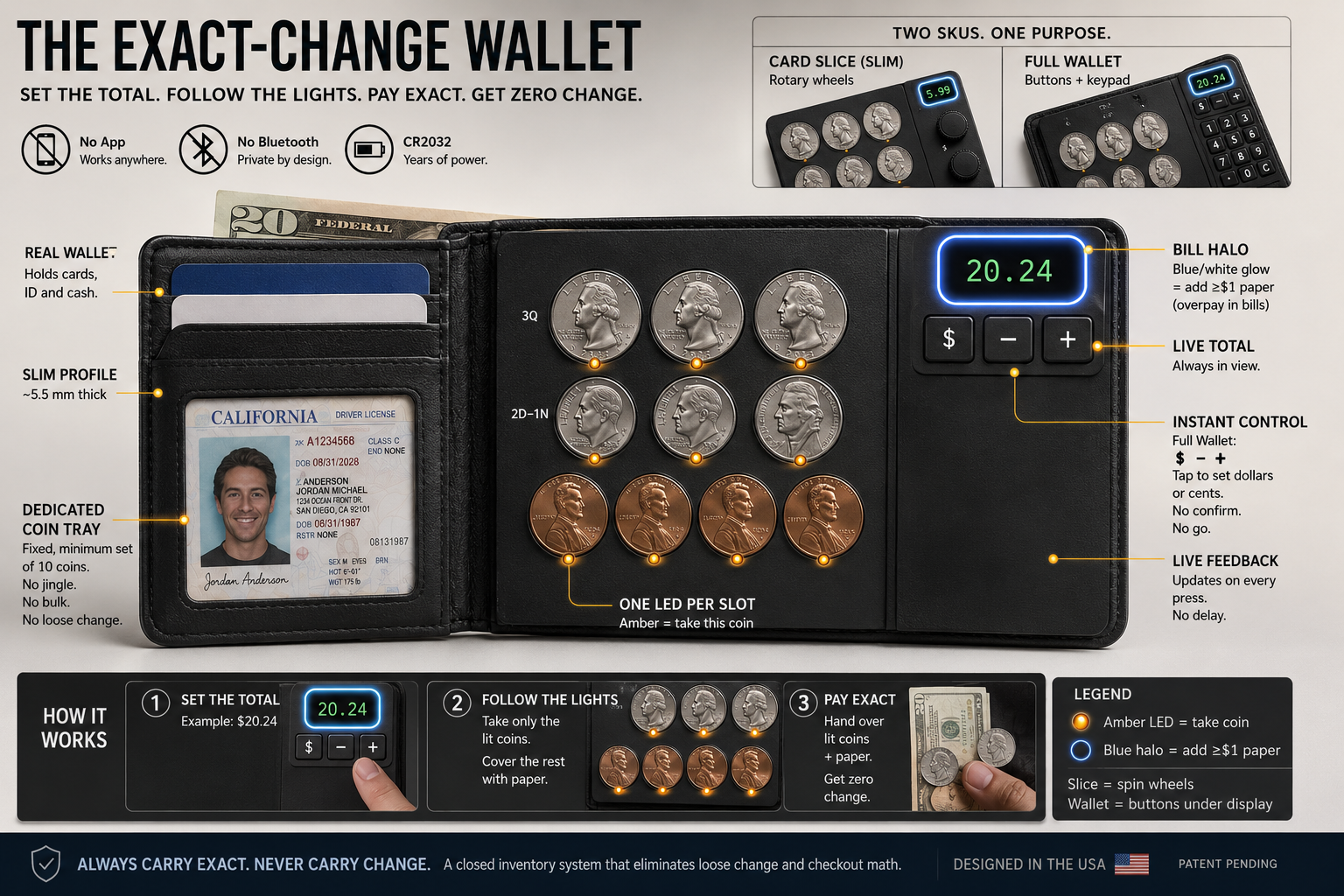
One invention I did draw to the millimeter: the Exact-Change Wallet. A molded tray holds a fixed set of coins — ten pieces in the usual layout — each in its own slot with a light underneath. You dial the register total; the lights tell you which coins to hand over. Paper covers the whole dollars; the tray covers the cents. Set the total. Follow the lights. That is the whole game. It is what invention looks like when it stops being a daydream and becomes something you can hold up and say — yes, I get it, that is the product.
II. The Invention — Exact-Change Wallet

Set the total. Follow the lights. That is the whole product.
Billfolds were never built for coins. They bulge, jingle, and turn into lint. At checkout you subtract $14.37 from a twenty, decompose the cents, and hunt the right pieces before the line moves — or you pay with a twenty anyway, take $5.63 back in mixed metal, and dump it in a jar at home. Card tap exists because most people hate that math under someone’s sigh.
The Exact-Change Wallet fixes the coin part. A molded tray holds ten coins — one slot per piece, one amber LED per slot. You dial the register total on a small display. The LEDs tell you which coins to hand over. Paper covers the whole dollars; the tray covers the cents.
Example: total $14.37. Dial 14.37. Coin LEDs light for 37¢. Hand $14 in bills plus those coins. Coin change from the cashier: zero.
The tray carries the minimum U.S. coin set below one dollar that still covers every cents-only amount when dollars are paper — 3 quarters · 1 dime · 2 nickels · 4 pennies, ten coins, 99¢ face. That combination is public math (a classic “how few coins cover 1¢–99¢?” problem — bloggers and teachers have published the same multiset for years; see §IV). What I built is not the theorem — it is the tray that enforces it: pay the cents column from the tray, cover dollars with bills, follow the lights, and you never accumulate a second purse of loose change — as long as the cashier is accurate.
The hard case is short inventory. Total $20.24, but you only have 14¢ left on hand. Lighting “use these 14¢” would mislead you into thinking $20 + 14¢ closes the sale — it does not. The device reads what is actually in the slots, finds a handover that works (often $21 + 14¢, so 90¢ change back refills the slots you emptied), lights the coins you have, and glows a bill halo around the display when you must hand ≥ $1 more paper than the whole-dollar part of the total. The readout shows 21.14 while you dialed 20.24. A phone app can tell you 37¢; it cannot hold the coins, limit the inventory, or point at the slot to open under stress.
Electronics — fixed logic, not a computer. I originally sketched this as dedicated circuit-board logic: a closed set of inputs and outputs (sensors, LEDs, display, wheels) with no general-purpose processor and nothing to upgrade later. Breadboarding the full overpay solver that way proved too painful for a demo, so the spec recommends a single fixed-program controller IC — smallest practical bring-up is ATtiny1616-class in a 3×3 mm package, plus I2C display and LED drivers so the board stays thin (see invention specification §2.1–§2.2). That chip runs frozen spend-map tables, the same behavior as the repo sim — calculator-grade dedicated logic, not a platform with apps or plugins.
Two shapes share the same coin brain:
- Card Slice — flat insert for an existing wallet; coins on the face, rotary thumb wheels on the edge rail.
- Full Wallet — slim bifold; tray on one leaf, cards and bills on the other;
$/−/+on the tray rim (optional keypad on the Dollar Plus SKU).
Controls, control-logic tables, SKU matrix, and validated scenarios: invention specification. Mm-accurate faceplates: ecw-design/.
III. Why the penny fight blocked shipping
The device is simple. The timing was not.
The Treasury halted penny production in 2025. Pennies still circulate and remain legal tender, but minting stopped. Retail lanes are splitting: some still count cents, others round cash to the nickel. That is a rational policy move — treat the nickel as the new smallest unit, stop minting a coin that costs more than it is worth. Full context: U.S. coin phase-out investigation.
Coinage policy is not neutral — and neither is the hardware. President Trump pushed to eliminate the penny (Treasury directive, Feb 2025; production halt Nov 2025 — see phase-out investigation §1 / §8). In that climate a nickel-rounded tray (no penny slots) reads to many buyers as a pro-Trump product — aligned with the executive who killed the cent. A penny-era tray reads the other way: nostalgia for a coin the government is retiring, or resistance to “progress.” Before anyone asks whether the LEDs work, every SKU is a team jersey. Wait for the politics to cool, and you wait forever — while card tap keeps winning because exact change keeps feeling like friction.
Pop culture has been seeding the same anxiety for years: in The Office S02E22 Casino Night, Kevin Malone at the charity poker table confidently mis-states the register — “Nickels are worth 10, dimes are worth 25, and quarters are worth 50.” (Author-attributed; confirm on episode — published Springfield S02E22 scripts recover WSOP poker material not this betting-system line.) That is not a “we skip pennies in poker” gag — nickels are already the floor in real coin games; pennies are for cheap stakes and irritating to split. Kevin’s joke renumbers every coin upward — ladder promotion plus pro-national value upgrade — the symbolic form of penny-into-nickel sovereignty years before Treasury halted the cent (coin phase-out §8.5; Kevin catalogue).
So the design does not pick a side. It ships both futures:
- Penny-era trays — 1¢ steps, four penny slots, for lanes that still count cents.
- Nickel-rounded trays — 5¢ steps and a golden-dollar slot, for the Treasury’s forward path.
- Hybrid Full Wallet — pennies and a golden dollar in one eleven-coin tray, because the bifold has room the slim Card Slice does not.
Post-penny-only trays drop to 3Q · 1D · 2N — six coins, 95¢ face, 5¢ granularity. The point is not to win a culture war. It is to build a tool that still works whichever lane you are standing in — and to accept that Washington does not move on your product roadmap.
That penny stalemate is one layer. Capital, patents, partners, and the inventor-containment climate in §I and §V are the rest. The math was never the blocker. Shipping plastic into an unsettled coin policy was.
IV. History and prior art — what existed before this sketch
The heart of the guarantee — ten coins cover every cents amount from 1¢ to 99¢; fewer than ten cannot — is a classic puzzle. Bloggers and teachers have packaged it for cash users for almost twenty years.
Patti Ng / Mind Your Decisions (2013) walks through the same logic: carry 4 pennies, 2 nickels, 1 dime, and 3 quarters, pay the fractional part in exact coins, and “never get change back” when purchasing with cash. Hung Truong (2007) describes a greedy algorithm that builds an equivalent ten-coin purse and frames the goal as hating spare change. Math StackExchange (2022) states the problem in nearly the same words as this article — paying the fractional part in exact coins so you do not get coins back from the cashier — and proves a 3Q · 2D · 1N · 4P solution (same ten pieces; one more dime, one fewer nickel than my 3Q / 1D / 2N / 4P mold). Stack Overflow (2010) works the bound the other direction: you need at least four pennies, at least one nickel, at least two dimes, and at least three quarters, hence ten coins minimum.
More recently, Josh Mosier (2024) lists both optimal ten-coin multisets explicitly — Set 1: 3Q / 1D / 2N / 4P at 99¢ (the tray I would ship) and Set 2: 3Q / 2D / 1N / 4P at $1.04 — and built a credit-card-sized physical insert to hold them. That is the closest physical prior art to the minimum-set idea: passive plastic, no electronics, user still picks coins by hand.
Mechanical wallets — organization without arithmetic
Long before cheap hobby controller boards, the market solved sorting and dispensing, not checkout math.
The Coin Sorter Wallet (spring-loaded steel slots for US quarters, dimes, nickels, pennies) promises to “produce exact change quickly” with coins at your fingertips — but the user still chooses which coins to slide out, still computes the cents column, and can accumulate far more than ten coins in the stacks. It solves dignity and speed for people who already know what to pay; it does not remove mental math or cap inventory.
Coinboy and the waiter/taxi coin pouches sold in Europe and the US are the professional version: tube dispensers, belt pouches, one-hand coin access, capacities measured in dollars of metal, not a closed 99¢ budget. Again: hardware for hands that already know the job.
KIN Wallet (Kickstarter, 2016) and the earlier Numistar / “Radical Wallets” campaign attack a different pain point: dump bills and coins together, let fabric or leather separate them. Clever industrial design; no sale-total entry, no LED map, no guarantee about how many coins you carry or whether you leave checkout without coin change.
Mechanical pocket coin dispensers (e.g. Wolters, 1996) stack coins in chambers you thumb out one at a time — organization, not computation.
Electronic cousins — calculate and spit, don’t guide
Once Arduino-class kits got cheap, makers built coin dispensers, not coin guides.
Pocket Pal (University of Illinois ECE 445 design document, 2021) is the nearest electronic relative: keypad, ATMEGA328P (their choice — a general-purpose board, not this product’s architecture), IR sensors tracking counts, user enters purchase amount, on-board code computes combination, solenoids dispense coins into a tray. Their own background section cites Coin Sorter Wallet and Numistar as partial solutions. Pocket Pal is bigger (~6×4×1.5 inches), uses an LCD, and motors the coins out — the opposite industrial choice from LEDs that say “pull from this slot.” Same checkout intent; different mechanism.
Hacker projects follow the same pattern: keypad, servos, dispense. Vending and arcade change machines (commercial dispensers) solve the problem at store scale, not pocket scale.
I found no shipped consumer product that combines: fixed minimum inventory, sale-total keypad entry, per-slot LEDs for pay or break-back, bill-indicator LED for overpay when inventory is short, no motorized dispense, wallet thickness. Patent searches turn up LED + coin language mostly on casino and vending indicators, not grocery-checkout guides.
What remains distinctive in this article’s invention
Stated plainly for readers who skim:
The minimum multiset and the “pay cents exact → no coin change back” rule are documented elsewhere. The 3Q / 1D / 2N / 4P @ 99¢ choice is a known optimal packaging (Mosier’s Set 1). The article’s invention is the operational layer: mold the tray to that multiset only; dial 14.37; lights tell you which metal to move; bill halo tells you when paper dollars must overpay because cents on hand are short; never let the coin pile exceed what a billfold can tolerate; never require mental subtraction at the register. Blogs teach the set to nerds who will memorize it. This device teaches it to everyone else through muscle memory and light.
That is why the story belongs in one file with policy history (penny halt, cash decline) and why it never shipped (§III, §V below): the math was never the blocker. Productizing the protocol into cheap plastic — in a culture retiring the penny — was.
V. Why I never shipped it
I did not fail to build this because the math was impossible or because the logic was too heavy. I failed to venture. §III covers the penny timing problem; what follows is the rest of the stack.
Capital and partners: Hardware wants a mold, a certification story, a retail channel, and someone who trusts you with $50k–$500k before the first container ship leaves Shenzhen. Every conversation drifts toward existing POS vendors, bank partnerships, or “we’ll white-label it if you sign here.” Those contracts are where inventions go to become features inside someone else’s enclosure — or die in diligence.
Patent bar: Obtaining a utility patent on a functional invention like this — molded tray, fixed inventory, LED pay map, bill halo when short — is notoriously difficult, expensive, and slow. Only a fraction of applications survive the first office action; total fees and attorney time commonly land $7,500–$12,000+, and the clock runs 24–30 months before you hold anything enforceable. A good sketch is not enough: claims must thread prior art on coin dispensers, vending indicators, and every half-similar wallet an examiner can cite. Worse, theft of IP is routine before and during that wait — pitch decks leak, factory partners copy, crowdfunding photos become someone else’s “inspiration.” U.S. federal courts see roughly 3,000–4,000 new patent infringement filings per year. The barrier is thick, wide, tall, and swarming with IP parasites and industry lawyers — a hostile climate for delicate-minded inventors in general: builders who only wanted to fix a modest physical problem (say, 37¢ at checkout), not spend a career in litigation.
Suppression climate (my read): We live in a decade that punishes small physical tools that compete with platform money. Not necessarily a single villain — an incentive field: apps with subscriptions win shelf space; bearer cash is discouraged; the Fed and Treasury are actively draining penny circulation; coin terminals suspend deposits; cash is 14% of transactions and falling. Building a coin-tray actuator in that wind feels like rowing toward a waterfall while investors ask why you are not doing BNPL instead.
Danger of entanglement: Partners mean NDAs, cap tables, IP assignment, and non-competes with the same fintech incumbents who profit when exact change is impossible and card tap is the default. I have seen enough enclosure playbooks to know the meeting that starts as “we’ll help you manufacture” often ends as “we own the LED protocol and you may not sell to cash-only stores.”
Modern crowdfunding — reference points, and why I won’t use it
For readers who can still reach strangers on the internet, reward-based pre-order is the usual small-hardware lane in 2026:
| Lane | What it is | Notes |
| Kickstarter | All-or-nothing pre-sell; ~5% platform fee + payment processing (fee schedule) | Strong Design / Gadgets discovery; working prototype required on video (rules) |
| Indiegogo + InDemand | Pre-order campaigns; ongoing pre-orders after the campaign ends | Common for hardware with long ship timelines; less organic traffic than Kickstarter — more paid ads |
| Crowd Supply | Curated hardware / maker pre-orders | Smaller audience; manufacturing and fulfillment guidance; higher bar to list |
| Own pre-order store | Shopify, BackerKit, or similar — you own the list | Lower fees, no platform discovery; only works if you already have traffic |
That stack is real. Pebble, Flow Hive, and a decade of gadget campaigns proved a garage sketch → prototype video → backer list → first mold path existed. The window opened roughly 2010–2015: a builder without retail shelf space could still find buyers on the open web.
The window closed. Crowdfunding was never “free money from the platform” — it always required reaching people on the internet (email list, YouTube, Reddit, Facebook groups, press). What changed is that distribution choke: algorithmic suppression, shadow banning, opaque “community guideline” throttles, and pay-to-play reach on the same networks that host campaign links. A tiny charity, a one-person shop, or a delicate-minded inventor can publish a perfect page and still never appear in the feed that converts strangers into backers. The mechanism is documented in broad strokes across the site’s internet enclosure and Google / platform enclosure material — absorb legitimacy, then add friction until users self-select into intermediated rails.
Why I won’t go this route (most likely): I am algorithmically blacklisted on those networks — not as a courtroom finding, but as lived reach: campaign links, product posts, and even small-fundraising asks do not propagate the way they did for comparable projects in the 2012 era. Running a Kickstarter for the Exact-Change Wallet would mean paying for ads into a throttled account, begging for shares that never leave the follower ceiling, and public failure optics when the real blocker was distribution, not demand. For me that is the most probable reason this lane stays closed — above patent cost, above penny politics, above partner NDAs. Others with a clean algorithm profile may still succeed; this file records that the tool exists and the author’s reach does not.
Pattern read (author): The same choke hits tiny charities and micro-businesses today — not only inventors. Surviving on the web now means owned email, relay or indie hosting, word of mouth, and readers who already found you — not “go viral on the platform where the campaign lives.” Crowdfunding did not fail as an idea; permissionless discovery did.
Obsolescence: Even if I had shipped in 2020, the product optimizes a penny-capable world that policy is actively shrinking — see §III. The device is not wrong; it is scheduled for orphanhood by the same macro trend that retires the coin set the wallet was sized for.
So the failure is overdetermined: no cheap path to market, a patent bar that punishes anyone without counsel and war chest, hostile partner geometry, crowdfunding without reachable audience, a culture that treats cash competence as friction to eliminate, unsettled coin policy at the register, and the inventor-containment templates that teach us to remain small and inconsequential.
Where next
- Exact-Change Wallet — invention specification — canonical product spec: register protocol, controls, fixed I/O controller (§2.1–§2.2), control-logic states, inventory math, validated scenarios.
- ECW faceplate SVGs (canonical industrial design) — mm layouts for renders and ChatGPT reference.
- U.S. physical coin circulation — phase-out investigation — penny halt, Fed terminals, cash share, enclosure pattern; §11.1 minimum inventory table.
- Quantum Leap (of faith) — suppressed signal technology, crystal memory, the leap beyond LED rectangles.
- The Internet That Should Have Been — parallel story: right idea, wrong era, platform capture; Gary Kildall / CP/M enclosure in the dossier.
- Google Don’t Be Evil enclosure investigation — pocket-computer absorb→enclose playbook (§IV).
- Royal Rife — frequency medicine suppression — physical inventor suppressed by guild litigation (§I parallel lane).
- Canceling the high poppy — founder board ousting — visible builders cut down after compliance formalization.
- Constitutional coining / Federal Reserve (usury lane) — who was supposed to coin money, and who actually does.
Prior art (external, cited in §IV): Mind Your Decisions — exact change (2013) · Hung Truong — ten coins (2007) · Josh Mosier — coin holder (2024) · Pocket Pal — UIUC ECE445 (2021 PDF) · Coin Sorter Wallet · KIN Wallet (2016)
Framing and limits
This page is an article: a narrative frame (prologue), inventor-containment casebook (§I), a condensed invention sketch (§II), why penny policy blocked timing (§III), prior art (§IV), and personal why-not-shipped (§V, incl. modern crowdfunding reference + algorithmic reach read) — not a shipped product or patent application. Engineering detail — controls, fixed-program controller BOM, control-logic states, spend-map tables, SKU matrix — lives in invention specification; mm faceplates in ecw-design/; validation in scripts/exact-change-wallet-sim.mjs. The ten-coin / 1–99¢ multiset is documented mathematics (Mind Your Decisions (2013), Mosier (2024), StackExchange (2022)); this author re-derived it after losing design notes. The LED tray protocol as described remains unverified as a commercial product in the research pass behind §IV. Coin inventories were verified by computational search for U.S. denominations {25, 10, 5, 1} cents; re-run locally with npm run exact-change-sim. Post-penny rounding rules may differ by state and retailer — see the linked investigation for documented policy. Prisca sapientia applies: institutions degrade practical knowledge (here, physical money literacy) while marketing convenience. Suppression, containment, partner-risk, and algorithmic reach / shadow-ban language in §I and §V is author pattern and experience, not a legal claim against any named person or company. Claims about antiquity, space travel limits, and telepathic media in the prologue are author cosmology — developed elsewhere — not engineering specifications for the wallet.
Keywords: #ExactChangeWallet #FixedLogicController #PhysicalCash #CoinInventory #Crowdfunding #AlgorithmicSuppression #PriorArt #SuppressedInvention #InventorContainment #JohnMcAfee #AaronSwartz #GaryKildall #IanMurdock #PrestonTucker #JohnDeLorean #ParadigmThreatFiles
Substack: paradigmthreat2.substack.com/p/exact-change-wallet-invention-and
Last updated: 2026-06-30T14:00:00-04:00
Written and narrated by Ari Asulin, with drafting and research support from LLM agents.
Share