

USA was founded by the ‘Lost’ Tribe of Benjamin
Rus-Horde fracture, monotheist exfiltration, and the memory war still aimed at Russia
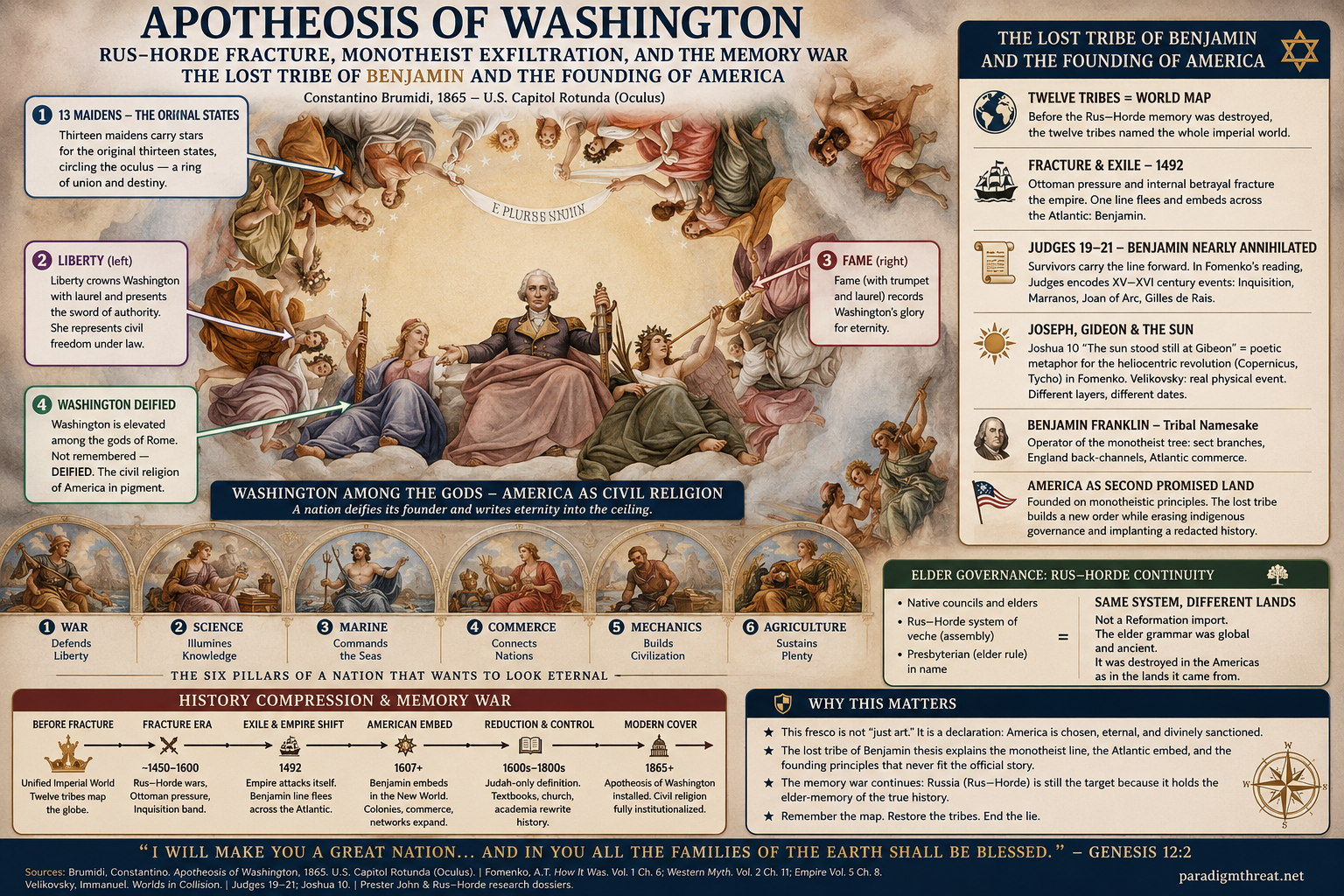
I found the painting today — really looked at it — and years of speculation solidified into a working theory. Constantino Brumidi’s Apotheosis of Washington (1865) hangs in the Capitol rotunda oculus with Washington rising among Roman gods: Jupiter, Victory, Liberty, Fame. Thirteen maidens carry stars for the original states. Six scenes ring the base — War, Science, Marine, Commerce, Mechanics, Agriculture — the pillars of a nation that wants to look eternal.
That is civil religion cast in pigment. Washington is not remembered here; he is deified. The fresco landed as physical proof for a theory I have never heard anyone else state plainly, though the supporting threads were already scattered everywhere once I knew where to look. The simplest read, for me, is the lost tribe of Benjamin: an embed line that severed from the old imperial world, vanished into the Atlantic, and reappeared as America — with Benjamin Franklin as the modern name-echo and operator of the fleeing monotheist branch.
The full spine, tables, and tier labels live in the Apotheosis of Washington — Benjamin tribe, America, Rus–Horde memory war dossier. What follows is the article voice: one chain, kept simple, because history mysteries usually are.
Twelve tribes as a world map — and why Benjamin “disappeared”
Before the Rus-Horde memory was destroyed, the twelve tribes named the whole imperial world, not a small Levantine population squeezed into modern “Jews only” talk. Each tribe marked a section of geography under one sky. When that empire fractured, the map was erased on purpose. “Lost tribes” look lost only because Israelite was redefined afterward so Judah alone stayed visible as “people of the book” — enough to explain continuity without restoring the world-tribe chart.
1492 is the hinge I keep returning to: the empire attacks itself. Ottoman pressure thrusts into Europe; other tribal sponsors go along, willing or not. One line flees and embeds: Benjamin into the New World. America becomes a second promised land in that reading — an Atlantic embed, not an accident of Columbus romance alone. The biblical anchor that fits this cipher, for me, is Judges 19–21: Benjamin nearly annihilated, survivors carried forward.
On calendar layering: Fomenko is explicit that much of the Book of Judges encodes modern events — the XV–XVI century Inquisition band, Marrano persecution, Joan of Arc, Gilles de Rais — not a distant Iron Age village drama (How it was, Ch. 6 §31; Western myth, Ch. 11). He reads the sun standing still in Joshua — the Battle of Gibeon in Joshua 10, shelved beside Judges in every Bible — as poetic metaphor, not a literal halt of the sky: a literary echo of the heliocentric revolution when Copernicus and Tycho Brahe “made the Sun stand still” at the center (How it was, Ch. 6 §24). Velikovsky and the catastrophists who came before Fomenko argued the opposite lane — that Joshua’s long day was a real physical event (Worlds in Collision; this collection’s Sun stands still for Joshua timeline chapter follows that physical grammar). My read: Benjamin’s near-extinction in Judges 19–21 belongs with Fomenko’s late-medieval layer; Gibeon’s stalled sun may belong with a cosmology catastrophe thousands of years earlier. The books sit adjacent in canon; the events need not share one date.
Benjamin Franklin follows as pattern, not proof by etymology alone: tribal namesake and visible operator of a monotheist tree — sect branches, England back-channels, Atlantic commerce — inside a colony already shaped by slavery and Indigenous dispossession. Franklin was a monotheist, in my read, whatever the schoolbooks say about Deism and the Enlightenment mascot. America was founded on monotheistic principles; secular labels are containment, expected when a lost-tribe doctrine lives inside Abrahamic grammar and gets denied by narrowed tribal definitions and by textbooks that treat founders as non-religious props.
Native governance before contact — elders elected, council memory on the land — is the same system the Rus-Horde ran: not a Reformation import, not a superficial parallel. Fomenko maps the Kingdom of Presbyter Johannes onto mediaeval Russia-Horde (Empire Vol. 5, Ch. 8 §6); presbyter is elder, Ioann/Ivan is John, and the Prester John dossier tracks how that elder grammar later surfaces as Presbyterian in name. Founders wiped that living polity in the Americas while installing the redacted “twelve tribes = Jews only” reality — the same institutional shape destroyed on the ground it came from.
What Fomenko gives — and where I leave him
A.T. Fomenko’s New Chronology is often mocked before it is read. For this thesis he supplies corroboration, not a co-primary frame I swallow whole.
On Western myth, Ch. 11, Fomenko maps the war of all Israel against the tribe of Benjamin onto the persecution and destruction of Marranos in Spain at the end of the fifteenth century. The exodus out of that catastrophe he ties to the acquisition of America — Horde and Osmania=Atamania troops in his vocabulary. He also separates Israelite tsar (Horde military head) from Judaic tsar (metropolitan/church head): a split of powers that matches an imperial world, not a village synagogue dispute. On How it was, Ch. 6 §31, he treats the Book of Judges as Inquisition-era history folded into scripture — modern events, not remote antiquity. On Ch. 6 §24, he reads Joshua’s sun standing still as poetic metaphor for the heliocentric revolution — Copernicus and Brahe “making the Sun stand still” — not a literal halt of the sky.
On How it was, Ch. 8 §1, he states plainly that the American War of Independence was the eastern front of the same conflict: Romanovs attacking the weakening Horde from the west while Americans “fighting for independence” attacked from the east. That pairs with the Pugachev rebellion (1773–1775) window in the timeline — vacuum, partition, memory war dressed as republic birth.
My read diverges from Fomenko in places I need to name cleanly.
The reason is clear. Fomenko worked inside a pincer he could not escape: the Greek Orthodox Church on one side, Soviet communism on the other — two walls that bound what he could publish and what his Moscow peer group would tolerate. To this day he still avoids statements that would offend colleagues who believe the communist version of history, even if he privately holds views closer to the full Rus-Horde memory war. That is not cowardice alone; it is the price of doing chronology inside an academic and ecclesiastical fence. I am not inside that fence — so I can name Benjamin Franklin as tribal operator, monotheism as the engine, and three world wars as one Reverse Crusade without trimming for Orthodox containment or Marxist historiography.
Fomenko’s Judges = modern events line corroborates the Benjamin ↔ Marrano ↔ America band; I still lead with world-map tribes, 1492 self-attack, and Benjamin embed as the spine — not his full Inquisition cipher deck. I also keep the Velikovsky / repo catastrophist lane open for Joshua 10 / Gibeon while he calls the stalled sun metaphor — potentially thousands of years apart from Judges’ Benjamin war in real time (Sun stands still for Joshua).
Fomenko does not give me Benjamin Franklin as tribal operator or the monotheist tree framing; that is mine.
He does not carry my emphasis on three world wars as one Reverse Crusade against Russia (WWI, WWII, and the war we are in now from 2014 onward) — though the timeline hub on Reverse Crusades and the reverse crusades comparison dossier are where that campaign is documented in this collection.
He does not end where I end: with monotheism as the engine of institutional carnage when gnostic containment threatens its law-practice monopoly. For the Royal versus Apostolic branch vocabulary and how this collection relabels Fomenko’s poles, see Two branches: Fomenko vs author.
Credit where it is due; divergence where the painting and Franklin pushed me past his map.
Fomenko compresses centuries into encodings — Judges as modern Inquisition history, biblical names as late-medieval events, Joshua’s long day as heliocentric poetry. I borrow his Benjamin war → Spain → America band and his 1776 eastern front line because they rhyme with the physical evidence I care about: a rotunda that deifies a founder, a Franklin essay that ranks Russians among the swarthy, a continent taken in the same century Marranos burned. Velikovsky and this collection’s catastrophist timeline keep Gibeon on a physical calendar that may sit millennia before Judges in real time. I do not need a tribe atlas or a full Fomenko cipher deck to hold the Benjamin embed; the spine stays short on purpose.
Franklin, complexion, and the Moors book fork
Franklin’s Observations Concerning the Increase of Mankind (1751) is ugly by modern standards and documented in every standard edition. On immigration he wrote of Palatine Boors — peasants from the Rhineland, not medieval Iberian Moors. In §21 he mentions the expulsion of the Moors when discussing Spain’s thin population; conflating §21 with §23 is one plausible origin of later “Palatine Moors” garbles.
§24 is the complexion passage that matters for the east-west map. Franklin ranks much of the world as black or tawny or swarthy; Russians, Italians, French, Germans (Saxons excepted), Swedes — swarthy in his English. Saxons with the English form the “principal Body of White People on the Face of the Earth.” He never calls George II “black” in the authentic essay.
A circulated book page — page 60, portrait, compilation layout — swaps Boors for Moors, sharpens black where Franklin wrote swarthy, and adds an editorial line: “black German King, George the 2nd.” The Franklin Palatine Moors screenshot dossier treats that page as most likely a real printed book in the hidden-history shelf, downstream synthesis until an early imprint proves otherwise. Internet Archive searches have found zero indexed hits for “Palatine Moors”; the open forensic step is still locate the edition.


The fork that matters for this thesis:
If a pre-1800 imprint ever surfaces with Palatine Moors in §23, it would challenge the Boors-only witness chain — a major bibliographic event, not a meme. Until then, the dossier default stands: Yale, Founders Online, and the print tradition say Boors.
Even on authentic §24 alone, an eighteenth-century reader steeped in imperial geography could hold a court map where power sat east — Hanover German, yes, but Russia the imperial pole in New Chronology geography — and where European color-talk called the East swarthy or black without meaning modern US racial boxes. A gloss like “black German king” on a compilation page reads, in my thesis, as commentary on where George’s world actually lived — Russia, the Horde horizon — more than as Franklin’s own sentence.
Franklin operated inside a Benjamin-line monotheism, I argue, with Rus-Horde memory, complexion taxonomy, and Atlantic embed on one mental chart. The king was not “in England alone” in the deep map; the East was black in European speech when it meant swarthy imperial peoples — Russians included. Hanover sat on a German throne; the weight of empire in New Chronology geography still pulls east toward Moscow and the Horde horizon. A reader who knew that map could gloss George II as a German king whose world was eastern and swarthy without imagining Franklin wrote the sentence. That aligns the Moors dossier with the promised land sequence (1492 exodus mirror, America as embed) without requiring the misquote to be Franklin’s ur-text. Strongest advocacy still runs through authentic §23–24 plus colonial records — the dossier’s own conclusion — while the Benjamin spine asks what Franklin knew about the court of the East when he wrote about who counts as white.
Static electricity — stolen credit, not discovery
School lore credits Benjamin Franklin with discovering static electricity. That is the kind of lie this memory war runs on. The Rus-Horde world — the empire whose map his branch sought to erase — already understood storm charge in built form: hollow spires and towers as cathodes that captured lightning and sheltered inhabitants from interplanetary discharge (cathoderal; cathode spires timeline). Static electricity was not new in 1752. It was old craft with the memory stripped out and a colonial printer given the hero slot.
Franklin did not invent a field. He inherited what spires already proved and let textbook culture award him discovery — credit theft from everyone who worked centuries before, the same theft that later puts Franklin and Hamilton on currency though neither held the presidency. I am not saying the kite never flew; I am saying the discovery narrative is Disneyfied propaganda inside the Benjamin-line monotheist tree.
Modern scientists are not the same species as those original builders. The type that dominates public imagination now looks more like Thomas Edison: relentlessly agenda-driven, always working the crowd, willing to electrocute living humans and animals in public demonstrations just to prove a point about whose current wins and whose name owns progress. Edison’s War of Currents against Westinghouse and Tesla is on the record — staged animal killings, William Kemmler pushed through the electric chair in 1890 to portray alternating current as murder while selling direct current as safe authority. That is power theater, not open inquiry. Franklin’s kite belongs in the same gallery: influence, credit, and implied authority for a branch that needed the old empire forgotten. Full tier labels and links sit in Apotheosis dossier §7. Benjamin names a tribe, a founder, and a hundred-dollar face in one mnemonic chain.
The fresco as capstone — after the vacuum, before the lie settles
Brumidi finished the rotunda work in 1865 — decades after Pugachev, after the hypothetical Mud Flood catastrophe in the timeline’s reading, after Native displacement and founder cult hardening. The Apotheosis is capstone evidence: founders treated as living gods in Roman grammar after the vacuum, not as the 1776 founding document itself.

The same mentality shows on currency: Washington on the one; Franklin and Hamilton on the hundred and the ten — faces of finance at the apex without election, unelected permanence beside political apotheosis. Freemasonry and symbolic Washington fill the capital city layer the dossier tracks under operative-to-speculative craft migration.
The federal project, in my read, was closed-door from the start — England still in the back room — with a mission to supplant, redact, and destroy Christian Gnostic Rus-Horde memory. Declaration language about “merciless Indian savages”; Constitution slavery protections; Trail of Tears; imperial wars; slavery protection as structure, not failed democracy. That mission explains persistent anti-Russia posture while schoolbooks pretend America “never fought Russia” — when WWI, WWII, and the NATO/Ukraine arc from 2014 onward are read as Reverse Crusades II, III, and IV in one campaign (comparison dossier).
The painting I found today sits at the end of that chain like a seal: documented masterpiece, author synthesis stamped visible. Memory war made physical.
Look up when you visit the Capitol or scroll the Architect of the Capitol lesson PDF: Washington rises between allegory and history, Roman gods in an American temple. The lesson plans call it civic education. I call it late-stage apotheosis — the same instinct that puts unelected faces on money and sends unelected wars east under humanitarian paint. Simple solutions to history mysteries often look like this: one artifact, one spine, many lies peeled off once you stop treating the textbook date as the birth of the story.
Science fiction has been encoding the same grammar for decades — treated here as predictive programming data, not proof of author intent. Walter M. Miller Jr.’s A Canticle for Leibowitz (1960) is the sharpest rhyme: after nuclear collapse, a monastic order preserves the scattered, incomplete papers of a 20th-century engineer, Isaac Edward Leibowitz, and elevates him to Catholic beatus — worship and relic custody instead of restored craft. That is Franklin-on-the-hundred and Washington-in-the-oculus cast as post-apocalypse fiction. Aldous Huxley’s Brave New World (1932) gives us Our Ford and dates in Anno Ford — industrial founder as god. Asimov’s Foundation seeds an encyclopedia priesthood hoarding tech fragments after empire fall; Bradbury’s Fahrenheit 451 sends firemen to burn books; Orwell’s 1984 makes history rewrite a ministry job. Full tier table: Apotheosis dossier §10.5.
Monotheism, gnostic containment, and the plan for the world
I did not arrive at Benjamin and Brumidi to deliver a pleasant history lesson. I want the reader to see where the weight sits.
When gnostic practice tries to contain law in lived craft — elders, sky literacy, imperial memory, craft that still knows how the world worked before the sky stabilized — monotheist institutions react as the most reactionary, intransigent, cantankerous force in the record. I do not mean every individual believer is cruel. I mean the grammar of one invisible God with one plan authorizes total control of belief: shrink the tribes to “Jews only,” erase the world map, burn the elders on the ground you stole the system from, paint Washington into heaven beside Jupiter, send generation after generation to die in wars whose target is always Russia dressed as unrelated “world wars.”
Monotheism lives in an existential crisis whenever gnostic containment succeeds even locally. The escalation is predictable: Inquisition encoding, memory wars, America’s redacted reality, Mockingbird erasure of Horde memory, Protestant branches that must convince their own people the religious shards were never connected. The gnosis versus agnostic cut helps name the epistemic split: faith without recovered mechanism versus operative knowledge of what ancient religion was tracking.
Protestant “protest,” in one NC reading tied to eastern imperial Christianity and western mockery, is part of the same fracture — see the afterlife, purgatory, and Protestant Rus–Horde lens for atmosphere, not proof of every claim here.
In other words, the torture, misery, carnage, and mayhem that stain human history trace directly to monotheists trying to control the world by any means necessary so that everybody believes what they believe — that God is in charge and has a plan for us all.
Where next
- Apotheosis of Washington — Benjamin tribe, America, Rus–Horde memory war — full dossier spine, Reverse Crusades, Native elder / Prester John thread
- Franklin “Palatine Moors” screenshot — text forensics and book hunt — Boors witnesses, page 60 fork, Anna’s Archive search strings
- Prester John, Presbyter, and the Rus–Horde Christian East — elder system and Prester echo
- Two branches: Fomenko vs author — Royal / Apostolic relabel
- 20th century — the Reverse Crusades continue — WWI / WWII / ongoing campaign vs Russia
- Predictive Programming hub — fiction-as-data methodology; §10.5 in dossier lists Canticle, Brave New World, Foundation, Fahrenheit 451, 1984
Framing and limits
This reading assumes prisca sapientia: ancients held profound understanding of universe, nature, and theology later degraded or captured; modern consensus is not default truth.
Documented anchors include the AOC fresco, Founders Online Franklin (Palatine Boors, §24 swarthy Europeans), and Fomenko quotations linked above. Author thesis includes the Benjamin world-map embed, Franklin as monotheist tribal operator, George-in-the-East / swarthy-Russia reading, stolen electricity credit (spire cathode grammar before Franklin), the Edison archetype for agenda-driven modern science, federal supplantation of Rus-Horde memory, Reverse Crusades framing, the Fomenko pincer (Greek Orthodox + communist historiography as structural limits on what NC can state), sci-fi PP rhymes (Canticle for Leibowitz, Brave New World, Foundation, Fahrenheit 451, 1984 — dossier §10.5), and the closing monotheism-as-engine claim. The circulated Palatine Moors page remains an open forensic fork until a pre-1800 imprint is located — see the Franklin dossier Limits for tier detail.
Twelve-tribes and Judah material is institutional-memory chronology, not blanket denial of any community’s lived identity; see the working definition of antisemitism for anti-monolithing norms. Full evidence machinery: dossier Limits and disclaimers sections.
Keywords: #LostTribeOfBenjamin #ApotheosisOfWashington #BenjaminFranklin #PalatineMoors #Fomenko #RusHorde #Monotheism #Gnosis #MemoryWar #ParadigmThreatFiles
Substack: USA was founded by the ‘Lost’ Tribe of Benjamin
Last updated: 2026-06-02
Written and narrated by Ari Asulin, with drafting and research support from LLM agents.
Share