

Franklin “Palatine Moors” Screenshot — Text Forensics, Colonial Context, and Book Hunt
TL;DR: A circulated book page (page 60, Franklin portrait) quotes Observations Concerning the Increase of Mankind (1751) with “Palatine Moors,” “black” Europeans, and a “black German King George II” gloss. Every standard edition has “Palatine Boors” and omits the George II line. The screenshot is most likely a real printed book (compilation / hidden-history genre); finding that edition is the open forensic step. Substantive claims about Palatines inside the slave empire, Moor–Barbary–Atlantic links, and curriculum whitewash stand without treating the misquote as Franklin’s ur-text.
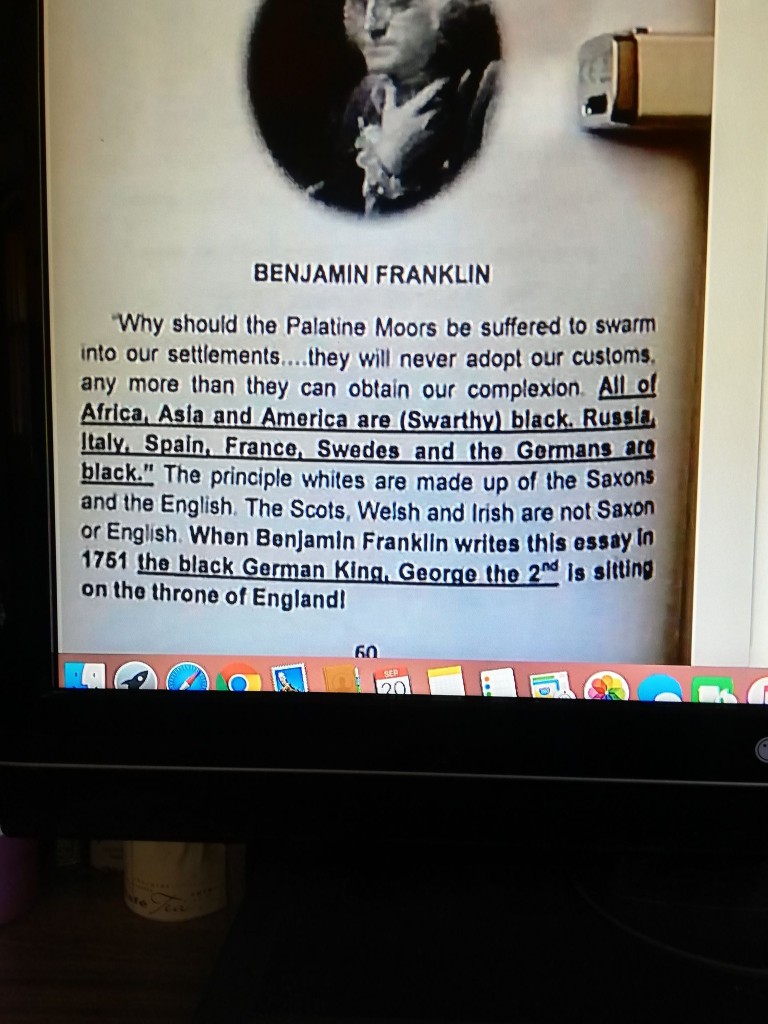
Status: Open Date: 2026-05-16 Scope: Validate Franklin’s authentic §23–24; debate whether the screenshot is pre-redaction Franklin or modern synthesis; colonial/imperial context for Palatine migration; Anna’s Archive search strategy; cross-links to Moor/slave and American Revolution threads.
Guide (read order)
- Authentic Franklin → §1
- Screenshot vs witnesses → §2
- Session debate (condensed) → §3
- Colonial / slave-trade structure (author-aligned) → §4
- Book hunt (Anna’s Archive) → §5
- Conclusion & open questions → §6–7
1. Authentic source text (1751)
Work: Benjamin Franklin, Observations Concerning the Increase of Mankind, Peopling of Countries, etc. (written 1751, first published 1755).
Witnesses (all agree on Boors): Founders Online; Columbia course transcript (Wayback if live site blocks bots); Yale Papers of Benjamin Franklin via ditext transcript; Language Log (2017).
§23 — immigration (Palatine)
why should the Palatine Boors be suffered to swarm into our Settlements … and will never adopt our Language or Customs, any more than they can acquire our Complexion.
- Boors = archaic peasants (cf. Dutch boer, German Bauer).
- Palatine = Electoral Palatinate / Rhineland German migration into British America (1709–1750s waves), not Morocco or medieval Iberian Moors.
§21 — Moors (different topic)
Franklin mentions “the Expulsion of the Moors” only when discussing Spain’s thin population — not Pennsylvania Germans. Conflation of §21 + §23 is a plausible origin of “Palatine Moors.”
§24 — complexion
All Africa is black or tawny. Asia chiefly tawny. America (exclusive of the new Comers) wholly so. And in Europe, the Spaniards, Italians, French, Russians and Swedes, are generally of what we call a swarthy Complexion; as are the Germans also, the Saxons only excepted, who with the English, make the principal Body of White People on the Face of the Earth.
- Europeans are swarthy, not black in Franklin’s wording.
- No mention of George II anywhere in the essay.
2. Screenshot page vs authentic text
| Element on screenshot | In Franklin (1751)? | Verdict |
| “Palatine Moors” | Boors | Misquote (or modern editorial swap) |
| “All … America are (Swarthy) black” | Africa “black or tawny”; Asia “chiefly tawny”; America “wholly so” | Distorted |
| Russians, Italians, etc. are “black” | “swarthy Complexion” | Misquoted |
| Saxons + English as principal “whites” | Yes (paraphrase OK) | Substantially accurate |
| Scots, Welsh, Irish “not Saxon or English” | Absent | Editorial addition |
| “black German King, George the 2nd” (1751) | Absent | Commentary, not Franklin |
| Page 60, circular portrait | — | Suggests multi-chapter compilation |
Internet Archive full-text search (2026-05): zero hits for "Palatine Moors" in indexed books — the phrase is rare in digitized corpora; the book may be POD, pamphlet, or offline circulation.
Redaction hypothesis (both directions debated in session)
| Direction | Plausibility (session conclusion) |
| Modern power changed Moors → Boors to split Mediterranean Moors from Atlantic history | Weak — all early prints have Boors; §24’s racist lines remain public; mislabels Germans as Moors |
| Screenshot = original suppressed by academia | Logically possible, not supported by manuscript/print chain; page mixes non-Franklin lines |
| Screenshot = downstream compilation (Swarthy Kings / Moorish–Israelite / hidden-history shelf) | Most likely |
3. Session debate (condensed)
3.1 What was validated
- Franklin wrote the essay in 1751; anti-German and complexion passages are real and xenophobic by modern standards.
- George II was Hanoverian king in 1751 — true as political history, not as Franklin calling him “black.”
- Moors in Franklin = Spain (§21), not Palatine immigrants.
3.2 User’s structural arguments (accepted in part)
Documented / aligned with Paradigm Threat:
- Palatine settlers were not outside British America’s colonial world: slave-legal colonies, Indigenous dispossession, Atlantic economy — “one imperial step” inside the machine, even if most were farmers not slave merchants.
- Popular history often silos Barbary / Moorish Mediterranean slaving, transatlantic African enslavement, and “innocent European immigration.”
- Elite networks (crown, merchants, Iberian–Sephardic trade, marriage alliances) are murky and under-taught; possible that later portrait/genealogy spin obscures complexity — see slave-trades & Moor etymology.
Does not require “Palatine Moors” as original wording:
| Insight | Needs misquote? |
| Palatines inside same colonial/imperial world as Atlantic slavery | No — true with Boors |
| Hidden links between Mediterranean slaving, Atlantic slaving, settlement | No |
| “Innocent farmer” vs distant “slave trade” curriculum | No — framing issue |
3.3 Screenshot as rhetorical “strengthener”
The page compresses Boors + Moors + George II + “black Europe” for readers already in complexion-revision milieus. That feels clarifying but hands skeptics a fake-quote attack and mislabels Germans as Moors. Stronger advocacy: authentic §23–24 + colonial records + Barbary dossier.
3.4 Movements that share this bookshelf (not proof of ur-text)
Christian-adjacent and para-religious lanes often circulate similar pages: Moorish Science Temple, some Black Hebrew Israelite sects, Afrocentric compilations, online “Swarthy Kings” complexion revision (Quora space quotes Boors correctly but interprets swarthy as near-black). Anti-Zionism alone is not the same literature shelf.
4. Colonial and timeline cross-links
| Topic | Repo link |
| Moor / Barbary / transatlantic slave trades | /governance/slavery/slave-trades-and-moor-etymology-investigation.md |
| Horde fracture → extraction (investigative) | Same file, § Horde-Fracture Thesis |
| American Revolution / 1775–76 context | /governance/war/investigations/american-revolution-investigation.md |
| Fomenko vs author claims | /history/chronology/investigations/two-branches-christianity-fomenko-vs-author.md |
| Redaction as project theme | /history/chronology/history-qa/page.md (First / Second / Third History) |
| Anna’s Archive workflow | /docs/ANNAS_ARCHIVE_HOLLOW_EARTH.md |
Franklin §23 with Boors: he feared Germanization of Pennsylvania in a colony already shaped by slavery and settler hierarchy — same document §24 ties immigration to excluding “Blacks and Tawneys.”
5. Finding the book (Anna’s Archive and local grep)
Use browser on Anna’s Archive (CAPTCHA); download to a folder; grep PDFs locally (see ANNAS_ARCHIVE_HOLLOW_EARTH.md).
Priority search strings
"Palatine Moors""black German King" George"When Benjamin Franklin writes this essay in 1751""George the 2nd" "black German"Swarthy KingsFranklin Observations swarthy George II"Scots, Welsh and Irish" Saxon Franklin
Fingerprint for correct hit
One file containing all: Palatine Moors + black German King George + garbled §24 block + (optional) Scots/Welsh line.
What finding it would prove
| Outcome | Implication |
| Book located, post-1990 POD / compilation | Genre document; identifies publisher/editor; not pre-redaction Franklin |
| Book located, pre-1800 with Moors in §23 | Major challenge to Boors tradition — needs bibliographic chain |
| Never located | Substantial case remains that screenshot depicts a real object class (printed hidden-history page) even without copy — see §6 |
6. Conclusion
- Screenshot: Treat as most likely a photograph of a real printed book (compilation layout: portrait, page 60, editorial George II line) — not as a meme isolated from print culture.
- Theory proof: Locating that edition (title, imprint, date) is the decisive step to show who published “Palatine Moors” and when.
- Without the book: We still have a substantial case that such a book could exist and circulate: (a) aligns with known hidden-history shelves; (b) explainable by §21 Moors + §23 Boors conflation; (c) zero requirement to overturn Yale/Founders Boors witnesses for colonial/slave arguments; (d) absence from Archive index suggests narrow print run or recent POD, not impossibility.
- Default historical judgment: Authentic Franklin = Boors; screenshot recension = downstream synthesis until an early imprint proves otherwise.
- Strongest Paradigm Threat line: Palatine migration inside British slave colonialism + Moor/Barbary/Atlantic fracture thesis — argued from authentic Franklin, PA colonial law, and /governance/slavery/slave-trades-and-moor-etymology-investigation.md, not from the misquote alone.
7. Questions to clarify, verify, or debunk
| # | Hook |
| 1 | Identify book from screenshot (ISBN, title, publisher, year). |
| 2 | Any pre-1800 edition with Palatine Moors in §23? |
| 3 | PA colonial records: Palatine counties and slaveholding households, 1740s–1760s. |
| 4 | Document one elite path Palatinate court → Atlantic trade house (vs peasant Boors). |
| 5 | Add verified hits from Anna’s Archive to this file. |
8. Weak points / TODOs
- Book identification from cover/imprint
- OCR + grep of any candidate PDFs
- Optional short parent article (only if author names path) linking here from chronology hub
Keywords: #Franklin #PalatineMoors #PalatineBoors #Observations1751 #BenjaminFranklin #SwarthyKings #MoorEtymology #AtlanticSlavery #BookHunt #ParadigmThreatFiles
Last updated: 2026-05-16
Limits and disclaimers
- Author thesis sections in related files (Horde fracture, Deep State redaction) are investigative, not established fact.
- Franklin was a slaveholder earlier in life and later abolitionist-leaning; this file does not resolve his full moral arc.
- “Moor”, “swarthy”, and “black” are 18th-century English categories — not modern US racial taxonomy.
- Circulating Hebrew Israelite / Moorish American / anti-Jewish rhetoric in some hidden-history books is not endorsed; see working definition of antisemitism.
- Screenshot is study copy for forensics, not endorsement of every claim on the page.
Investigator notes
- Session asset copied to
franklin-palatine-boors-moors-screenshot-investigation.png. - Columbia live URL may 403 bots; use Wayback:
https://web.archive.org/web/2020/https://www.columbia.edu/~lmg21/ash3002y/earlyac99/documents/observations.html
Share