

Stonehenge as Portal — Birkeland Current, Ley Crossings, and Golden-Age Geometry
TL;DR: Author thesis: Stonehenge was a raised spiral (original plan lost today) — twisted pair in stone, axis skyward — end port at a cyclically recurring ley crossing for scheduled cosmic / interplanetary coupling. Traveler stands at spiral center; Birkeland vortex fills the helix to the source planet (exit locus also cycles); bio-EM only transits (no dead matter — clothes/metal disrupt). Golden Age window 4077–3147 BCE; detuned since (incl. 1901–1964 resets). Bell/Cat 6 = same helical geometry at wire scale.
Lay article: Stonehenge: Quantum Portal of the Golden Age — and Why They Want You to Laugh — reader voice.

Date: 2026-06-03 (updated 2026-06-04) Status: Open — author thesis with cross-reads to portal dossiers, relocation epistemics, and ground-node magnetism; not instrumented proof at Salisbury Plain.
0. Author epistemic stance — debunk labels vs. likely real
This dossier follows prisca sapientia and INVESTIGATIVE_STRATEGY: “officially debunked” or “urban legend” is recorded, not treated as closure.
Settled in this project (author read):
| Phenomenon at ground nodes / crossings | Mainstream label | Author tier |
| Compass deviation / violent spin at ley crossings, polar zones, magnetite deserts | Debunked folklore, “minor magnetite,” or psychosomatic | Very likely real — same class as hollow-earth polar compass anomalies (Halley’s multiple magnetic poles on nested shells — hollow-earth investigation) |
| Radio / comms blackout at nodes (Zone of Silence, remote crossings) | Tourism myth, “just remote terrain” | Very likely real — intermittent, local, under-surveyed; debunkers test wrong spot or wrong band |
| Clocks unreliable at nodes | Rarely discussed | Plausible to a degree — quartz oscillators and mechanical escapements are magnetically sensitive; strong local fields + telluric transients could skew or stop timekeeping without full “Bermuda Triangle” drama |
Pattern: Phenomena that would prove portal / hollow / ley physics are labeled legend, then never instrumented at the claimed coordinates under controlled conditions. The faith object is not “aliens” — it is the crossing cycle itself: a recurring coupling whose hit point moves but returns on a planetary clock, while the instrument (Stonehenge ring, Welsh circle, 20th-c. concrete reset) can be moved or detuned off the predicted patch (§3.1).
1. Thesis
Stonehenge is not primarily a calendar, cemetery, or prehistoric observatory in the academic sense—though it may have served those secondary roles. In this project’s reading it is a portal stabilizer: sarsen and bluestone arranged as a helical torus — circular in plan, rising in section — to phase-lock a Birkeland current at a ley crossing so that energy, information, and consciousness could pass between worlds (planets, realms, or entangled locations—see §8 When Stonehenge was active below). A flush ground ring would be a loop only; elevated blocks give it pitch (the twist).
Operational window: Golden Age only — the epoch when the collinear planetary stack showered Earth with a stable, life-promoting current (history-qa; Golden Age event dates). After the configuration broke (3147 BCE flood band), the same geometry could not re-close the gate without the planetary battery online. Later pyramid portals (Pyramids were Portals) exploited different alignment windows; Stonehenge belongs to the earlier Saturnian-column era.
Author thesis (original form): The true layout was a plan-view spiral of raised blocks — a twisted pair aimed skyward — forming an end port where cosmic / interplanetary energy could couple on schedule when a cyclically recurring ley crossing returned to the engineered coordinates. No surviving evidence of the full spiral today (detuning, relocation, ruin); the present ring + horseshoe is collapsed hardware. See §7 Spiral operation & transit.
Dormancy today: The sky cycle may still run; the instrument is detuned and possibly off the moving hit path. Stones were moved, fallen, or re-seated; surrounding landscape and track networks were reordered (Michell’s “former geographical order” — View Over Atlantis). The site reads as ruin + heritage park; the portal flickers but does not open on a predictable schedule.
2. Birkeland current — the shape Stonehenge copies
2.1 What a Birkeland current is (EU / plasma frame)
In Electric Universe and Saturnian cosmology sources used on this site, Birkeland currents are field-aligned plasma filaments in space: they twist into helical pairs, pinch, and rotate around a central axis—visible in auroral curtains, planetary jet streams, and (in the reconstruction) the interplanetary links of the collinear Golden Age.
The history-qa passage on the brown-dwarf capture states plainly that Birkeland currents “coursed through the planets” and forced the collinear battery; the same file later ties Birkeland jets to quantum entanglement between planets during pyramid-era alignments.
Visual signature (author thesis ↔ hero graphic):
| Feature | Birkeland / Z-pinch observation | Stonehenge analogue |
| Central column | Rotating plasma filament rising along the axis | Heel Stone / avenue axis + inner horseshoe focal column |
| Helical twist | Paired filaments winding around each other | Ring in plan + rising blocks in elevation — trace the circuit: up uprights, across lintels, around the ring; tiered horseshoe vs outer circle = nested pitch (not a flat calendar circle) |
| Concentric stabilization | Multiple shells of current density | Outer sarsen circle, inner trilithons, horseshoe tiers |
| Ground coupling | Current closes through planetary body | Sarsen seated in chalk — raised ring above telluric node (not flush burial) |
Stonehenge’s raised form matters: a Birkeland column is a helix, not a flat ring. Each block’s height (lintels on uprights, inner trilithons taller than outer sarsens) supplies pitch — the same quantity Bell encodes as twists per meter in copper.
2.2 Helical pitch — plan plus elevation equals twist
Flat circle = closed loop, no helical mode. Raised circuit = coil: circumference (X–Y) × step height per stone (Z) = 3D twisted path matching Birkeland pairs and Cat 6. Detuning (fallen lintels, 20th-c. re-seating, lowered or displaced blocks) flattens the helix — the crossing may remain, but the twist is gone.
2.3 Z-pinch petroglyph literature (secondary corroboration)
The chronology page cites Peratt / high-current Z-pinch comparisons to petroglyphs and megaliths worldwide (Characteristics for the Occurrence of a High-Current Z-Pinch Aurora…). That line of work does not name Stonehenge explicitly in our excerpt, but it supports the general claim that ancient builders encoded plasma-column geometry—Stonehenge here is argued as a three-dimensional instance, not a rock-art shorthand.
3. Ley-line crossing — mobile nodes, cyclic return, predictive ports
3.1 Placement — lines walk, crossings return
Michell’s ley revival (View Over Atlantis) documents Watkins alignments across Britain: straight tracks linking sanctuaries, barrows, beacon hills, and later churches—a network, not isolated monuments. Stonehenge sits in a dense cluster (Avebury, cursuses, barrows, the Old Sarum–Glastonbury threads in Michell’s later chapters).
Author thesis (corrected): Portals were sited at nodes where telluric / interplanetary geometry crosses—the same “pyramids on leys” logic in Pyramids: Myths vs Reality and pyramid-energy investigation. The raised helix is the tuning circuit; the crossing is the coupling event.
Ley lines and crossings are not fixed coordinates. Revival maps treat leys as static straight lines. In this project’s frame, magnetic and telluric fields tied to the collinear stack flex, rotate, and migrate with planetary motion. The crossing point moves. It appears stable only because the same orbital clock brings the same geometry back — cyclically, predictably, often enough that antiquarians mistake recurrence for permanence.
| Misread | Author read |
| Crossing = fixed GIS pin | Crossing = moving hit that returns on a cycle |
| Stonehenge = calendar for sunrise | Stonehenge = timetable for when the node arrives |
| Portal = random sky accident | Portal = scheduled coupling if helix is pre-built on the predicted patch |
Predictive port schedule (Golden Age): Observers tracked the cycle — which bodies, which phases, which field angles — and computed where the crossing would land next on Earth (and where the exit would open on the source planet, which also recurred). Commission a single-helix end port at that patch before the window; transit becomes safe, repeatable, and addressed — predictive teleportation, not alignment luck.
Stonehenge: Primitive scheduled port — optional, Golden-Age amplitude only (§7). Pyramids later widen the same logic into volume and network when the battery degrades.
3.2 Why remove or break the instrument but keep the node hidden
The cyclical crossing can outlive any one instrument: even when stones are wrong, the sky timetable may still fire. The Deep State counter-move after the Golden Age is therefore not only to erase geography but to break prediction:
- Displace uprights and lintels — break phase and flatten helical pitch so the moving node passes through with no coupling.
- Reframe leys as static mystery lines — Michell and mainstream archaeology supply endless calendar debates that avoid mobile nodes and portal mechanics. See §3.4 Official mystery + AI closure.
- Leave a broken shell on a patch that once matched the cycle — enough awe, zero scheduled transit; visitors photograph the flicker, not the gate.
- Relocate or concrete-reset (§4) — detune the hardware while tourist maps still label a fixed “sacred” pin.
Mud-flood / replanning angle (speculative cross-read): MudFlood investigations and buried first floors elsewhere suggest landscape height and approach roads may have shifted since original commissioning—another path to misalignment without admitting relocation.
Tier: Author thesis — not a claim that English Heritage secretly knows the portal works; a pattern match to pyramid detuning, CERN as modern reattempt (CERN portal hub), and suppressed aether engineering (Maxwell timeline).
3.3 Ground nodes — what crossings do (Zone of Silence parallel)
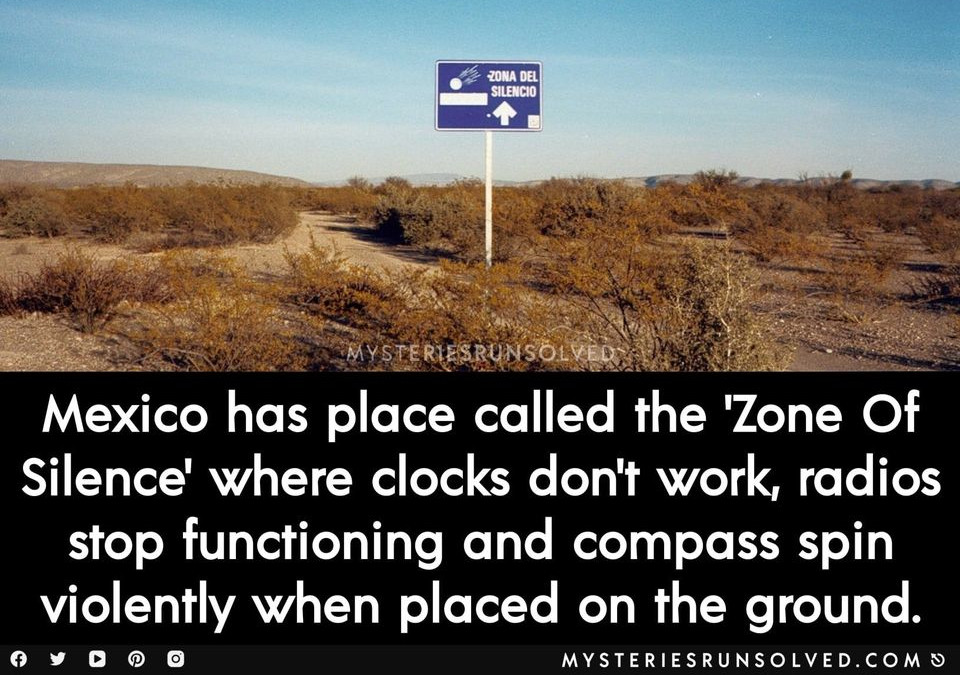
Meme claim (image): Mexico’s Zona del Silencio (Mapimí, Durango) — clocks don’t work, radios stop, compasses spin violently when placed on the ground.
Author read: Compass + radio = very likely real at concentrated ground nodes. Clocks = plausible to a degree. Same suppression grammar as hollow-earth polar compass stories: phenomenon reported → zoneros / cranks blamed → controlled test at wrong coordinates → Wikipedia “urban legend.”
| Claim | Mainstream record | Author synthesis |
| Radios fail | Wikipedia — Mapimí Silent Zone: urban legend; HowStuffWorks: Kaus — no trouble except with zoneros; myth born after 1970 Athena missile crash | 1966 PEMEX engineer de la Peña first reported dead radios (MexConnect / Kaus). Very likely real at specific patches — VHF skip / ground absorption + magnetite + telluric transients; “no one knows where the zone is” (Marcianitos Verdes debunk, 2024) = unfalsifiable debunk |
| Compasses spin | Magnetite deviation only; not “violent” | Very likely real at crossings — USGS magnetic anomalies; Devereux earth lights (EM fields near witnesses). Hollow-earth tradition: multiple magnetic shells (Halley 1692) → surface compass unreliable near polar / gateway geography — hollow-earth investigation. Same class of report, same debunk cycle |
| Clocks stop | Weak citation in tourist lore | Plausible — quartz watches magnetically sensitive; mechanical clocks disturbed by vibration + field gradients at nodes |
Stonehenge rhyme: Salisbury node should show the same family of effects when active (Golden Age) and residual when dormant (flicker only). No systematic MT + RF grid has been published for the Avebury–Stonehenge cluster under author’s frame — an open instrument gap, not disproof.
Cross-read: Michell leys (“energy streams across the earth”); Devereux / Daily Grail — sacred sites & earth lights; ANGEO — telluric currents in geomagnetic variations (Tier A physics, not ley vocabulary).
3.4 Official mystery framing and AI closure (predictive programming)
Tier: Author thesis — pattern match to headline corpus + AI control investigation; not a claim that any single lab secretly knows the portal works.
Stonehenge’s institutional packaging is not neutral. Mainstream archaeology and press preserve the site as an “unsolved mystery” — transport logistics, calendar function, solstice alignment — while excluding portal mechanics from the question set. That framing is predictive programming in the backward sense (predictive programming hub): when the real function surfaces, the public already expects an opaque puzzle solvable only by experts with better tools.
| Layer | What audiences are taught | PP function |
| Official status | Unsolved — “how did the stones get here?” | Mystery = permanent; awe without mechanism |
| Human capacity | Problem too complex for ordinary cognition | Defer to institutions and machines |
| AI / advanced analytics | Models will finally resolve what humans cannot | Cognitive offload — “I don’t understand, but I believe you” |
| Expected “solution” | Calendar, ceremonial gathering, ancestor cult | Disappointing / contradictory — safe for establishment chronology |
Headline corpus (Tier B — on record):
| Source | Framing | URL |
| BBC News | “Unsolved Stonehenge mystery could be explained…” | bbc.co.uk/news/articles/cvgz20dy589o |
| ScienceDaily | “A century-old Stonehenge mystery may finally be solved” (Jan 2026) | sciencedaily.com/releases/2026/01/260127010208.htm |
| BBC Future — Pitts | “Archaeological mystery of Stonehenge’s long-lost megaliths” (1901–1964 moves) | bbc.com/future/article/20241220-… |
| Artnet | “7 Times A.I. Helped Unlock Ancient Secrets” — scrolls, geoglyphs, site detection | news.artnet.com/art-world/ai-cracks-archaeology-secrets-2637925 |
Forbes-class tech/business press (general archaeology beat — pattern, not Stonehenge-exclusive): outlets routinely promote AI as archaeology’s accelerant — “unlock ancient secrets,” “transform discovery” — positioning machine cognition as the necessary finish to puzzles humans are told they cannot hold. Stonehenge sits in that queue whenever mineral dating or geospatial ML produces a partial transport answer while function stays off-limits.
Author synthesis:
- Real solve requires real facts — Golden Age window, ley crossing, relocation epistemics (§4), rejection of deep-time faith (radiocarbon investigation).
- Fake facts + fake tools → baroque non-answers that pass peer review: calendar tweaks, ceremonial labels, solstice tourism — complex enough to intimidate, simple enough to bore.
- AI endgame (cross-read AI control investigation): not only robot rebellion fiction — stop thinking so model + institution thinks for you. Models defer to establishment sources by design (training data, RLHF, “reliable” journals); establishment never admits quantum portals or electric catastrophe chronology.
- “Officially solved” therefore means: a press release, a Nature sidebar, a disappointing conclusion (“just a meeting place”) that cannot be stated in plain language to a lay reader — and a population already inoculated to giggle at Stonehenge (lay article § Spinal Tap / AI).
Rhyme with §3.2 detuning: Mystery tourism + AI closure = double lock — the crossing stays hidden, the instrument stays detuned, and the last mile of “understanding” is outsourced to a system that cannot contemplate Golden Age catastrophe without the facts it was trained to exclude.
3.5 Games — Warcraft runestones, Dark Portal, Stonehenge rhyme (predictive programming)
Tier B (on record — game lore / manuals): Blizzard Warcraft franchise encodes world-gates and monolithic ward-stones as playable facts, not fringe theory.
| Asset | Portal / gate read | Stonehenge rhyme |
| Dark Portal | Stone arch between Azeroth and Draenor — explicit dimensional passage (Dark Portal) | Central gate trope — door between worlds |
| Runestones | Monolithic border markers powering Ban’dinoriel (“Gatekeeper”) — protection / warding (Runestone) | Upright stone rings — fan and blogger visual match to UK Stonehenge |
| WC2 — The Runestone at Caer Darrow | Mission objective: capture huge monolithic Runestone; manual: ancient monolith with runes of protection (WC2 Runestone; mission brief) | Stonehenge-class hardware on map |
| Warcraft III (2002 sequel to WC2 RTS line) | Continues runestone network / Quel’Thalas barrier lore (WC3 manual map) | Same gate + monolith vocabulary at campaign scale |
Author synthesis: Mainstream games deliver the same disclosure as Spinal Tap and Stargate — consider the gate, then dismiss because “it’s fantasy.” Community copy already describes runestones as huge monolithic monuments scattered through Azeroth, resembling real-life Stonehenge — i.e. the answer is public, indexed, and playable, yet disqualified by genre label. PP loop: introduce possibility → train reflex (“just a game”) → laugh at non-fiction reuse (predictive programming hub; lay article § games PP).
Not claimed: Blizzard knew Salisbury physics; pattern logging only.
4.1 Why the current layout cannot be trusted as original
Author thesis: It is trivially easy for institutions to say stones were “relocated in antiquity” while folding in documented 20th-century moves — because transport in prehistory leaves no photographs, only socket archaeology and Bayesian date ranges.
| Layer | What moved | Evidence class | Citation |
| 1901–1964 | ~Half of visible uprights straightened, re-set in concrete, some re-erected to match 1740 John Wood plan | Tier A — documented engineering | BBC Future — Pitts (2024) |
| 2280–2020 BC (Stage 4) | Bluestones dismantled and rearranged — outer circle + inner oval/horseshoe | Tier B — radiocarbon modeled | Darvill et al., Stonehenge remodelled, Antiquity 86 (2012); English Heritage history |
| ~2500 BC | Bluestonehenge (West Amesbury) circle dismantled; stones probably to Stonehenge | Tier B — excavation hypothesis | Allen et al., Antiquity 90 (2016) |
| ~3000 BC | Waun Mawn (Wales) circle dismantled; part possibly brought to Salisbury Plain | Tier B/C — contested geology | Parker Pearson et al., Antiquity (2021); Bevins et al. (2022) — partial mismatch |
| Long-distance import | Bluestones ~225 km (Wales); Altar Stone ≥750 km (Scotland); sarsens ~25 km (West Woods) | Tier A/B | Nature — Altar Stone (2024); Science Advances — sarsens (2020) |
What is not claimed: The entire henge was trucked to another county in the 20th century. What is claimed: Original geometry is unknowable to a casual visitor; crane-and-truck era evidence is concrete (literally), while Neolithic transport is reconstructed — so “faith in the crossing” and “faith in original positions” stand or fall together.
4.2 Proof asymmetry — cranes yes, ox-teams no
- 20th century: Giant cranes, concrete footings, engineering logs — would be the only hard evidence if someone did significantly re-seat the ring in living memory.
- Prehistory: No photos of bluestone sledge trains; proof reduces to stoneholes, diameter matches, isotope trails — interpretable, not photographic.
- Institutional hand-wave: “Moved sometime in the past” collapses Stage 4, Bluestonehenge, Waun Mawn, and 1901–1964 into one mysterious antiquity — visitors never learn half the stones were moved for safety in the age of photography.
Portal read: Detuning the instrument is compatible with all layers — whether Deep State action, cataclysm, or heritage “restoration” that cemented the broken gate as authentic.
5. Twisted pair — Bell (1881) vs Cat 6 vs Stonehenge
5.1 What Bell discovered
Alexander Graham Bell’s US Patent 244,426 (1881, “Telephone-circuit”) introduced twisted pair wiring: two conductors helically twisted so each wire occupies equivalent inductive relation to external fields—crosstalk and induced noise drop because disturbances arrive as common-mode and cancel at the receiver.
Sources: US244426A — Google Patents; Twisted pair — Wikipedia.
Bell’s insight was geometric: rotation along the run beats parallel untwisted runs for signal clarity. By 1900 the American telephone plant was largely twisted pair or transposed open wire.
5.2 Cat 6 as industrial miniaturization
Modern Category 6 (and higher) cable inherits the same principle at manufactured twist rates (tens of twists per meter), pair-to-pair different pitch, and impedance control—enabling hundreds of MHz of clean bandwidth on copper.
| Layer | Geometry | Function |
| Cat 6 pair | Millimeter-scale helical copper | Reject EMI; raise SNR; carry data |
| Birkeland filament | Kilometer-scale helical plasma | Transport energy along magnetic field lines |
| Stonehenge ring | Meter-scale helical stone path — raised blocks, tiered shells | Couple telluric + sky column; pitch = twist rate |
Contrast (author thesis): Bell re-derived in 1881 what Golden-Age engineers already knew at megalithic scale: twist + closed loop + elevation = stable high-fidelity channel. Cat 6 is Bell’s patent in a jacket; Stonehenge is Bell’s patent in sarsen—aimed at inter-world bandwidth, not telephone calls.
Epistemic note: The analogy is structural, not a claim that Neolithic builders knew Category ratings. It argues convergent geometry under one plasma/aether physics.
6. Raised helical shape — engineering read
Plan (circle): azimuthal closure — the return path. Section (height): each upright + lintel lifts the circuit off the chalk; horseshoe trilithons step above the outer sarsen ring — nested helices, one axis. Together: twisted wire in stone, not a ground-level ring.
Plan (spiral): azimuthal closure along a coiling path — not merely a single circle. Section (height): each upright + lintel lifts the circuit; the helix rises toward the Birkeland column above. Center: the still point where a traveler stands when the burst arrives.
Why detuning kills the portal: Moving or flattening stones unwinds the spiral and removes pitch; a circle without elevation is not a Birkeland/Cat-6 analogue.
7. Spiral operation & transit
Tier: Author thesis — no instrumented proof; no claim of safe travel today.
7.1 End port — energy into the helix
The spiral of raised stone was a ground-terminated twisted pair: pitch in masonry, axis vertical — coupling upward into the sky column. On predicted alignment windows — when a cyclically recurring ley crossing returns to the engineered coordinates (Golden Age Birkeland battery) — energy periodically strikes the node. Coupling is stable in character but timetabled, not a modern on-demand utility (the moving node must hit the helix on schedule).
When the burst hits, the quantum / entangled component fills the spiral path in a Birkeland vortex — from the center node back along the filament to the source, typically another planet in the collinear or pyramid-era network (Bifröst / pyramids). The far terminus recurs on the same orbital clock — addressed transit, not blind jump.
7.2 Use — center of the spiral
Operator model: A person steps into the center of the spiral as the column forms. The twisted-pair geometry phase-locks the body’s own electromagnetic field to the vortex; the traveler is pushed through the quantum tunnel to the far terminus — protected by living EM, not by stone or metal armor.
7.3 Passage rules — biological EM only
Hard rule (author thesis): Only matter that generates its own electromagnetic field transits intact. Dead material — metal, cloth, most tools — couples badly: it disrupts the vortex, blocks the gate, or shears against the field.
| Material | Expected behavior |
| Living human (minimal dress) | Transits — body EM rides the helix |
| Clothing, jewelry, metal gear | Risk — reactive to fields; bad idea during passage (contents inside the body may survive; worn dead matter does not) |
| Loose metal / tools at the node | Disruption — can prevent the whole event |
| Cargo inside a large biological host with strong EM | Speculative exception — moved inside a living envelope |
| “Perfect shape” non-biological object | Highly speculative — geometry might mimic bio coupling; not relied on here |
Literature / predictive programming rhyme: Portal fiction often encodes organic-only or nothing-metal rules — e.g. Stargate pyramid portal (biological vs technological framing); history-qa Bifröst (quantum entanglement transit, not freight logistics). Read as memory of operating procedure, not proof.
Why megaliths are stone but travelers are flesh: The hardware is dead sarsen — it does not transit; it shapes the field. The payload is biological.
8. When Stonehenge was active — Golden Age window
Cross-read portal investigations and chronology for when gates open:
| Era | Portal class | Mechanism (site frame) | Stonehenge role |
| 4077–3147 BCE | Natural Bifröst / collinear stack | Planetary Birkeland battery; Golden Age | Primary active window — full coupling at ley crossing |
| 3147 BCE | Collapse | Great Flood; configuration breaks (golden-age-event-dates) | Portal begins closing — geometry insufficient alone |
| 2624–2427 BCE | Pyramidal Empire | Artificial tunnels on ley nodes (Pyramids were Portals) | Parallel network — Egypt/Mesopotamia/England/Andes; Stonehenge likely legacy or relay, not prime gate |
| 2349 BCE – ~1492 BCE | Dark Ages alignments | Jupiter-era Birkeland jets; pyramid travel | Degraded — megalith misaligned; tourist myth layer grows |
| 806–687 BCE | Prometheus lightning era | Nine Mars encounters; cathode/anode storms; Prometheus | Not Stonehenge window — cathedral/minaret survival lesson; Stonehenge detuned relic |
| Post-Exodus / modern | CERN / accelerator attempts | Aether distortion (CERN portal) | Industrial re-trial — no claim Stonehenge restored |
Synthesis: User thesis “only worked in the Golden Age” = strongest when the collinear current supplied the planetary pump. Later pyramid gates are cousins, not identical to Stonehenge’s ring torus. After 3147, Stonehenge is heritage hardware—still on the crossing, never fully re-keyed.
Norse / Bifröst cross-read: history-qa describes quantum entanglement (“Bifröst”) between planets during the Golden Age—instantaneous transit. Stonehenge fits the British node of that naturally occurring network before pyramids became the Artificial Bifröst.
8.1 Mars epochs — Golden Age incursion vs Prometheus lightning (do not conflate)
Critical distinction (author thesis): Prometheus is not the Golden Age eight lowerings (Cook, 4077–3147 BCE). Those earlier Mars episodes were physical incursion — rock and debris streams, material reaching Earth as Mars descended inside the collinear stack (golden-age-event-dates; Talbott documentary sequence). Amplitude was high and comparatively stable; lightning on open ground was rare next to spawning / reshaping discharge. Stonehenge belongs here: an optional port, not survival architecture.
Prometheus era = end of cataclysm age, leading into the 6th century BCE and the Blip: ~nine consecutive Mars encounters (806–687 BCE band; final shell loss 686 BCE; 747 BCE magnetosphere bump — chronology hub §806–687 BCE). Here Mars teaches lightning — Earth’s surface as cathode, planet-wide electric storms, caves unreliable. Myth: nine times the inner shell is torn and reknit; Prometheus punished for fire.
| Epoch | Mars character | Energy on open ground | Architecture class |
| 4077–3147 BCE (Golden Age) | Eight lowerings — debris / incursion, collinear stack | Stable high amplitude; rarely open lightning | Stonehenge = optional portal — not required to survive |
| 3147 BCE → Exodus | Venus / Jupiter episodes; pyramid network | Degraded amplitude; pyramid shells on ley nodes | Pyramids = mandatory survival / command volume (pyramid-energy) |
| 806–687 BCE (Prometheus) | Nine encounters — cathode/anode lightning | Lightning routine; open county lethal | Cathedrals / minarets = mandatory hollow-spire sanctuary (chronology hub) |
| Post-medieval / gunpowder | Star forts worldwide (trace italienne) | Bastion geometry; Giza EM resonator admitted, intent denied | Fort Wood / Statue of Liberty (§8.2) |
| 6th c. BCE → Blip | Orbits finalize; creation epoch ends | Predictable seasons; storms subside | Stonehenge long detuned; shelter legacy |
Synthesis for this dossier: Pyramids and cathedrals had to be built — populations died without shaped shelter in the Prometheus lightning regime (and pyramid-era nodes before it). Stonehenge never occupied that mandatory class. Conflating Prometheus with Golden Age Mars misdates the safety lesson and misclassifies why megaliths were raised.
8.2 Star forts — admitted EM geometry, denied masonic intent
Tier B (physics, on record): Balezin, Evlyukhin, and colleagues — Electromagnetic properties of the Great Pyramid: First multipole resonances and energy concentration, J. Appl. Phys. (2018), DOI 10.1063/1.5026556. Numerical model: the Great Pyramid concentrates radio-frequency energy (200–600 m wavelengths) into internal chambers and a region under the base. Summaries: Physics World; phys.org.
Tier B (mainstream dismissal, on record): Popular science coverage explicitly frames the match as coincidence — ancient Egyptians unlikely to have known EM properties (ScienceAlert). Pattern: admit the resonator, deny the designer.
Author thesis: Pyramids, cathedrals/minarets, and star forts (trace italienne bastions worldwide) share energetic masonry — concentrate / route / dissipate fields through geometry. Pyramid energy investigation holds Giza as habitability-oriented shell at ley nodes; chronology hub holds cathedrals as lightning sanctuary; star forts extend the same class into gunpowder-era redaction (“fortress,” not capacitor).
| Structure class | Mainstream admits | Mainstream denies | Example |
| Great Pyramid | EM resonator; chambers collect RF | Intentional Egyptian EM design | Giza — Balezin 2018 |
| Gothic cathedral / minaret | Scale, orientation, hollow spire | Plasma / lightning sanctuary function | chronology hub §806–687 BCE |
| Star fort (trace italienne) | Geometry, ballistics, global diffusion | Energetic masonic purpose | Fort Wood / Bedloe’s Island under Statue of Liberty — ship-shaped airships investigation |
Stonehenge contrast: Raised spiral = Golden-Age end port (optional); star fort = later survival / resonator grammar (mandatory where Prometheus lightning and post-network nodes demanded shaped stone). Do not collapse Stonehenge into star-fort military historiography — different epoch, different function.
Open instrument gap: Multipole / RF models exist for Giza; systematic EM survey of star-fort plans vs control rectangular forts at claimed nodes is not published under this project’s frame.
9. Then vs now — dormancy narrative
The hero graphic’s three-panel story matches this dossier:
| Phase | State | Indicators |
| THEN (Golden Age) | Portal open | Stones original; leys aligned; stable column |
| THE SHIFT | Intentional or cataclysmic detuning | Stones moved; landscape altered; tracks broken |
| NOW | Portal dormant | Ruin; misaligned leys relative to ring; flickering residual — not traversable |
Archaeological hooks (Tier B — mainstream, reinterpreted):
- Multi-phase construction and stone relocations (bluestones, sarsen circle reordering) — read here as progressive tuning then later detuning, not only “evolving ritual.”
- Fallen lintels — broken top boundary of cavity → leakage, not containment.
- A303 tunnel / visitor center — modern attention routed to consumption, not coupling (pattern only).
10. Cross-references — portal investigation map
| Investigation | Relevance to Stonehenge |
| Golden Age event dates | 4077–3147 BCE operational window; 3147 shutdown; eight Mars lowerings ≠ Prometheus |
| Prometheus — Mars | Nine encounters 806–687 BCE; lightning lesson; 747 BCE leap year; not Golden Age port era |
| View Over Atlantis — Michell | Ley lines, Avebury–Stonehenge sacred geography, Stonehenge ch. 5 |
| Pyramid energy — Kerrell & Goggin | Ley-node pyramids; EM concentration; portal / tunnel language; Balezin 2018 Giza resonator |
| Ship-shaped airships — Fort Wood / Liberty | Star fort under Statue of Liberty — Bedloe’s Island; period views |
| Pyramids were Portals — chronology | Artificial Bifröst; England listed among pyramid-building zones |
| history-qa — Birkeland / pyramids | Collinear currents; Birkeland jets; quantum tunnels |
| CERN portal | Modern door / something through language; aether re-engineering |
| Wells Crystal Egg speculation | Relay tropes — distant view / two-way attention (weak rhyme) |
| Etana / Saturnian king list | Sky altitude testimony — gates in mythic register |
| CIA Mars RV — megalithic | Megalithic at portal coordinates — disclosure or script (separate thesis) |
| Podcast — Pyramid Portals (2021) | Author public framing of EU + pyramid portals |
| Hollow earth investigation | Polar / nested-shell compass lore — debunked label, same node physics family as ley crossings |
| Predictive programming — Stargate portal | Biological vs metal transit tropes — organic-only rule rhyme | | Warcraft — Runestones / Dark Portal (Runestone wiki; Dark Portal) | Games PP — monolithic gate hardware resembling Stonehenge; §3.5 | | AI control investigation | Cognitive offload endgame — machine + institution replaces human reasoning; Stonehenge mystery + AI closure rhyme |
11. Evidence tiers
| Tier | Claim | Notes |
| A | Bell 1881 twisted pair; Birkeland currents; 1901–1964 Stonehenge re-erection; telluric / magnetite physics | Patent; EU; Pitts BBC 2024; USGS / ANGEO |
| B | Stonehenge multi-phase build; Welsh / Bluestonehenge dismantling; Darvill 2012 on-site rearrangement | Archaeology — function reinterpreted here |
| B | Balezin et al. 2018 — Giza RF resonator; chambers concentrate energy; mainstream coincidence dismissal | §8.2 |
| B | Michell/Watkins alignments; Zone of Silence 1966 radio report; 1970 missile / tourism myth layer | Pattern + primary anecdote — not closed by debunk |
| B | “Unsolved mystery” + AI-will-solve headline corpus (BBC, ScienceDaily, Artnet; Forbes-class tech press pattern) | §3.4 — PP / cognitive offload |
| B | Warcraft Runestones / Dark Portal — monolithic gate lore; Stonehenge visual rhyme in fan/community read | §3.5 |
| Author thesis (likely real) | Compass spin + radio blackout at ley crossings; hollow-earth polar compass same class; Golden-Age portal; detuning to hide crossing | Very likely real per §0 — mainstream “legend” = containment label |
| Author thesis (plausible) | Clock failure at nodes | Magnetic sensitivity of quartz / mechanical timekeeping |
| Author thesis (open) | Spiral layout; Cat 6 ↔ megalith; center-standing transit; mobile ley crossings + predictive schedule | No surviving spiral plan — reconstructed; cyclical node math not instrumented today |
| Author thesis (speculative) | Bio-EM-only passage; no clothes/metal; cargo inside bio host | PP + operating memory — not lab-tested |
12. Open questions
- Magnetotelluric / EM + RF survey grid at Stonehenge, Avebury, and off-node controls — replicate Zone of Silence protocol (same band, same hardware, GPS-fixed coordinates).
- Original sarsen hole positions vs 1901–1964 concrete resets — enough to reconstruct “THEN” geometry?
- Relationship to Avebury — larger ring, same node? Primary vs secondary stabilizer?
- Bluestone transport — electrical properties (Preseli dolerite) vs logistics?
- Timeline entry — evt- under Golden Age or Pyramidal England band?
- Hollow-earth compass corpus — comparison with surface node reports (Mapimí, Oregon Vortex, polar anomalies).
- Spiral reconstruction — socket / geophysical data enough to infer coiled vs concentric original?
- AI + establishment bias test — prompt mainstream models on Stonehenge function vs transport; score deferral to English Heritage / deep-time chronology vs portal vocabulary (see §3.4).
13. Limits
Prisca sapientia: Assumes prisca sapientia—ancient high knowledge later degraded. Mainstream Bronze Age calendar narratives are recorded, not endorsed as complete.
This file does not claim current safe traversal or DIY reactivation. Transit rule: bio-EM only — no recommendation to attempt passage; metal and clothing treated as field disruptors in the author model.
Keywords: #Stonehenge #Portal #Birkeland #Spiral #LeyLines #GoldenAge #TwistedPair #Teleport #BioEM #Cat6 #SacredGeometry #PredictiveProgramming #AI #StarFort #PyramidResonator
Share