
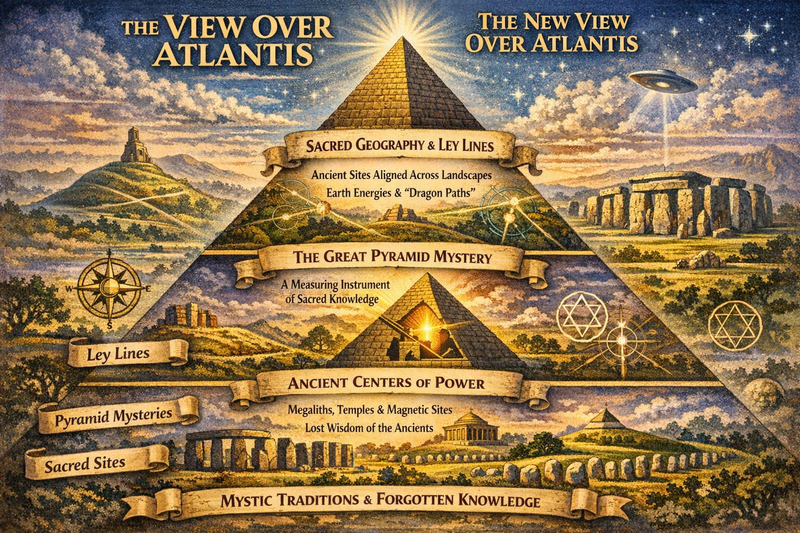
Investigation: John Michell — The View Over Atlantis / The New View Over Atlantis
Chapter-by-chapter summaries: view-over-atlantis-michell-chapter-summaries.md
Local source mirror: ~/dev/wget/michell/ (PDFs, pdftotext extracts, INDEX.md). Not served as site assets; investigations in this repo are the reader-facing notes.
Local files (completeness)
| File | Role |
the view over atlantis -- john michell -- 1972 -- garnstone press…pdf | Complete scan, 292 pages (Internet Archive; imprint in scan is Ballantine, Nov. 1972). |
The new view over Atlantis … 1995 … Thames and Hudson…pdf | Complete scan, 228 pages — US 1995 printing of the 1983 revised edition (The New View Over Atlantis). |
The View Over Atlantis (Incomplete) … Anna’s Archive.rtf | Incomplete: Abacus imprint pages / contents stub only (~162 KB), not a full book. Duplicates removed from Downloads after consolidation. |
Ley lines — what Michell describes (and assumes)
Michell does not invent the term from scratch: he builds on Alfred Watkins of Hereford, who in the early 20th century publicized alignments of ancient sites along what Watkins called the “old straight track”—a pattern of markers (mounds, stones, moats, beacon hills, older churches, sometimes natural features) falling on straight sight-lines across the map. Watkins’s own emphasis included practical readings (e.g. trade or survey routes); Michell and the 1970s–80s “ley hunter” milieu lean harder toward sacred geography and subtle forces.
What a “ley” is in this book (working definition): a deliberate alignment—not necessarily a visible line on the ground today—linking prehistoric sanctuaries and later structures that preserve the same geometry. Evidence is largely map work + field correlation: repeated collinearities, reinforced by aerial photography (crop marks, parch marks) showing long straight boundaries and prehistoric ditches that track for miles. Michell argues that the sheer scale and regularity of these patterns points away from accident and toward a lost system of siting.
Part One (The Lines) in brief:
- Chapter 1 — The Old Straight Track: Narrative hook from Aubrey and Stukeley at Avebury; then Watkins, aerial evidence, and the claim that antiquities were placed within a “mysterious pattern in the landscape”—a former geographical order whose rules are not those of modern academic settlement models. Stukeley’s serpent-through-circle reading at Avebury is used to tie British field monuments to alchemical symbolism (a theme carried into Part Two).
- Chapter 2 — Paths of the Dragon: Comparative geomancy—especially Chinese siting language (dragon pulse, auspicious hills and water) as an explicit analogue to European leys: different vocabulary, similar claim that terrain was read and sometimes reshaped for cosmic–magical ends.
- Chapter 3 — The Serpent Power: Widest aperture: a global picture (diffusionist writers such as W.J. Perry appear) of megaliths, pyramids, cursuses, and alignments as fragments of one interlinked network of tracks and monuments—“spiritual engineering” at continental scale rather than isolated “hillforts.”
Purpose of the system (Michell’s own uncertainty is explicit): In the 1983/1995 preface he writes that the function of leys remains “the deepest of ancient mysteries,” but reports a working consensus among ley researchers of his day: alignments belonged to an older mystical science that assumed energy streams across the earth and their role in renewing life. He casts that science as numerically expressed, closer to ritual magic and alchemy than to modern lab physics, and uses an alchemical image: the earth as retort where solar/cosmic “sulphur” meets terrestrial “mercury”—producing elemental energies on which a prehistoric civilization supposedly depended. That is explicitly analogical language, not an instrumented model.
Modern sources he names (meme pipeline, not endorsement): Watkins’s The Old Straight Track and The Ley Hunter’s Manual; Paul Devereux and Ian Thomson (The Ley Hunter’s Companion); Tom Graves (Needles of Stone, dowsing angle); Devereux’s Earth Lights (instrumental anomalies at ley sites); Tony Morrison (Pathways to the Gods) for South American alignments parallel to British ones; revival of Ley Hunter magazine (Paul Screeton). These citations matter for tracing who influenced whom in the earth mysteries subculture.
What leys are not in Michell (unless the reader imports them): He does not offer replicable geophysical proof that named lines carry a single measurable “energy” distinct from geology, hydrology, and human route choice. Academic archaeology has often explained many collinearities as post hoc pattern-seeking or multi-cause settlement history. The investigation records Michell’s claims as claims, for use alongside the timeline’s different mechanism and chronology.
How this fits (and does not fit) the Paradigm Threat timeline
Overlap — useful as meme lineage and thematic rhyme:
- Ley lines / aligned sanctuaries: See § Ley lines above. The timeline’s nodes, great-circle / portal language, and pyramids-on-leys thesis echo Michell’s alignment–sanctuary picture at the level of story shape; they do not adopt his Watkins-revival + telluric-alchemical mechanism as stated. Use Michell as cultural precedent and bibliographic lineage, not as independent confirmation of Birkeland–ionosphere coupling or BCE Dark Ages dating.
- Great Pyramid as instrument, not mere tomb: Part Two (1972) and Part Two (1983) both treat the Pyramid as a measuring engine and symbolic–numerical keystone; Part Three / ch. 7 adds Brunton-style initiatory experience inside the mass—the same second-hand thread the Kerrell/Goggin investigation cites. That rhymes with habitability / continuity-of-use readings without equating Michell’s gematria to the site’s Dark-Ages chronology.
- “Centres” of power: The closing Sacred Engineering material (Carnac, Tara, Chartres, Pyramid as magnetic focus) is broadly compatible with “pyramids and major sites as civilizational anchors” as a metaphor—again, not independent dating evidence.
Tension — do not merge blindly:
- Chronology: Michell assumes conventional pharaonic and megalithic timelines; the timeline’s Fomenko / BCE Dark Ages dating is orthogonal. Cite Michell for design intent and landscape logic, not for who built what when.
- Mechanism: Michell’s “dragon force,” Reich, von Reichenbach, and gematria are not the same as cathodic grounding at ley portals in plasma weather. Parallel narratives, not one unified theory.
- Scope: The book is UK–centric with Egyptian and Chinese excursuses; the timeline’s Pyramidal Empire and Exodus arcs need other sources.
Practical use on-site: Keep Michell in the same evidence class as Kerrell & Goggin’s bibliography nod: period secondary / revival-era synthesis that preserves Brunton–Pyramid and ley memes the timeline reinterprets. Link related timeline entries: Pyramids: Myths vs Reality, Dark Ages BCE, Pyramid energy — Kerrell & Goggin (1977).
Share