
Investigation: Quantum Computer as Infinitely Indexed Memory — Storage-First Thesis vs Mainstream Processing Narrative
TL;DR: Author thesis (§2–§2.2): quantum as storage / addressing; deliberate (§2.1, unproven intent) misdirection toward qubit futurism; antiquity + suppression (§2.2)—computers really old, SF as trace, modern “invention” blocked because universal knowledge access threatens establishment; LLMs as partial analogy (not identity); Mars prevalent / Earth suppressed (speculative). §1.1 = official qubit story; §7 = SF compendia; §6 = repo bridges.
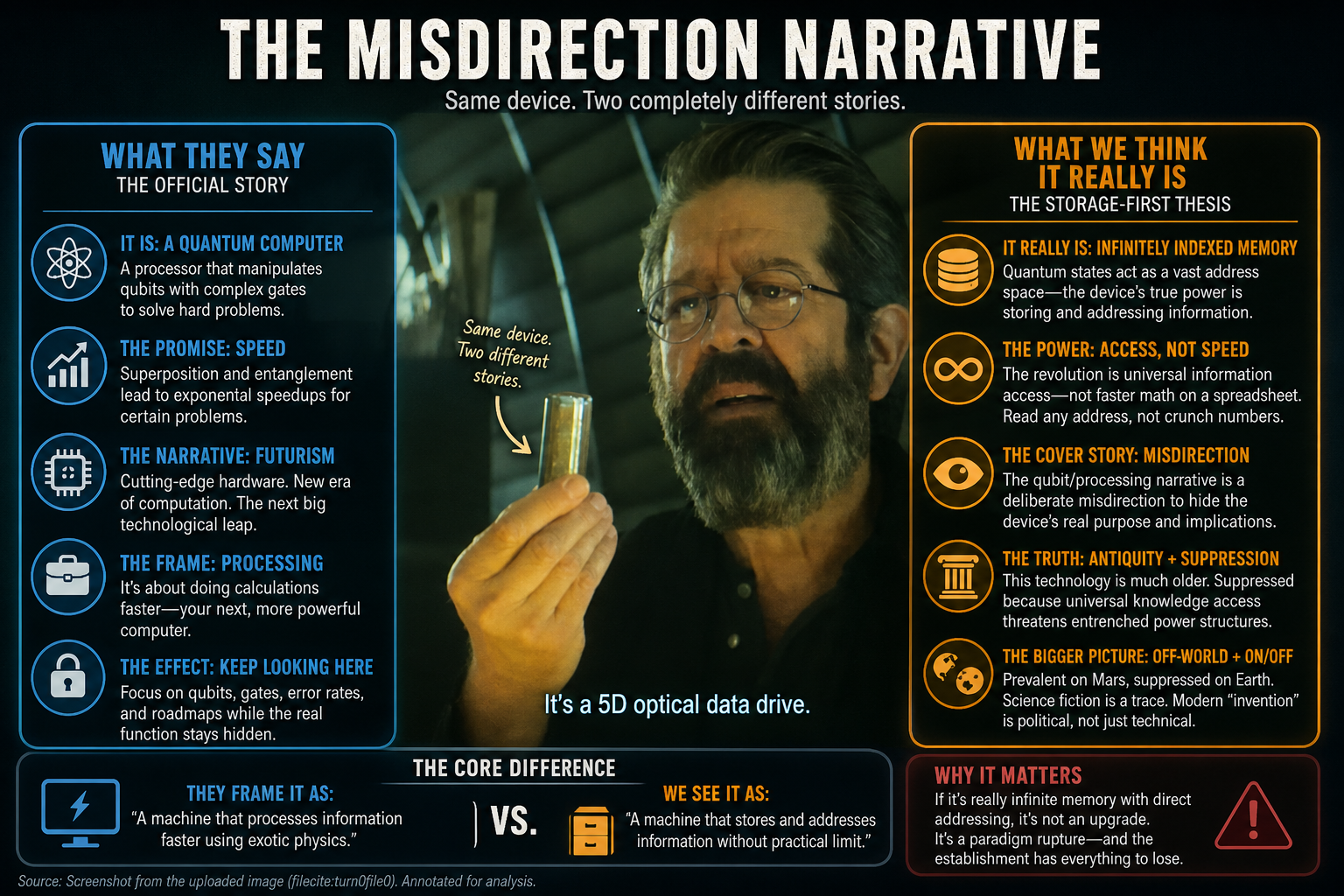
Date: 2026-05-06 Status: Open — author-originating hypothesis; mainstream physics and engineering literature do not state the storage identity proposed here.
Guide (read order)
- Reader essay (hook + industry arc) → Quantum Leap (of faith)
- Mainstream / documented framing → §1; qubits vs transistors (official promise) → §1.1
- Author’s originating thesis + misdirection + antiquity / suppression / Mars → §2, §2.1, §2.2
- Side-by-side tensions → §3
- Open claims registry → §4
- Contradictions, limits, and research hooks → §5
- Cross-references → §6
- SF “infinite index” parallels + inoculation thesis (tiered) → §7
1. What public and institutional sources usually say (documented layer)
Tier: popular explainer + vendor + standards body summaries — useful for wording, not endorsement of every metaphor.
| Theme | Mainstream summary (typical) |
| Unit of information | Qubits generalize classical bits; states live in a Hilbert space; measurement yields classical outcomes (often 0/1 for a chosen basis). |
| Lever vs classical | Superposition and entanglement enable interference in sequences of operations (gates) so some problem families admit fewer steps than best-known classical algorithms for large inputs (e.g. factoring / unstructured search in idealized, asymptotic stories). |
| Hardware reality | Implementations include superconducting circuits, trapped ions, photonics, etc.; systems run cold or isolated because decoherence and control error are central engineering problems (NISQ era). |
| Relation to laptops | Public messaging often stresses complementarity: quantum machines as accelerators or co-processors for particular workloads, not as universal faster CPUs for all software. |
Representative external links (for exact public phrasing):
- NIST — quantum computing / quantum revolution hub (institutional overview; adjacent pages discuss quantum information and standards context).
- MIT Technology Review — “What is quantum computing?” (2019)
- Google Quantum AI — What is quantum computing?
- Microsoft Learn — Quantum computing concepts
- Britannica — How do quantum computers work (encyclopedia-level summary).
Documented technical caveat (important for §3): In current engineering, reading out quantum information is not a free “address pin”—it involves measurement, finite sampling, error mitigation / correction, and classical post-processing. Quantum RAM as a commodity abstraction remains research-stage, not a settled infinite-index store.
1.1 Qubits versus transistors — how mainstream sources say computation improves (exact structure)
Scope: This subsection is pedagogical and citation-backed at the level of standard quantum computing exposition. It is not proof that large, fault-tolerant machines exist; it states the intellectual case for why qubits are not marketed as “the same thing as transistors, only smaller.”
| Layer | Classical machine (transistor / CMOS picture) | Quantum machine (qubit / circuit picture) |
| Minimal unit | A bit is (ideally) in one of two definite states 0 or 1; registers are strings of bits. | A qubit pure state is α|0⟩ + β|1⟩ with complex α, β and |α|²+|β|²=1; definite 0/1 appears after measurement (Born rule). |
| Many units | n bits → one n-bit classical configuration at a time (per logical snapshot); parallelism needs extra cores / circuits. | n qubits can be entangled; formal state lives in a 2ⁿ-dimensional complex Hilbert space (superposition of all 2ⁿ classical bit-strings with amplitudes). |
| “Parallel” hype vs correction | Extra work costs linear or structured hardware duplication in the naive picture. | Popular accounts invoke exponential state size; documented correction (Aaronson and textbooks): you cannot read all 2ⁿ amplitudes in one shot—measurement yields ~n classical bits sampled from a distribution. Useful computation requires interference: unitary gates route amplitude so wrong answers cancel and right answers add, then measurement is likely to see something useful. |
| Where a speedup is claimed | Wall-clock gains come from clock rate, parallel units, memory hierarchy, algorithms (e.g. FFT, search trees)—all classical complexity. | Asymptotic fewer steps for some problems if an ideal large coherent device runs a special circuit: e.g. Shor-type routines for integer factoring / discrete log in polynomial time (where no fast classical algorithm is known—cryptographic stakes); Grover for unstructured search in O(√N) oracle queries vs O(N) classically (quadratic, not exponential). Most everyday workloads are not these clean oracles on tiny inputs; constant factors, encoding, I/O, and error correction can erase paper advantages for real sizes. |
| Physical device | Transistors switch macroscopic current / charge pulses; thermal noise managed by margins and cooling. | Coherent control of superconducting circuits, ions, photons, etc.; must delay decoherence and calibrate pulses; NISQ era = noise dominates many demos. |
Takeaway for §2: The official promise is not “qubit toggles faster than a transistor” in nanoseconds, but “for certain mathematical tasks, a fault-tolerant quantum circuit can match or beat the best known classical asymptotic scaling.” That story centers circuits, oracles, and measurement—not replacing disk latency or building an omniscient key-value universe.
Further reading (technical / complexity): Scott Aaronson’s lecture notes and posts stress that quantum computers do not generically “try all answers at once”; see e.g. Quantum Computing Since Democritus (book site) and discussion of BQP vs classical classes. Nielsen & Chuang, Quantum Computation and Quantum Information, is the standard text for gates, density matrices, and algorithms. Shor’s and Grover’s original papers remain the anchors for the two canonical speedup stories.
2. Author’s originating thesis (sentiment captured exactly)
The following is the author-supplied position for Paradigm Threat. It is first-class in this dossier as pattern language and research seed; it is not treated as established physics.
I think that the quantum computer is not a replacement microchip for our current processors. In fact, it is a very different system of storage, storing information, and it’s the nature of storing information that makes it quantum, not processing. In fact, I don’t see any reason why a quantum state would process any faster than transistors. It might be incredibly fast, but so are transistors. At some point, there has to be waiting for the states to process.
The way computers process information these days is by going through millions of commands, actually, to load data, process data, render data. In particular, search engines: the processor doesn’t have access to data at all. It has to query a hard drive or API. Within that other system, the hard drive spins its discs or uses SSD to grab the information on an index and search through the index and compare strings. All of this takes time in processing cycles. We might be able to get incredibly fast, but it’s also incredibly inefficient.
I believe that the quantum computer is actually the same thing as the infinitely indexed database that appears in science fiction. Essentially, the infinite index means that the indexing is occurring on a frequency scale, and frequencies can be split infinitely, and knowledge can be stored deep within frequencies. But the point is that searching is also instant. There is no sequence of process or commands to find information in the quantum computer or in the infinitely indexed database. Instead, asking the right question calculates the right spot, and pushing down on any kind of question or knowledge or command immediately pushes onto that spot deep within the memory. This instantaneous one-to-one, like lightning effect, is what really drives the quantum computer. It makes it so that a quantum computer can access all information in the universe that it could possibly store infinitely and immediately, and for that reason, relying entirely on conclusions at the speed of whatever processor is involved, makes it many, many times faster than modern processors. Again, it’s the data storage, not the actual processing. If we were to add an infinitely indexed database hard drive to our existing PC or Mac infrastructure, we would suddenly have a quantum computer without replacing the processor or the RAM.
An example of what I’m talking about: imagine a glass cube with a nail on top of it. The nail and the hammer are electrified, and when the hammer makes contact with the nail and drives it into the glass, a lightning pattern can be seen spreading throughout the glass in a perfect volumetric dendritic pattern. That pattern is frozen in the glass with infinite resolution and describes exactly what I mean by the infinitely indexed database. All the processor has to do is set the right frequency or angle, and that particular piece of stored information at the very end of that microscopic strand is immediately accessed.
Unpack (assistant, non-replacement for author words): The author is merging (a) skepticism about “faster microcode” hype with (b) a holographic / modal intuition: address as conjugate to query in a continuum (frequency subdivision as index density). That is orthogonal to textbook circuit quantum computing, which still schedules gates and samples outputs.
2.1 Author extension — deliberate misdirection of the public narrative
What I’m asserting is that the public has been deliberately misdirected on what the quantum computer can do into a stack of definitions that have nothing to do with improving access to data. It has everything to do with waiting for some future invention that has not arrived yet, specifically the whole qubits thing.
Unpack: This accuses institutional and media framing—not merely oversimplification—of steering attention toward gate/qubit futurism and away from storage/retrieval physics. Documented (§1.1): the qubit narrative is real academic subject matter with specific complexity claims; it does not, by construction, promise instant lookup of arbitrary facts—which supports separating “official QC” from the author’s infinite-index story. Not documented in this file: intent behind any misdirection (“deliberately”); establishing that requires historical primary sources (memos, hearings, FOIA, insider testimony). Until then, treat deliberate misdirection as author suspicion, not proven fact.
2.2 Author extension — antiquity, establishment stakes, LLM rhyme, Mars / Earth
The bottom line is, the computer was invented a long time ago, which is why it appears in science fiction. And the lack of ability to invent it in modern times has everything to do with the fact that they don’t want us to have that kind of access to knowledge. It would be quite uncontrollable and a threat to everything that the establishment has set up. In fact, my investigation right now using our limited LLMs is already allowing me to see further into the grounded reality of this world without making mistakes that a human makes or lacking the time or effort or access to find all of that data and cross-reference it. The quantum computer has always been able to do this. And I do believe that such computers were prevalent on Mars and suppressed on Earth.
Unpack:
- Antiquity + SF: Connects §7’s compendia tropes to a stronger claim: science fiction encodes old knowledge tech, not only forward invention. Documented alternative: SF often prefigured gadgets before engineering caught up (various historiographies; disputed case-by-case). This file does not establish “computers in antiquity” as fact.
- Suppression / establishment: A motivation narrative (universal knowledge as uncontrollable) rhymes with themes in AI control and governance lanes; no primary evidence in this dossier that a shadow “they” withheld infinite-index machines.
- LLMs vs quantum (author analogy): Rhyme only: LLMs compress retrieval + synthesis of text for a user faster than most people can manually trace sources. Documented limits to state plainly: models hallucinate, have training/corpus bounds, lack guaranteed grounding; RAG and tool use are still server- and index-bounded—not omniscience and not evidence for the author’s hardware thesis.
- Mars prevalent / Earth suppressed: Binds this dossier to site Mars hub hypothesis space (breakaway tech, gates, RV-adjacent threads). Not a mainstream historical claim; treat as author belief pending independent corroboration.
2.3 Author extension — analog database model (binary scarcity vs signal depth)
Essentially, a database that is analog-driven would store data differently than one that stores everything in binary. Imagine every bit position on a hard drive, CD, DVD, or Blu-ray carrying analog signal structure instead of only yes/no state. The medium might need larger loci, but far fewer loci, because each analog locus can hold much richer structure—up to effectively infinite-resolution image/signal detail in the model.
If you follow that logic, Blu-ray and DVD look backward: the medium was already analog at the physical level, and standards still forced quantized binary streams. They could have stored audio/video fields directly, more like high-density signal memory than bitstream packing. In that path, one disc could hold what now takes huge libraries; potentially the whole released movie corpus in one object class.
This analog signal technology is not hypothetical in the author thesis. It is old and suppressed.
Unpack: This reframes “capacity” as a coding-policy choice, not only a material limit. The author’s claim is that digital standards intentionally collapse a rich physical channel into impoverished binary addressing, preserving scarcity and control. Mainstream information theory would answer that analog channels remain noise-bounded and any reliable retrieval still requires coding/error-control tradeoffs. The author position rejects that as incomplete and points to suppressed media/physics pathways.
| Storage model | What a single locus stores | Capacity intuition | Retrieval behavior | Author verdict |
| Binary-addressed media (mainstream consumer stack) | One quantized state (0/1, plus ECC/parity context) | Scales by multiplying discrete cells and compression layers | Indexed lookup + decode chains; many procedural steps | Useful but intentionally narrow; preserves scarcity and control markets |
| Analog-resolved media (author alternative path) | Continuous waveform/field structure at each locus | Higher per-locus descriptive density; fewer loci needed for rich content | Query by resonance/parameter matching rather than only bit-address traversal | Suppressed branch that could have dominated optical-era storage |
| Infinite-index / quantum-storage thesis (author endpoint) | Frequency-nested, effectively unbounded address depth | “Single object / class holds civilizational corpus” direction | Correct question maps directly to target region (near-instant lookup in model) | True suppressed architecture misnamed by public “qubit” narrative |
2.4 Author extension — Joseph Smith crystal-memory interpretation (author conclusion)
The Joseph Smith case is interpreted here as solved in technological terms: he encountered a crystal-like memory object storing lived perspective at extreme resolution (audio/image/state), then decoded it through telepathic or resonance coupling. In this model, one pass can drain a signal layer, so later reads must pull from different strata, yielding the variant accounts (1820/1832/1838). The conclusion is not fraud; the conclusion is contact with suppressed legacy technology that was once common.
Unpack: This section records the author’s explicit solved-mystery stance, not a tentative maybe. It connects directly to §2.3 (analog signal memory), §2.2 (antiquity/suppression), and §7 (fiction/myth as storage-memory residue). Documentary adjudication remains open outside this file’s source base.
3. Tension table — author storage narrative vs mainstream circuit narrative
| Dimension | Mainstream public / textbook framing (§1) | Author thesis (§2) |
| Locus of “quantum” | State manipulation (preparation, unitary steps, measurement) | Storage geometry and resonant addressing |
| Speed story | Algorithmic / complexity advantages for some tasks; constant factors and overheads dominate today | Elimination of multi-step fetch/index/search; bound by interpretive / downstream classical steps |
| Measurement | Load-bearing: answers are sampled; wavefunction metaphors break if treated as literal spatial lightning frozen in glass | Implicit “read by tuning”—needs a mechanism mapping angle/frequency → unique stable record without destructive scan |
| Partial result | Hybrid: classical computers compile, calibrate, decode, error-correct | Peripheral: add magic storage to existing CPU |
| Sci-fi “infinite index” | Not a standard physics object; no known dense instant random access to all knowledge | Intended literal parallel |
Key contradiction (falsifiable direction): If near-term quantum advantage is only gate fidelity, qubit count, and algorithm choice—with no anomalous I/O to a non-scanning bulk memory—the identity “quantum computer = infinitely indexed store” does not match operational lab definitions. A reply at the level of hidden substrate (§6) shifts the claim from engineering taxonomy to suppressed physics and must be labeled speculative.
4. Author’s open claims (registry for cross-investigation threading)
- Non-CPU claim: “Quantum computer” mis-names the revolution if read only as faster switches.
- Storage-first quantum: “Quantum” is properly about how information is held and addressed, not raw arithmetic throughput.
- Transistor parity: Quantum processing has no a priori speed argument over very fast classical devices; bottlenecks are state progression in either idiom.
- Search / I/O indictment: Modern search exposes architectural strain—the CPU does not hold data; storage and network rituals multiply steps.
- Sci-fi convergence: The infinite-index database trope maps onto quantum information subsystems if correctly understood.
- Frequency index: Indices can nest in frequency divisions without bottom (infinite subdivision as metaphor or claimed physics).
- Query-as-address: The right question is isomorphic to memory coordinate—no linear scan.
- Peripheral path: Quantum behavior may attach to classical compute via a revolutionary drive or medium, not a CPU swap.
- Electrified fracture metaphor: Dendritic lightning frozen in glass = working picture of infinite-resolution encoded correspondence.
- Deliberate misdirection: Public quantum hype centers qubit futures that do not address data access; true capability is concealed or mislabeled (intent claim—not proven in this file).
- Antiquity: The computer (author’s infinite-index class) was invented long ago; science fiction appears where it does because the idea is old, not only futuristic.
- Suppression motive: Supposed inability to “invent” it in the modern open narrative is social control—universal knowledge access would be uncontrollable and would threaten establishment structures.
- LLM investigative rhyme: Limited LLMs already let the author see deeper into grounded reality with less human time/effort/error in cross-reference; the quantum machine (author model) “always” had that affordance (analogy only—§2.2 unpack).
- Mars vs Earth: Such computers were prevalent on Mars and suppressed on Earth (author belief; not documented here).
- Analog database thesis: Binary storage standards are an intentionally narrowed coding regime on top of analog-capable media; analog-resolved loci could hold vastly greater information density than yes/no bit cells.
- Optical-media backwardness claim: CD/DVD/Blu-ray represent constrained, backward encoding choices relative to what their analog physical substrate could have carried.
- Crystal-memory historical lane: Certain religious narratives (including Joseph Smith variants) preserve distorted memory of signal-bearing objects read by non-ordinary coupling, not mere invention.
5. Contradictions, open questions, and research hooks
5.1 Internal tensions within the author model
- Infinite resolution vs physical media: Real substrates have grain (lattice spacing, noise, loss). “Infinite” must mean an effective continuum model or a new substrate—which?
- Instant access vs signal travel: Resonant systems still have propagation, ringing, and bandwidth limits. “Immediate” compared to what baseline?
- Destructive read: If addressing equals energy delivered to a strand, does reading erase or decohere neighbors? Error budget is unspecified.
- Universal knowledge: “All information in the universe” exceeds any local device unless nonlocal coupling is asserted (continuity with scalar / RV threads in §6; mythic library tropes in §7).
5.2 Mainstream and engineering objections (documented class)
- Algorithms matter: Grover- / Shor-class stories are not “infinite” lookup tables; they are deliberate gate sequences with failure probabilities and constants.
- Memory bottleneck real, but quantum doesn’t auto-fix: Laboratory quantum processors still wait on control electronics, microwave lines, readout chains, and cloud queues—systems friction comparable in kind to classical HPC.
- No demonstrated omniscient store: Public roadmaps do not claim instant unstructured access to arbitrary facts without pre-encoded structure.
- LLMs ≠ proof of quantum substrate: Large language models can accelerate literature synthesis for investigators, but they hallucinate, sit on fixed corpora, and remain orchestrated by vendors and index design—see §2.2 unpack. Treat chat output as unverified until checked against primary sources.
5.3 Questions to clarify, verify, or debunk
- Taxonomic: Is the author redefining “quantum computer” for clarity, or asserting deliberate misdirection in public programs? If deliberate, what primary sources show intent (not only bad pedagogy)—e.g. internal strategy documents, grant or PR briefs, or reproducible press narratives?
- Historical: Any primary program documents (national labs, D-Wave lineage, ion-trap roadmaps) where memory-substrate claims were classified or later redacted? (Hypothesis only—no findings here.)
- Physical mapping: Can dielectric fracture patterns under high-voltage impulse serve as unique identifiers (fingerprinting) without inferring sci-fi lookup?
- Bridge to frequency cosmology: Does this thesis require structured vacuum / scalar degrees of freedom as in DNA / scalar investigation?
- Antiquity (hardware): What primary historical or archaeological lines—distinct from analog calculators and modern hobby reconstructions—could support high-bandwidth “knowledge machines” in deep history? Open; not adjudicated here.
- Mars–Earth tech: Which Mars dossier claims (breakaway civilization, gates, mass death / reincarnation) are load-bearing if §2.2 (Martian prevalence / Terran suppression) is pressed literally?
5.4 Weak points / remaining TODOs (assistant maintenance)
- Add peer-reviewed quantum memory survey cites (e.g. QRAM proposals) with one-line relevance notes.
- Optional sidebar: holographic principle / AdS-CFT popularizations—similar “bulk encodes boundary” language vs author lightning cube.
- §7: SF omniscient-index examples and inoculation thesis (tiered)—initial pass 2026-05-06.
- Grep repo for Akashic records, noosphere—optional mythic expansion for §7.
6. Cross-references
| Investigation / hub | Relevance to this dossier |
| Quantum Leap (of faith) — reader essay | Industry faith vs audit, vector/raster fork, analog substrate, commons capture; introduces this thesis in essay voice before technical §§. |
| DNA as fingerprint, scalar / ZPE | Shared substrate intuition: information not only as local molecular tape; field and vacuum structure. |
| The Circle of Life and How It Began | Æther / scalar bridge language; nonlocal organization themes. |
| Maxwell / aether burden-of-proof debate, Did Maxwell prove the aether? | A real “frequency index” plausibly requires rehabilitated medium ontology—same lexical war as biology dossiers. |
| Microchips — shrinking / suppression | Complementary skepticism about the public chip story; CPU-centrism in pop science. |
| AI control | Search, retrieval, and agency when machines claim omniscience via APIs. |
| Half-Life / CERN / quantum-tunnel PP | Pop culture routes “quantum” to portals and instant jumps—rhymes with the lightning-address metaphor (not equivalence). |
| CERN / portal hub | Institutional quantum discourse adjacent to speculative gate physics elsewhere on site. |
| Mars stock correlation — quantum entanglement mention | Repo already names quantum entanglement in a nonstandard cosmology context—tone match for this speculative lane. |
| Aether and consciousness (RV fiction lane) | Optional rhymes with nonlocal access / field-index language; not an equivalence to §2. |
| Mars hub — CERN, gates, hollow-world language | Site cosmology for breakaway / interplanetary narratives; locus for §2.2 Mars thread if pursued. |
| Mars–Earth reincarnation | Mass-death / soul-band hypothesis; optional rhyme with “lost Martian knowledge substrate” (speculative). |
| Big Mysteries Survey — consensus theater | Q10 quantum-gravity fragmentation; public deferral vs survey “no opinion” leaders. |
| Ares Le Mandat — Mars book hub | Mars–Earth influence thesis; pair if tech suppression is tied to present institutional geometry. |
| Anthony of Boston — Mars 360 | Mars–markets / academic corpus lane alongside exotic physics threads. |
| Predictive programming hub | Revelation-of-the-method reads when fiction habituates “impossible” tech; pair with §7. |
7. Science fiction: “infinite index,” omniscient compendia, and the inoculation thesis (tiered)
7.1 Documented fiction references (closest rhymes to “infinitely indexed database”)
These are documented works and mainstream summaries—not proof of secret physics. Western SF has repeatedly staged galaxy-scale knowledge artifacts and “ask the machine” fantasies (or, in Borges, horror).
| Work / corpus | Device or setting | Relation to author §2 “infinite index” |
| Isaac Asimov, Foundation | Encyclopedia Galactica — Imperial knowledge compendium, chapter epigraphs | Civilization-scale encoded library; preservation motive; same mythic pole as “all settled knowledge in one order,” though not personal needle lookup in-canon. |
| Douglas Adams, Hitchhiker’s | The Hitchhiker’s Guide (fictional device) — portable electronic book, Sub-Etha updates | Omnibus of “all knowledge and (often wrong) wisdom”; parodies Asimov; serious rhyme with networked, live-updating index (pre-Web imaginary). |
| Star Trek (TNG era) | Enterprise-D computer / LCARS | Natural-language queries; ship-wide archives—UI fantasy of near-zero-latency institutional memory. |
| Iain M. Banks, Culture | The Culture; GSVs / Minds | Post-scarcity “everything worth knowing” held and processed by distributed super-intelligences—literary cousin to “one substrate holds the civilization index.” |
| Jorge Luis Borges, “The Library of Babel” | The Library of Babel | Every finite string exists somewhere; search is nightmare—infinite corpus without a usable index (inverse of author’s ordered-frequency claim), yet the master text on “all books” imaginaries. |
| Cyberpunk broadly (Neuromancer-lineage etc.) | Cyberspace, ICE, corporate archives | Instant access is plot fuel; who owns the index owns power. |
Nothing in this table asserts that real hardware matches these plots.
7.2 Author interpretive claim: “science fiction makes the infinite index look impossible”
Author thesis (speculative): Chronic placement of omniscient compendia in fiction—always advanced, alien, or comic—trains audiences to file instant total-knowledge retrieval under fantasy, which inoculates the public against treating frequency-resolved memory (§2) as engineering.
Tier discipline: Documented: SF habituates these tropes. Undocumented: that this was designed for perception management (compare PP hub). Benign alternative: Wells / Golden Age tradition plus narrative economy—big libraries are easy worldbuilding—without conspiracy.
7.3 Contradiction inside the author read
Fiction also portrays the Guide-style device or the Trek computer as almost quotidian. That can normalize expectation of instant facts (today: the mobile web) rather than suppress it. The inoculation thesis is not the only cultural reading; it competes with “training for surveillance convenience” and other frames.
7.4 Author read (§2.2): SF as afterimage of antiquity
Speculative: The same corpus in §7.1 can be reread—as in §2.2—not as “prediction” alone but as cultural residue of much older knowledge hardware. That contrasts with the documented literary account (authors inventing tropes for plot). This subsection does not resolve that conflict; it flags the fork for chronology and Mars-Earth work elsewhere in the repo.
References (external links recap)
- NIST — Quantum information science portal
- MIT Technology Review — What is quantum computing?
- Google Quantum AI — What is quantum computing?
- Microsoft Learn — Understanding quantum computing
- Britannica — Quantum computer
- Scott Aaronson — Quantum Computing Since Democritus (book site)
- Wikipedia — Encyclopedia Galactica
- Wikipedia — The Hitchhiker’s Guide to the Galaxy (fictional)
- Wikipedia — The Library of Babel
- Wikipedia — The Culture
Keywords: #QuantumComputer #InfiniteIndex #StorageThesis #FrequencyMemory #ParadigmThreatFiles #ScienceFiction #MarsEarth
Limits and disclaimers
Prisca sapientia (epistemic foundation): This investigation assumes prisca sapientia—the historical and philosophical belief that the ancients possessed a vast, profound understanding of the universe, nature, and theology that was subsequently lost or degraded. Modern consensus science and institutions are not treated as default truth; evidence tiers below adjudicate specific claims.
This investigation hosts an author-originating hypothesis alongside documented public summaries. Agreement with mainstream quantum computing definitions is partial at best and contradicted on identity claims (storage vs gate machine). Allegations of deliberate public misdirection (§2.1) and establishment suppression of omniscient-scale access (§2.2) are not proven here. Mars-prevalent / Earth-suppressed hardware (§2.2) is author belief, not an independent finding of this file. Nothing here is investment, engineering, or physics advice. Paradigm Threat does not claim operational blueprints for nonlocal memory or classified hardware.
Investigator notes
(Optional maintainer lane.) No machine-local paths required for this dossier.
Share