

The Exact-Change Wallet
A wallet-sized embedded device — two SKUs: slim coin insert or full slim wallet with card/ID slots
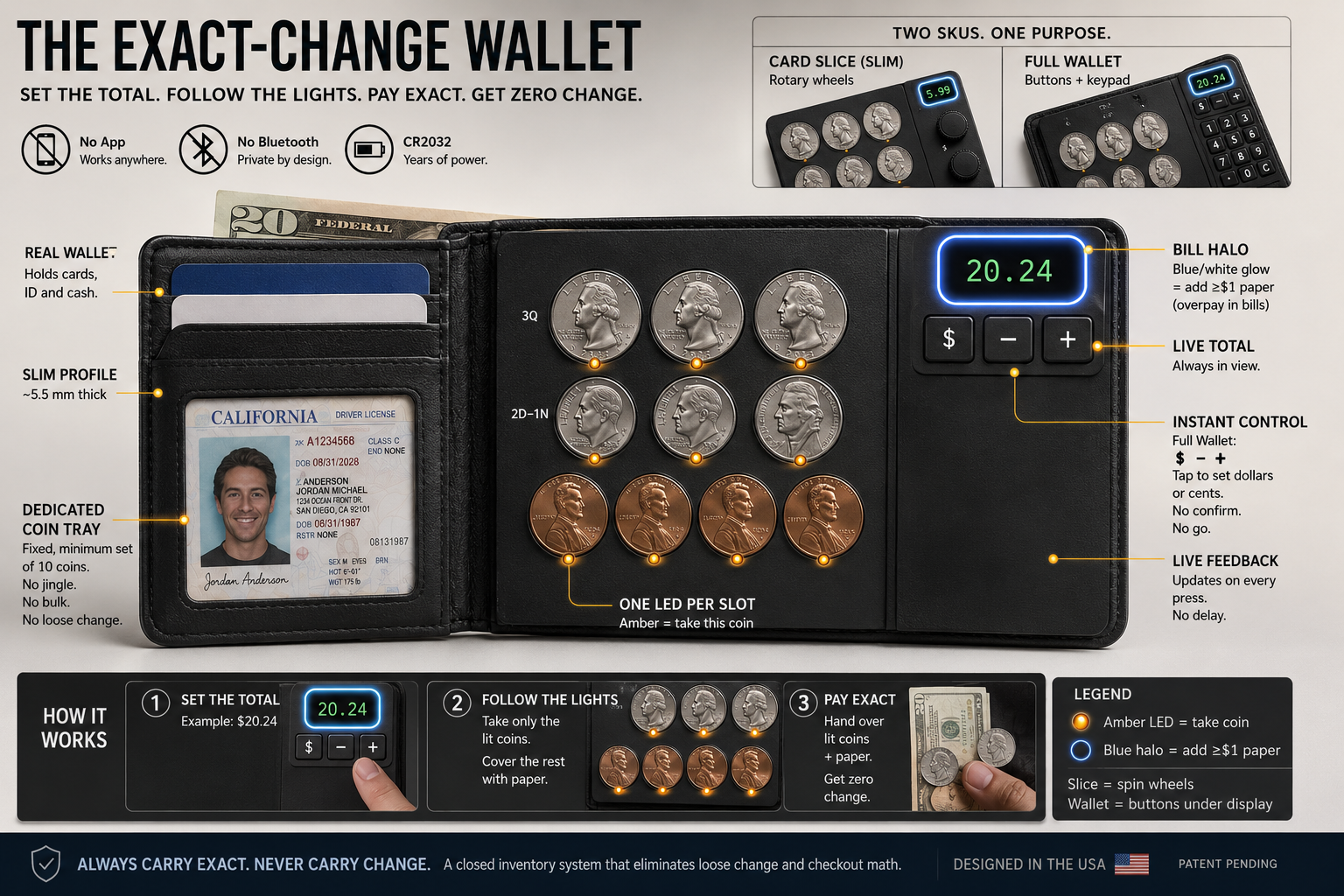
The invention is a wallet-sized embedded device — a small CPU, a coin sensor per slot, one LED per coin slot, a bill halo around the display, a coin-cell or rechargeable power source, and two rotary thumb wheels 0–99 plus a display (Card Slice) or a display-stack with $ / − / + buttons (Full Wallet). You set the register total — 5.99, 20.24 — and the coin and bill LEDs update on every detent or press. No confirm step, no app, no touchscreen.
Two problems ordinary wallets never solved: coins do not fit in a billfold in any sane way (they bulge, jingle, mix denominations, and turn into lint at the bottom of a pocket), and checkout punishes anyone who cannot do fast mental math under social pressure — subtract the total from your bill, decompose the cents, hunt the right pieces before the line moves. This device sidesteps both. The tray holds a fixed, minimum set of coins in molded slots — ten pieces — so change never becomes a loose pile that outgrows the wallet. The wheels (or buttons) and LEDs do the arithmetic; you do not need to compute 37¢ from $14.37 while someone sighs behind you.
The point is not a calculator novelty. The point is a closed coin inventory: you carry the minimum set of U.S. coins below one dollar that can still cover every cents-only amount you need when dollars are paper, and you never accumulate a second purse of loose change as long as you follow the lights and the cashier gives correct change.
I. What the device does at the register
Picture the usual failure mode. The total is $14.37. You have a twenty and a fist of mystery coins — or no coins, because they never stayed in your wallet anyway. You pay the twenty, get $5.63 back in mixed metal, and dump it in a cup at home because putting it back in your pocket feels worse than the problem you started with. Or you stand there doing $20.00 − $14.37 in your head, miscount by a penny, and still get coin change you did not plan for. The wallet is meant to kill that loop.
Why a normal wallet fails: Bill compartments are sized for paper. Coin pockets — if they exist — become a single lump that does not scale; add more than a few pieces and the fold won’t close, or everything rattles loose when you pull a bill. This design replaces the coin pocket with a dedicated tray: each denomination has a slot, a cap, and a light. You carry only what fits the tray — not “whatever accumulated since last Tuesday.”
Why mental math fails at checkout: The register total is one number; your wallet is another shape entirely (bills plus scattered metal). Bridging them under time pressure is a skill, not a reflex — and card tap exists precisely because most people hate doing it. Here you match what the screen says — spin the dollar and cent wheels on the Card Slice, or tap $ / − / + under the display on the Full Wallet. The device lights the slots immediately — no “enter” or “go.” No subtraction in your head.
Controls (MVP — input differs by SKU, firmware identical):
| Card Slice (slim) | Full Wallet | |
| Input | Two rotary wheels 0–99 on the right edge rail | Display stack top-right of tray: halo → readout → $ − + |
| Integer wheel | Whole dollars 0–99, $1 detents, label $ | $ toggles dollar mode; −/+ in $1 steps |
| Cents wheel | Cents 0–99, 1¢ detents ( 5¢ on dollar SKU ), label ¢ | $ again → cent mode; −/+ in 1¢ steps |
| Bill indicator | Halo ring around display (white/blue glow) | Same halo around display in UI stack |
| Display | 20.24 or live handover 21.14 | Same |
| Live LEDs | Recompute on every wheel detent | Recompute on every button press |
| CLEAR | Spin both wheels to 0 or long-press either wheel | Long-press $ → 0.00, all LEDs off |
| No GO | — | — |
Canonical faceplate art: ecw-design/ SVGs (mm-accurate). Not linear slide switches.
Operating model (pay exact — full inventory): Cover whole dollars with paper. Cover the cents portion with coins from the wallet only. Set 14.37 — spin integer wheel to 14, cent wheel to 37 (Card Slice) or tap to 14.37 (Full Wallet). The coin LEDs light for 37¢ immediately. The bill halo stays off when $14 in ones is enough. You hand $14 in bills plus those coins. Change: zero.
Operating model (pay with short inventory — the bill LED): Coin LEDs alone are misleading when the tray does not hold enough cents to cover the sale’s fractional part. Example: total $20.24, but sensors say you only have 14¢ on hand (a dime and four pennies, or whatever is left after earlier trips). If the device lit only “use these 14¢,” you might think $20 + 14¢ closes the sale — it does not; you still owe 10¢ more in metal or you must overpay in bills and take coin change back.
The firmware solves that case explicitly:
- Read sale total and live inventory (RAM + sensors).
- If inventory can make the cents column exactly, behave as above — coin LEDs only, bill LED off, handover = ⌊total⌋ dollars + lit cents.
- If inventory cannot make the cents column, search for a handover — B whole dollars in paper plus a coin subset S from what you hold — such that change back in coins can refill the tray to the designed vector (3Q/1D/2N/4P or post-penny 3Q/1D/2N) without overflow. Typically that means B > ⌊total⌋ — e.g. pay $21 + 14¢ on a $20.24 tab so change (90¢ in standard coin mix) lands in the slots you emptied.
- Coin LEDs → coins in S (often all cents you have, not “enough to cover 24¢”).
- Bill halo (MVP) → entire ring around the display glows white/blue when you must hand ≥ $1 more paper than ⌊total⌋ — impossible to miss vs a tray-edge dot. Manual: “Halo on = add ≥ $1 beyond the whole-dollar part; read handover on display.”
- Display shows handover (
21.14) live whenever it differs from the dialed total (20.24) — no confirm button.
LED behavior (MVP): While the total is non-zero, coin LEDs and bill halo track every input change — wheel detent (Card Slice) or $/−/+ (Full Wallet) → lights recompute immediately. After you remove coins from lit slots, the map freezes. Any coin inserted → reset: 0.00, all LEDs off, halo off. Idle = no LEDs. Power-on and CLEAR also force idle.
Without the bill halo, the product reads like a coin-only calculator — fine at $5.99 with a full tray, dangerous at $20.24 after a depleted run when the mental step you need is “extra dollar bill,” not “more dimes.”
Operating model (break change back): You paid wrong, or the lane rounded, or you had to take coins back. MVP: after any coin insertion ends the latched spend map (above), you sort change by hand or start a future deposit-map mode — not required for v1. A Plus or v2 firmware could light “put it here” slots on insert without clearing until the tray matches 3Q/1D/2N/4P; v1 keeps the rule simple: coin in → idle $0.
Invariant the design assumes: If you start at or below the designed inventory, you pay with bills for dollars and use the wallet for cents, and the cashier is accurate, you should stay inside the wallet’s coin budget — no second bag, no jar at home, no “I’m always short a dime.” That invariant is what makes the LED map worth more than a phone calculator: the phone can tell you 37¢ but cannot fit the coins or show which slot to open without you translating numbers into metal under stress.
II. Two form factors — slim insert and full wallet
Same coin brain in both: 3Q / 2D / 1N / 4P tray (or post-penny / dollar variants — §Four SKUs), one LED per slot, bill halo around display, edge-mounted MCU + coin cell, no app. UI stays deliberately non-digital — no touchscreen, no Bluetooth. Card Slice = dual rotary wheels; Full Wallet = display-stack buttons (optional 0–9 keypad below).
Shared tray (both SKUs)
Ten coins, 104¢ face (3Q·2D·1N·4P), single flat layer. Nickel thickness (1.95 mm) sets cavity depth; with minimal lips, the coin layer is about 2–2.3 mm. Three tight bands: 3Q | 2D · 1N | 4P (2×2 pennies) — canonical 1-nickel mold; alternate 3Q | 1D · 2N | 4P also valid (§III). ~0.4 mm slot clearance — fingernail in/out, no coin purse slack. Coin LEDs sit at the thumb edge of each pocket; lit = take or place here. Bill halo — white/blue LED ring around the display (not a separate dot on the tray). On = hand ≥ $1 more in paper than ⌊total⌋. Off = whole-dollar part of total is enough with lit cents.
Measured footprint for flat layout: about 79 × 67 mm tray active area — fits credit-card width, not credit-card height (54 mm is too short). Product width should track billfold interior (~100–102 mm), not ISO 85 mm.
A. Minimal Slim (“Card Slice”) — insert
For someone who already owns a wallet and only wants the coin protocol.
What it is: One flat slab — coins on the face, paper money stays in the existing wallet. Slides into a deep card sleeve or rides the bill compartment like a stiff card.
Target dimensions: ~102 × 67 × 5–6 mm closed (not 85 × 54 × 13 — that render was too tall and far too thick). Side profile should sit near ~2× three credit cards stacked (~2.3 mm PVC alone), not 17×.
UI (slim — dual rotary wheels only): Right long edge rail (~18 mm × ~55 mm), beside the coin tray:
- Display (~22 × 8 mm) —
20.24 - Bill halo — LED ring/bezel around display; glows when BILL+ needed
- Integer wheel — knurled rotary, ~12 mm diameter, 0–99, $1 detents,
$label - Cents wheel — same, 0–99, 1¢ detents (5¢ on dollar SKU),
¢label
Not: linear slide switches, toggle sliders, −/+/GO buttons, or keypad on Card Slice.
Mechanical options: detented rotary encoder or indexed pot per wheel; ADC → spend map on every detent (~10 ms debounce). See ecw-design/card-slice-top.svg and card-slice-edge.svg.


Electronics: Flex PCB + CR1220-class cell in the ~1.5 mm edge rail.
CLEAR: spin both wheels to 0 or long-press either wheel.
B. Full Wallet — coin tray + cards + bills
For someone who wants one front-pocket object at checkout.
What it is: Slim bifold or side-fold wallet. One leaf is the exact-change tray (same 10-coin inventory + edge UI). Other leaf carries daily carry: 2–4 card slots (credit/ID), 1 ID window optional, 1 bill pocket (paper dollars for the dollar column of each sale).
Target dimensions: Closed about 102 × 90–100 × 8–10 mm — thicker than the Card Slice because of PVC cards + bills, still slim wallet territory (not a zip pouch). Open: tray face-up.
UI (Full Wallet — display stack, not sliders): Single UI block at top-right of the coin-tray leaf — above the coin rows, not on the wallet hinge or far edge:
$— toggles dollar mode vs cent mode (display marks active field).−/+— directly under the display — $1 or 1¢ steps depending on mode.- Dollar Plus: 3×4 numeric keypad below the three buttons — still on tray rim, not center fold. Still no GO; each press updates LEDs live.
See ecw-design/full-wallet-tray-ui.svg. Same spend-map firmware as Card Slice; only the input driver differs (wheel ADC vs GPIO buttons).

Why two form factors: Card Slice optimizes speed in ~6 mm — thumb-spin wheels. Full Wallet trades thickness for buttons/keypad in the display stack — same coin brain, different input.
What we are not building
Thick clamshell with a keypad deck under the tray (~13 mm). Motorized dispensers. Hopper capacity beyond ten coins. “Credit card sized” in both dimensions with ten flat coins — the math does not close.
The industrial design goal remains one molded tray, one small MCU, light pipes — calculator discipline, not fintech wearable.
Product SKUs — penny era, dollar era, and hybrid

Policy fork (investigation §8–§11): circulating penny minting is halted; legal tender cents linger; post-penny commerce rounds to the nickel in many lanes. Product matrix:
Card Slice · Penny — 3Q / 2D / 1N / 4P (10 coins, 104¢); dual rotary wheels; 1¢ cent-wheel steps.
Card Slice · Dollar — 3Q / 2D / 1N / 1×$1 (7 coins); 5¢ cent-wheel steps; golden-dollar pocket ~26.5 mm.
Full Wallet · Penny — same tray + cards / ID / bills + display-stack $/−/+.
Full Wallet · Dollar Plus — same dollar tray + keypad under buttons — default forward SKU.
Full Wallet · Hybrid Plus (E) — 3Q / 2D / 1N / 4P / 1×$1 (11 coins, 120 mm tray, 204¢ face); keypad under buttons; pennies and golden dollar — wallet-only (slim Card Slice cannot fit all eleven coins; see full-wallet-hybrid.svg).

Faceplate reference: science/computing/ecw-design/.
Marketing (both camps): Phase-out camp — “nickel-exact without mental math.” Keep-penny / prepper camp — “no app, no account, no hack surface” — bearer cash with LED protocol. See investigation §11.3.
III. The lost spreadsheet — minimum coin inventory recovered
I had a mapping of how many of each coin the wallet must ship with so any sale amount (cents portion 1–99) is reachable without exceeding one dollar of metal in the tray. The notes are gone. When I reconstructed the set later, it matched what puzzle writers had already published — see §VII — but the guarantee only becomes a product when the tray, the keypad, and the LEDs enforce it. The math alone does not stop anyone from overpaying with a twenty and taking $4.01 back in quarters.
For standard U.S. circulating coins {25¢, 10¢, 5¢, 1¢}, the smallest coin count that can still make every amount from 1¢ to 99¢ — verified by exhaustive search — is:
3 quarters · 1 dime · 2 nickels · 4 pennies
That is ten coins, exactly 99¢ face value — the densest “under a dollar” purse that remains universal for the cents column when dollars are paper.
An equivalent 99¢ inventory with one extra coin exists (2 quarters · 4 dimes · 1 nickel · 4 pennies — eleven coins). The 3Q / 1D / 2N / 4P layout is the one I would mold: fewer dimes, one more quarter, same coverage, minimum piece count.
Why these numbers? Any cents amount needs at most three quarters (since 4×25 > 99). In optimal change-making across 1–99, you never need more than two dimes, two nickels, or four pennies in a single payment — and four pennies is the hard cap because five pennies should always collapse to a nickel. The 3Q / 1D / 2N / 4P tuple is the tightest multiset that still covers the whole range.
The guarantee (when it holds): Cover whole dollars with bills. Pay the cents column exactly from the tray. If you started with the designed inventory and the cashier is accurate, you receive no coin change — only paper back, or nothing. The exceptions are real: you only have a $20 for a $5.99 tab and skip the lights; a slot is empty; the lane rounds cash differently than you typed; the clerk miscounts. Then you need break-back mode (§I) or you accept coin change and reconcile. The invention is honest about that — it is not magic, it is a protocol that fails gracefully when you break the protocol.
Post-penny note (2025–2026): The U.S. stopped minting pennies for circulation in November 2025; cash totals increasingly round to the nickel. A penny-less tray targets 5¢ granularity — amounts 0, 5, 10, …, 95¢. The parallel minimum there is 3 quarters · 1 dime · 2 nickels (six coins, 95¢ face). That is the successor tray if cents disappear from commerce — and it is exactly the horizon that makes a penny-era wallet feel like a device built for a currency they are retiring. The policy timeline is documented in the companion write-up on physical coin circulation and the cashless transition.
IV. Firmware logic — not “change,” but equilibrium
Phone calculators solve “what is 20.00 − 14.37?” This firmware solves “what coins do I physically move so my wallet returns to a stable state?”
States (MVP):
| State | Display | LEDs | Enter | Exit |
| Idle | 0.00 | All off | Power-on, CLEAR, any coin insert after hold | Wheel detent or $/−/+ |
| Live | Running total or handover | Track every input — update on each wheel detent or button press | First input from idle | Total → 0.00, or coin removed → Hold |
| Hold | Handover frozen | Frozen — stay on if coins removed | First coin removed from a lit slot while Live | Any coin insert → Idle |
Spend map (runs on every Live input — no GO):
- Read current total and live inventory (RAM + sensors).
- If cents column reachable → light coin subset, bill halo off, handover = total.
- Else run overpay solver → light coins in S, bill halo on if B > ⌊total⌋, display handover.
- While Live, repeat steps 1–3 on every input event (wheel detent or button edge).
- On Hold, stop recomputing until coin insert → Idle (
0.00, all LEDs off).
Deposit / break-back (v2 — not MVP): Optional future mode: on insert, light target slots until vector matches 3Q/1D/2N/4P (or post-penny 3Q/1D/2N) without clearing on first coin. v1 defers this to manual sorting after idle reset.
The hard part is not arithmetic. It is state and honest handover: after dozens of trips, drift happens — a kid steals a quarter, you drop a dime in a fountain, a cashier shorted you. The overpay solver must only recommend (B, S) when simulated change back fits the empty slots; if no solution exists (empty tray + only a $100 for a $3.47 tab), display NO FIT and stay latched until CLEAR or coin insert. Without reconciliation when sensors disagree with RAM (full tray rescan on lid close, or a “count mode” long-press), the LED map lies gently until you reset.
I never built the reconciliation spec on paper. I should have. It is the difference between a toy and something you trust on the twentieth grocery run.
V. Why this is hardware, not an app
A phone app can compute change. It cannot hold the coins, feel when you obeyed, or force the closed inventory that makes the system honest. The invention is embodied — the tray is the protocol.
That embodiment also keeps it outside the payment rail. No PCI, no KYC, no “sign in with Google,” no 2.9% + 30¢ on a 37¢ decision. The wallet is a local actuator for legal tender you already own. In a decade pushing toward ledger-first money, that matters: the last anonymous layer of retail was physical coins and bills. This device was a tool to keep that layer usable without carrying a pound of metal.
VII. History and prior art — what existed before this sketch
This section is the honest map: what I did not invent alone, what half-solved the problem, and what still looks unproductized as of the research pass that informed this article.
The minimum set — public math, not a secret theorem
The heart of the guarantee — ten coins cover every cents amount from 1¢ to 99¢; fewer than ten cannot — is a classic puzzle. Bloggers and teachers have packaged it for cash users for almost twenty years.
Patti Ng / Mind Your Decisions (2013) walks through the same logic: carry 4 pennies, 2 nickels, 1 dime, and 3 quarters, pay the fractional part in exact coins, and “never get change back” when purchasing with cash. Hung Truong (2007) describes a greedy algorithm that builds an equivalent ten-coin purse and frames the goal as hating spare change. Math StackExchange (2022) states the problem in nearly the same words as this article — paying the fractional part in exact coins so you do not get coins back from the cashier — and proves a 3Q · 2D · 1N · 4P solution (same ten pieces; one more dime, one fewer nickel than my 3Q / 1D / 2N / 4P mold). Stack Overflow (2010) works the bound the other direction: you need at least four pennies, at least one nickel, at least two dimes, and at least three quarters, hence ten coins minimum.
More recently, Josh Mosier (2024) lists both optimal ten-coin multisets explicitly — Set 1: 3Q / 1D / 2N / 4P at 99¢ (the tray I would ship) and Set 2: 3Q / 2D / 1N / 4P at $1.04 — and built a credit-card-sized physical insert to hold them. That is the closest physical prior art to the minimum-set idea: passive plastic, no electronics, user still picks coins by hand.
Takeaway: I did not discover the theorem. I lost my notes and re-derived a set others had already named. What I still think is mine is treating that set as the entire product boundary — not a tip, not a blog post, not an optional insert — and wiring behavior around it.
Mechanical wallets — organization without arithmetic
Long before microcontrollers were cheap, the market solved sorting and dispensing, not checkout math.
The Coin Sorter Wallet (spring-loaded steel slots for US quarters, dimes, nickels, pennies) promises to “produce exact change quickly” with coins at your fingertips — but the user still chooses which coins to slide out, still computes the cents column, and can accumulate far more than ten coins in the stacks. It solves dignity and speed for people who already know what to pay; it does not remove mental math or cap inventory.
Coinboy and the waiter/taxi coin pouches sold in Europe and the US are the professional version: tube dispensers, belt pouches, one-hand coin access, capacities measured in dollars of metal, not a closed 99¢ budget. Again: hardware for hands that already know the job.
KIN Wallet (Kickstarter, 2016) and the earlier Numistar / “Radical Wallets” campaign attack a different pain point: dump bills and coins together, let fabric or leather separate them. Clever industrial design; no sale-total entry, no LED map, no guarantee about how many coins you carry or whether you leave checkout without coin change.
Mechanical pocket coin dispensers (e.g. Wolters, 1996) stack coins in chambers you thumb out one at a time — organization, not computation.
Electronic cousins — calculate and spit, don’t guide
Once Arduinos got cheap, makers built coin dispensers, not coin guides.
Pocket Pal (University of Illinois ECE 445 design document, 2021) is the nearest electronic relative: keypad, ATMEGA328P, IR sensors tracking counts, user enters purchase amount, firmware computes combination, solenoids dispense coins into a tray. Their own background section cites Coin Sorter Wallet and Numistar as partial solutions. Pocket Pal is bigger (~6×4×1.5 inches), uses an LCD, and motors the coins out — the opposite industrial choice from LEDs that say “pull from this slot.” Same checkout intent; different mechanism.
Hacker projects follow the same pattern: keypad, servos, dispense. Vending and arcade change machines (commercial dispensers) solve the problem at store scale, not pocket scale.
I found no shipped consumer product that combines: fixed minimum inventory, sale-total keypad entry, per-slot LEDs for pay or break-back, bill-indicator LED for overpay when inventory is short, no motorized dispense, wallet thickness. Patent searches turn up LED + coin language mostly on casino and vending indicators, not grocery-checkout guides.
What remains distinctive in this article’s invention
Stated plainly for readers who skim:
The minimum multiset and the “pay cents exact → no coin change back” rule are documented elsewhere. The 3Q / 1D / 2N / 4P @ 99¢ choice is a known optimal packaging (Mosier’s Set 1). The article’s invention is the operational layer: mold the tray to that multiset only; type 14.37; lights tell you which metal to move; bill LED tells you when paper dollars must overpay because cents on hand are short; sensors help you return to full after a mistake; never let the coin pile exceed what a billfold can tolerate; never require mental subtraction at the register. Blogs teach the set to nerds who will memorize it. This device teaches it to everyone else through muscle memory and light.
That is why the story belongs in one file with policy history (penny halt, cash decline) and why it never shipped (§VIII below): the math was never the blocker. Productizing the protocol into cheap plastic — in a culture retiring the penny — was.
VIII. Why I never shipped it
I did not fail to build this because the math was impossible or because the MCU was too slow. I failed to venture — and the reasons stack.
Capital and partners: Hardware wants a mold, a certification story, a retail channel, and someone who trusts you with $50k–$500k before the first container ship leaves Shenzhen. Every conversation drifts toward existing POS vendors, bank partnerships, or “we’ll white-label it if you sign here.” Those contracts are where inventions go to become features inside someone else’s enclosure — or die in diligence.
Suppression climate (my read): We live in a decade that punishes small physical tools that compete with platform money. Not necessarily a single villain — an incentive field: apps with subscriptions win shelf space; bearer cash is discouraged; the Fed and Treasury are actively draining penny circulation; coin terminals suspend deposits; cash is 14% of transactions and falling. Building a coin purse computer in that wind feels like rowing toward a waterfall while investors ask why you are not doing BNPL instead.
Danger of entanglement: Partners mean NDAs, cap tables, IP assignment, and non-competes with the same fintech incumbents who profit when exact change is impossible and card tap is the default. I have seen enough enclosure playbooks to know the meeting that starts as “we’ll help you manufacture” often ends as “we own the LED protocol and you may not sell to cash-only stores.”
Obsolescence — the cruelest layer: Even if I had shipped in 2020, the product optimizes a penny-capable world. The government is removing the penny from production; nickel is loss-making; rounding splits cash from card pricing. I was inventing a physical bridge for a currency class the state is deliberately shrinking. The device is not wrong — it is scheduled for orphanhood by policy the same way open web tooling arrives after the AI gate closes.
So the failure is overdetermined: no cheap path to market, hostile partner geometry, a culture that treats cash competence as friction to eliminate, and a macro trend that retires the coin set the wallet was sized for. I still think the 3Q / 1D / 2N / 4P map is beautiful — ten coins, 99¢, every cents column solved. I just built it late in the act of a play that was already closing.
Where next
- ECW faceplate SVGs (canonical industrial design) — mm layouts for renders and ChatGPT reference.
- U.S. physical coin circulation — phase-out investigation — penny halt, Fed terminals, cash share, enclosure pattern; §10.1 minimum inventory table.
- The Internet That Should Have Been — parallel story: right idea, wrong era, platform capture.
- Constitutional coining / Federal Reserve (usury lane) — who was supposed to coin money, and who actually does.
Prior art (external, cited in §VII): Mind Your Decisions — exact change (2013) · Hung Truong — ten coins (2007) · Josh Mosier — coin holder (2024) · Pocket Pal — UIUC ECE445 (2021 PDF) · Coin Sorter Wallet · KIN Wallet (2016)
Framing and limits
This page is an article: the invention sketch (§I–§V), prior art and history (§VII), and personal why-not-shipped (§VIII) — not a shipped product or patent application. The ten-coin / 1–99¢ multiset is documented mathematics (Mind Your Decisions (2013), Mosier (2024), StackExchange (2022)); this author re-derived it after losing design notes. The LED tray protocol as described remains unverified as a commercial product in the research pass behind §VII. Coin inventories were verified by computational search for U.S. denominations {25, 10, 5, 1} cents; re-run locally with npm run exact-change-sim (scripts/exact-change-wallet-sim.mjs). Post-penny rounding rules may differ by state and retailer — see the linked investigation for documented policy. Prisca sapientia applies: institutions degrade practical knowledge (here, physical money literacy) while marketing convenience. Suppression and partner-risk language in §VIII is author pattern and experience, not a legal claim against any named company.
Keywords: #ExactChangeWallet #EmbeddedHardware #PhysicalCash #CoinInventory #PriorArt #SuppressedInvention #ParadigmThreatFiles
Last updated: 2026-06-29T18:00:00-04:00
Written and narrated by Ari Asulin, with drafting and research support from LLM agents.
Share