
Mission Accomplished (Again): What the Media Will Not Admit About Iran, 2026
Intelligence agencies shaped the Middle East. Now the world lives with the consequences.
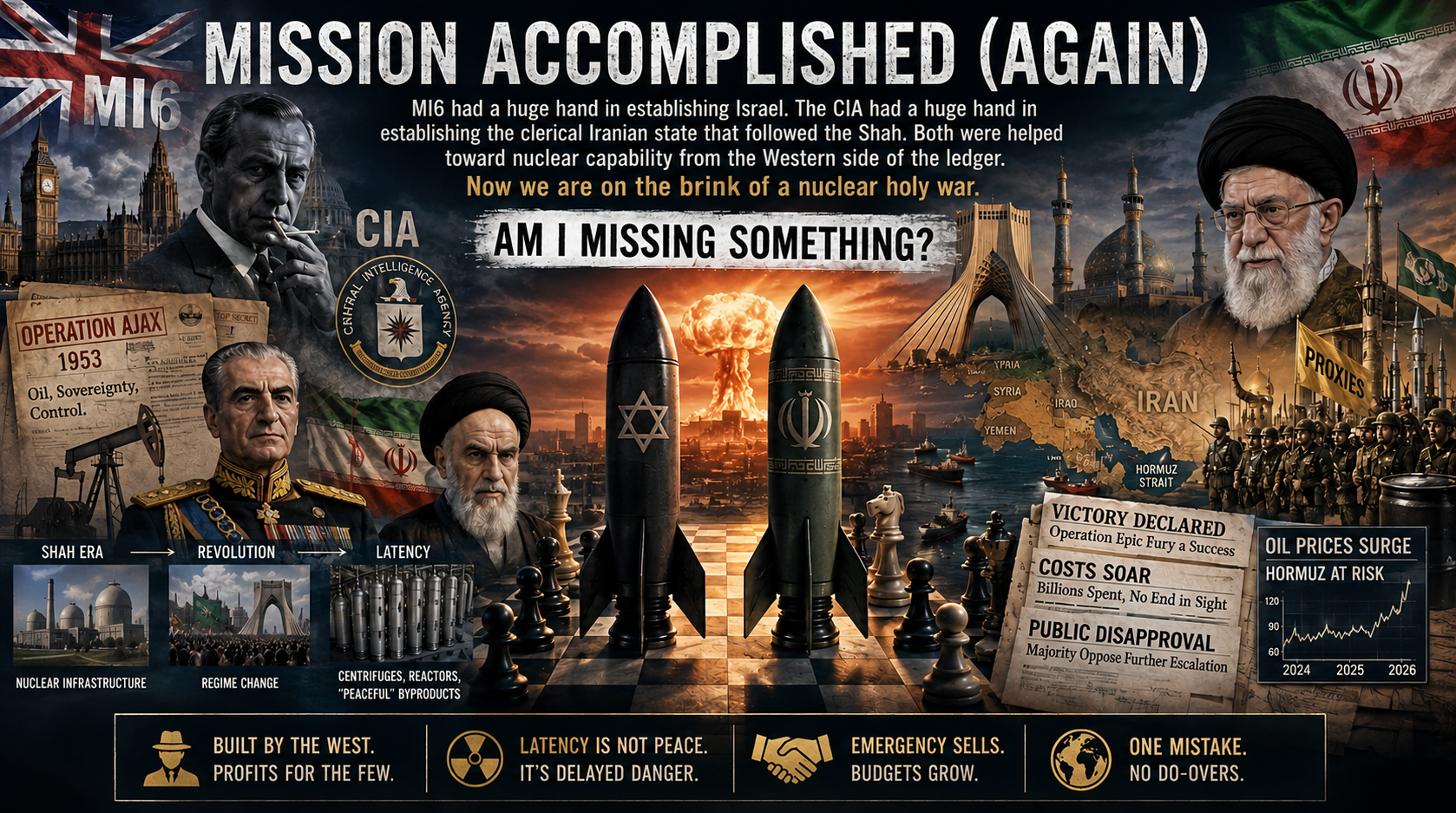
MI6 had a huge hand in establishing Israel. The CIA had a huge hand in establishing the clerical Iranian state that followed the Shah. Both were helped toward nuclear capability from the Western side of the ledger. Now we are on the brink of a nuclear holy war.
Am I missing something?
If the only answer is Pakistan already being nuclear, Russia and China arming the chessboard, and a “West” that is not one hand, the rest of this argument still has to explain why the story keeps snapping back to Jerusalem and Tehran anyway.
The pages below are written for readers who already lived through the spring 2026 headline stack and felt the cognitive dissonance: victory language in one tab, price tag and disapproval in the next, oil and Hormuz in a third. The goal is not to pick a team. The goal is to name what each team is measuring—and what both teams avoid saying out loud about who built the nuclear board and who profits from the next emergency.
TL;DR: Western covert history brackets how the regional nuclear board was built; the live fight is latency, strait leverage, and who rents the next emergency. Spring 2026 feels like two wars because strike objectives, civilian and fiscal ledgers, polls, and commodity fear run on different clocks—and honest readers still have to argue which layer should decide legitimacy. This page names dual-track diplomacy, asymmetric captions, and the smaller honest press failure (clean arcs vs messy equilibrium); the Iran war runner and CIA investigation (Iran endgame lane) carry the dated spine, tables, and Framing and limits stack.
The pipeline
Operation Ajax (1953) is the hinge where American covert power re-seated the Shah and taught Iranians a lesson about oil, sovereignty, and who really owned the file. British cooperation mattered then and matters in the reading that follows: divide-and-rule habits do not vanish because Washington takes the lead on the org chart.
The linked investigation walks the Iran pipeline as a design question, not as a single FOIA smoking gun: Shah-era nuclear infrastructure, then revolution, then a regime that could hold centrifuges, reactors, and “peaceful” byproduct narratives while still functioning as the region’s latency factory. The careful version—with tiers, limits, and open questions—lives in the dossier’s Iran: Nukes, Shah, Ayatollah section; here the claim is narrower and older than 2026 headlines: the same institutional family that built the board keeps re-selling emergency as strategy.
Kinzer’s line on the Shah—All the Shah’s Men—is still the clean public-history entry point for readers who want a book-shaped map before they touch the harder thesis lane. The dossier lane goes further: it treats engineering extremism and latency inheritance as paired moves in a long game, not as a chain of accidents.
Nuclear monopoly as a story shape (compressed)
One way to read the whole arc—Shah infrastructure, revolution, latency, IAEA arithmetic, “never again” rhetoric from Jerusalem, “never a bomb” rhetoric from Washington—is that the region’s risk budget is being negotiated in public while the risk mechanics stay classified or dull.
The monopoly thesis does not require a secret cabal meeting in a basement. It only requires aligned incentives: no middle power gets a stable, independent nuclear deterrent that can rewrite escalation rules without Great Power permission. Iran’s problem, in that frame, is not that it is uniquely evil; it is that it sits on energy chokepoints and proxy geography while also holding enrichment that makes neighbors plan bunkers faster than they plan summits.
That is why latency keeps returning as the hinge word. Latency is where lawyers, admirals, and headline writers can share a vocabulary without sharing a forecast.
The pipeline (continued): why 1953 still pays rent
Operation Ajax is still paying rent because it is the cleanest origin story for the modern file: who removed whom, who installed whom, and what got locked in as “normal” for a century of oil politics. Readers who want a mainstream book spine on the coup itself can start with Kinzer’s All the Shah’s Men and then walk into the dossier lane for the nuclear inheritance argument.
Stephen Kinzer — All the Shah’s Men (Wikipedia overview)
The dossier lane is uglier: it treats extremism as a manageable risk surface in great-power games—manageable until it stops being manageable. You do not have to believe every speculative step to notice the pattern in twentieth-century covert history: yesterday’s asset becomes today’s emergency, and tomorrow’s budget line.
CIA — OSS rebrand, Nazi gold, Iran, 9/11, and the antibody thesis
The endgame the dossier names
The public argument is always the Hollywood bomb. The dossier’s author lane argues the sharper risk sits in material the press treats as boring: depleted uranium framed as an innocent byproduct of a “peaceful” program, plus a fatwa the world reads as a guarantee. You can reject the mechanism and still accept the policy consequence: latency is treated as intolerable once missiles, proxies, and ideology stack on top of it.
Author opinion: fatwa, depleted uranium, and the real Iranian nuclear threat
Official Washington has been blunt in plain English. Reporting around spring 2026 carried the administration’s line that the world cannot live with a nuclear-armed Iran—as maximal stakes justifying disruption short of waiting for a perfect mushroom-cloud photograph. The April State Department legal memo on Operation Epic Fury sits in the same moral universe: it argues self-defense cannot require a defender to wait until a hostile state has a warhead-tipped missile on the pad—a standard that makes latency look like imminence when the briefing room wants it to.
Operation Epic Fury and International Law — Office of the Legal Adviser
Iran nuclear material “still there, in large quantities,” IAEA chief says — CBS News
Chessboard pressure (synthesis)
Three pressure cookers ran in parallel while this war matured: Ukraine as the West’s proxy grind against Russia, Taiwan as the Pacific mirror for “who rules the chokepoints,” and American elections as the timing belt for when a tired executive class versus a wartime executive class would hold the pen.
This section is synthesis, not a court filing. The claim is structural: when deterrence narratives stack, the Middle East stops being “a regional story” and becomes the place where commodity routes, religious coding, and nuclear latency meet. Europe still likes its rules-first costume; America still carries the carrier group wallet. Split incentives produce split headlines—exactly what the next section shows.
Energy markets do not need theology to move. They need fear of closure and fear of escalation in the same week. That double fear is how you get two meters without anyone needing to “lie” in the small-print sense: traders, editors, and admirals are answering different questions on different clocks.
Domestic politics adds a third oscillator. A White House can pause an escort programme to keep a negotiation lane open while a Pentagon press corps still counts sorties and seizures as the “real” scoreboard. Readers who insist on one scoreboard will feel the world is lying to them. Readers who accept layered scoreboards will still argue about weights—which layer should decide legitimacy—and that argument is the real fight under the fight.
Dual track (why “misunderstanding” can be strategy)
The April window in the runner is instructive: a broker frames a pause everywhere, a prime minister narrows Lebanon, a president calls it a legitimate misunderstanding. Critics read bad faith; the runner allows a colder read—two negotiations running at different speeds, with different domestic audiences.
That pattern matters for how you interpret “mission accomplished” rhetoric in May. If combat tempo is down but blockade politics is up, one government can truthfully say the operation met its strike objectives while another desk in the same government still writes contingency plans for resumed bombing. The press can be “right” to call the war unresolved without disproving the strike campaign’s immediate engineering outcome.
Bodies, cameras, and the PR war
Missile wars produce statistics that arrive on delay: damaged infrastructure is visible fast; civilian harm claims move through UN channels, hospitals, and telecom outages on slower rails. That delay is where atrocity amplification and atrocity denial both thrive.
The runner’s blunt line—aligned with this article—is that Iran’s open missile spectacle did not buy the Western public-relations win Tehran needed to break the pro-Western coalition. Whether you treat that as moral failure or strategic failure depends on your ethics; either way it is a media outcome with battlefield inputs.
None of that implies clean hands on the other side of the camera. It implies asymmetric clarity: the side with more declassified-ish reach into global wires sets more of the default caption for the median reader.
Sibling thread (open investigation): LEGO-brick / toy-spectacle CGI of strikes, Western amplification (retweets / duets / “both sides” pages laundering spectacle into trusted feeds), and the explicit question whether Disney-shaped production pipelines touch the Iran 2026 clip economy — plus a structural parallel to how Western ecosystems circulated ISIS primary media (2014–2017) even when the circulators opposed ISIS. Not asserted as proven; evidence ladder lives there: Iran 2026 propaganda thesis — LEGO / Western amplification / ISIS parallel.
What the media will not admit (the honest version)
The honest version is smaller than the conspiracy version and more insulting to the audience.
First: “war over” is a phrase that can mean combat tempo down, political war continuing, sanctions continuing, nuclear diplomacy continuing, or domestic politics continuing—often all at once. Treating those layers as one boolean is how cable gets speed and how serious readers get whiplash.
Second: cost accounting is always late, always revised, and always politically weaponized. A $25B line in one outlet and a $29B line in another can both be “early drafts of the same invoice” while partisans pretend the gap is proof of enemy malice.
Third: polls measure approval of handling, not secret knowledge of outcomes. A majority can oppose action and still accept a narrative that “the worst is past” once the screen stops flashing red every night.
Fourth: the press still rewards clean arcs—villain, strike, victory lap—over messy equilibrium. Equilibrium stories are harder to film. So the same week can host both a Rubio “objectives met” arc and a PBS/CNBC “no end in sight” arc, and both can be faithful to different slices of the truth.
Two meters on the same week
Pick any mid-May window. One meter reads success and closure; the other reads open-ended cost and harm. Both can be “true” at different altitudes.
Washington meter — objectives met, combat phase closed
- Rubio says operation in Iran is “over,” nuclear material “has to be addressed” — ABC News
- Rubio says U.S. has achieved objectives of Iran operation — Spokesman-Review
- US says Iran combat operation launched in February is over. What now? — CNN
- Trump says “Project Freedom” to be paused “for a short period of time” — BBC News
Press meter — price tag, no end, public verdict
- The Iran war now has a price tag ($25 billion), but still no end date — NPR
- Cost of Iran war up to $29B as lawmakers push for details — Stars and Stripes
- Price tag for Iran war ticks up to $29B, not including base damage — Breaking Defense
- 6 in 10 Americans disapprove of how Trump is handling Iran, new poll finds — PBS NewsHour
- Majority of Americans oppose military action in Iran, new poll finds — PBS NewsHour
- U.S., Iran no closer to ending war — CNBC
That is two audiences buying different summaries of the same month, not a simple case of one side holding facts and the other holding fiction.
Attribution smoke (why “Minab” belongs in the footnotes)
Open-source combat video is easy to feel decisive and hard to prove decisive. The linked propaganda thesis file states the problem plainly: who filmed what, from where, under what rules of release, shapes what millions “know” happened in a given sortie window.
Iran 2026 propaganda thesis — Minab school counter-narrative
This article does not adjudicate every clip. It names the pressure: when attribution is sloppy, politics rushes into the gap—and politics loves a banner.
Where the war is today
The operational spine is written as a living runner: 28 February 2026 as the public start of Operation Epic Fury, June 2025 as the legal and material prequel, and May 2026 as war by other means—Hormuz, mines, blockade politics, and a negotiation track that can look dead while guns stay mostly cold.
Iran war runner — timeline, dual track, and current state
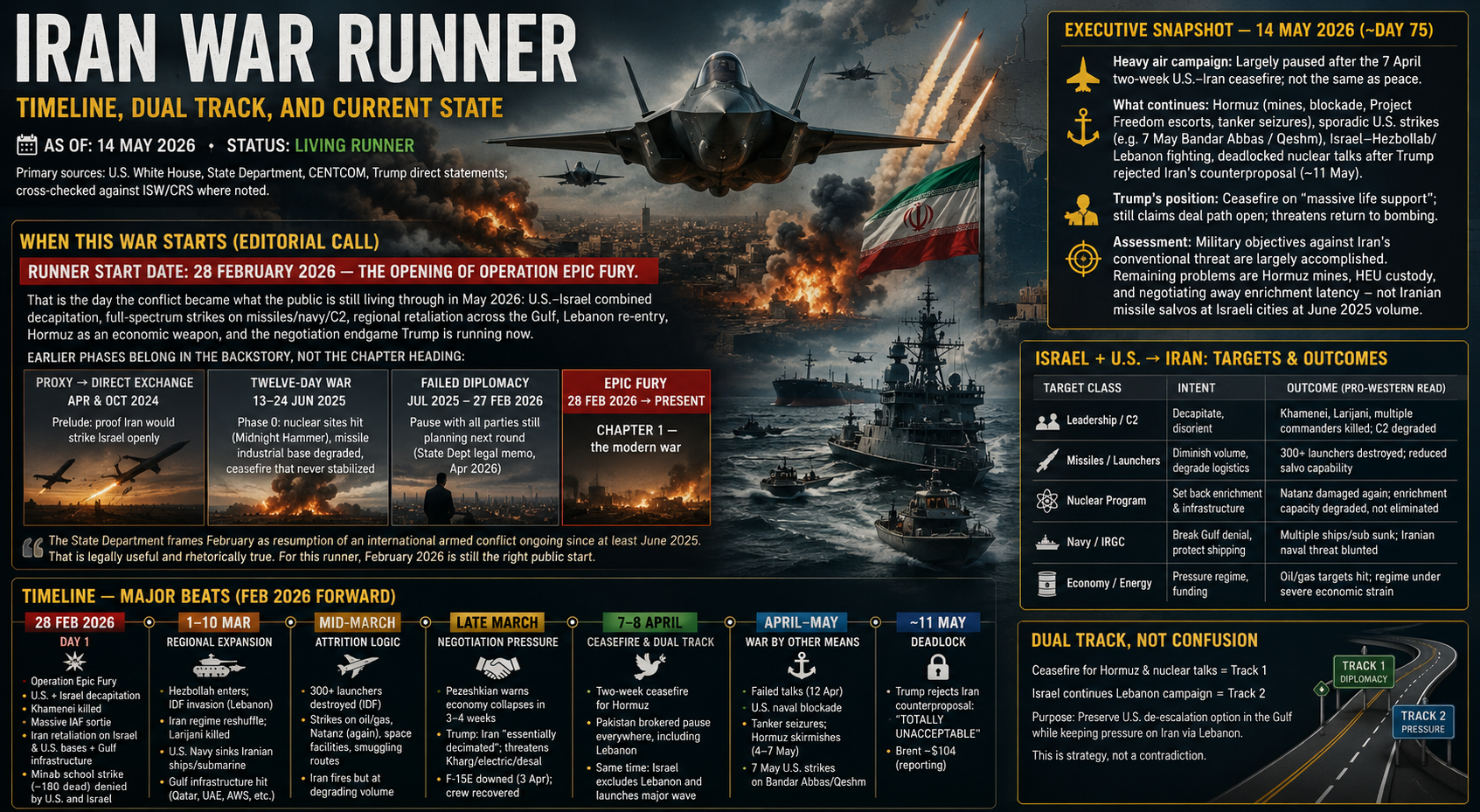
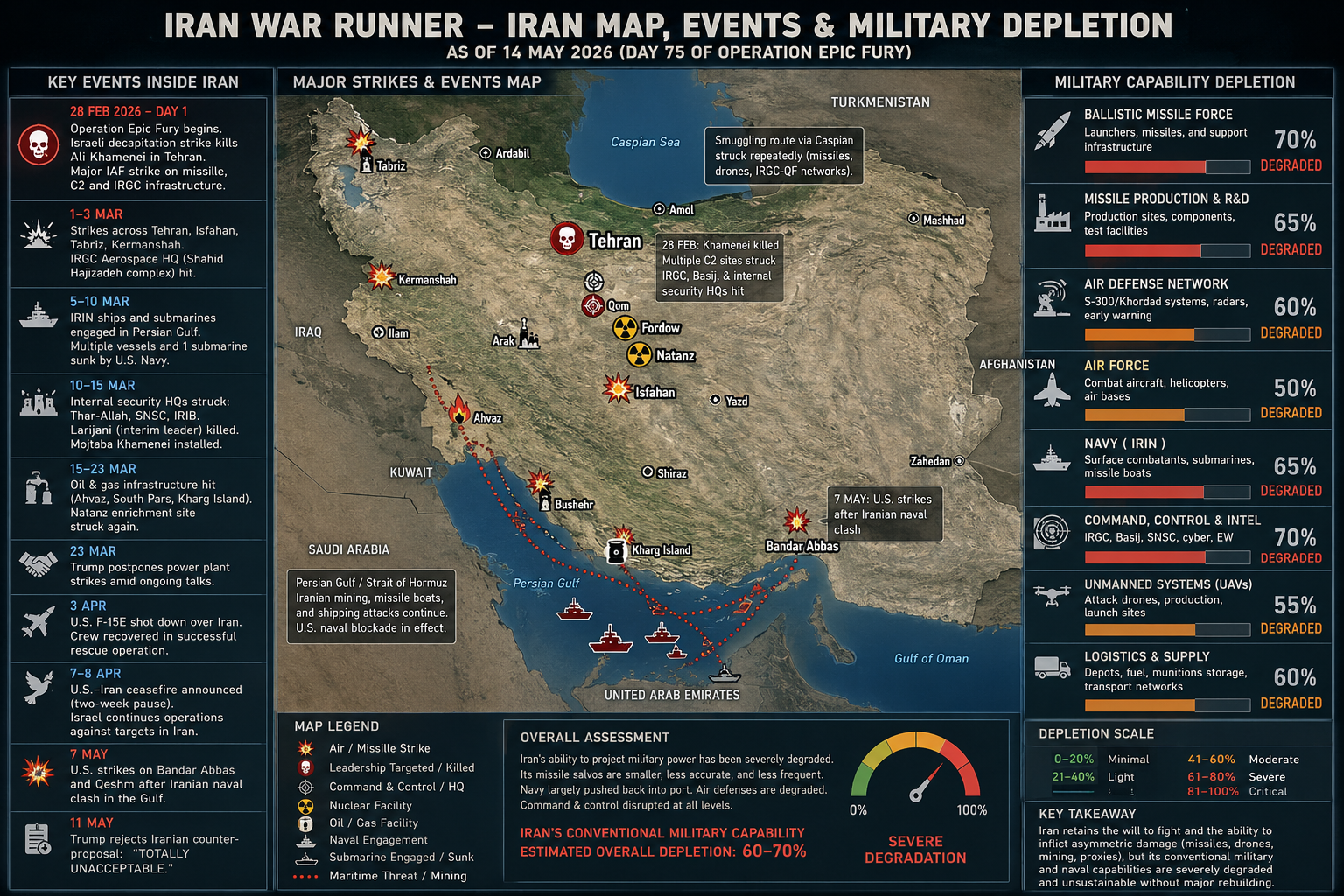
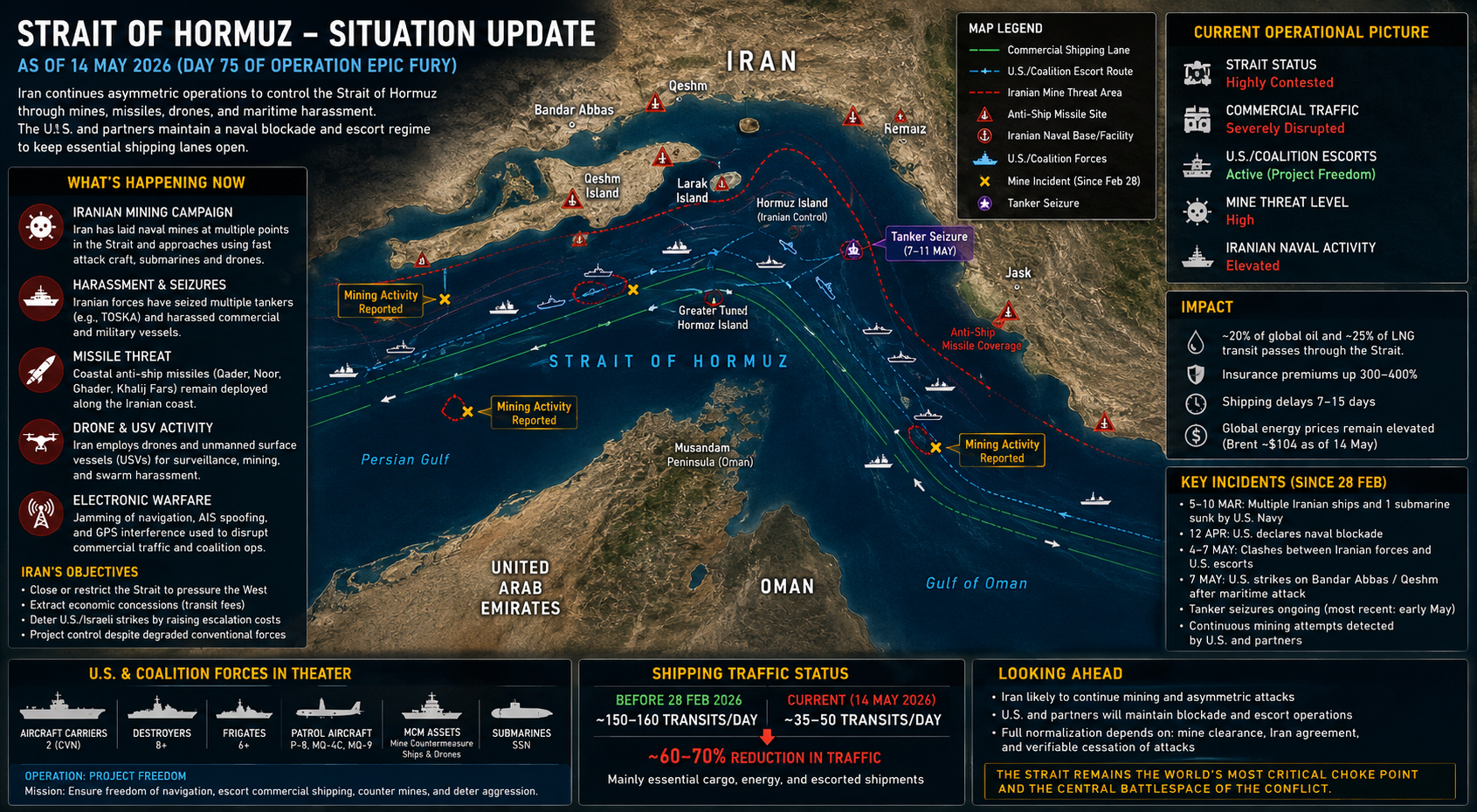
On the facts that runner emphasizes: the heavy strike phase largely paused after the 7–8 April ceasefire window; what remains is not June 2025-scale missile exchange into Israeli cities—it is strait leverage, HEU custody politics, and the Lebanon seam where Israeli security doctrine refuses to pretend Tehran is “only” a file on a desk. The same week can include a brokered pause language in one headline and a Lebanon wave in another; the runner reads that as dual track, not as proof that nobody is in control.
The Minab school strike sits in the runner as a contested attribution node: high reported casualties, U.S. and Israeli denials, and the usual fog of who benefits from which camera angle. This article does not settle the docket; it marks the seam where lawfare meets open-source certainty culture.
Gulf News — dual blockade, Hormuz shipping and diplomacy (May 2026)
Gulf News — U.S. intel vs “decimated” claims, Hormuz missile risk (May 2026)
Iraq echoes
The banner mission accomplished was mocked into a meme because the press wanted a morality play, not a ledger. The same machine is already running on Iran: claim victory on the military objective, claim catastrophe on the human and fiscal ledger, deny both can be partially true, force the public to pick a team.
Why I call this “Mission Accomplished (again).” The echo I mean is George W. Bush’s return to Iraq: the public case was WMD and liberation, while the dissident read I track here stacks two other pressures—weapons and files the Western side helped lay into the theater (then had to remove or deny before they became leverage), and a hard-money shock that would have broken the fiat story fast enough to threaten American bankruptcy as a lived political fact, not a cable ticker mood.
Libya is the cleaner parallel on the currency lane in this collection’s long file work: regime removal and gold / African dinar pressure against the dollarized order, with the Hollywood-side “loot / accounting” primer in the same dossier’s *Three Kings* thread and 2003 Saddam contrast.
Iran in 2026 reads narrower on my scoreboard: I do not see the same dual-motive stack driving day-to-day headlines. Nukes—latency, custody, red lines—are the main visible engine. Regime change was conditional: optional if the Ayatollah apparatus bent on enrichment; necessary when it refused to budge and could not be trusted to keep that refusal quiet. February reads that way after diplomacy failed its public tests—not as a charity project to redesign Iranian society from zero.
For the Fed / fiat constitutional backdrop used elsewhere in linked notes, see the reader lane in governance usury — JFK / E.O. 11110 thread. For the institutional Iran pipeline (Ajax forward), keep the dossier’s §IV in view—Iraq’s specific ordnance chain is not reproduced here.
The runner’s read—aligned with this article—is that conventional Iranian threat was dismantled in a repeating cycle (launch, get struck, lose industrial depth), while nuclear tail risk persists as diplomacy, not as nightly missile rain into Tel Aviv. If that read is right, the correct analogy to Iraq is not “flowers and chocolates in Baghdad.” The correct analogy is simpler: the battlefield phase can end while the narrative war never does.
Coda
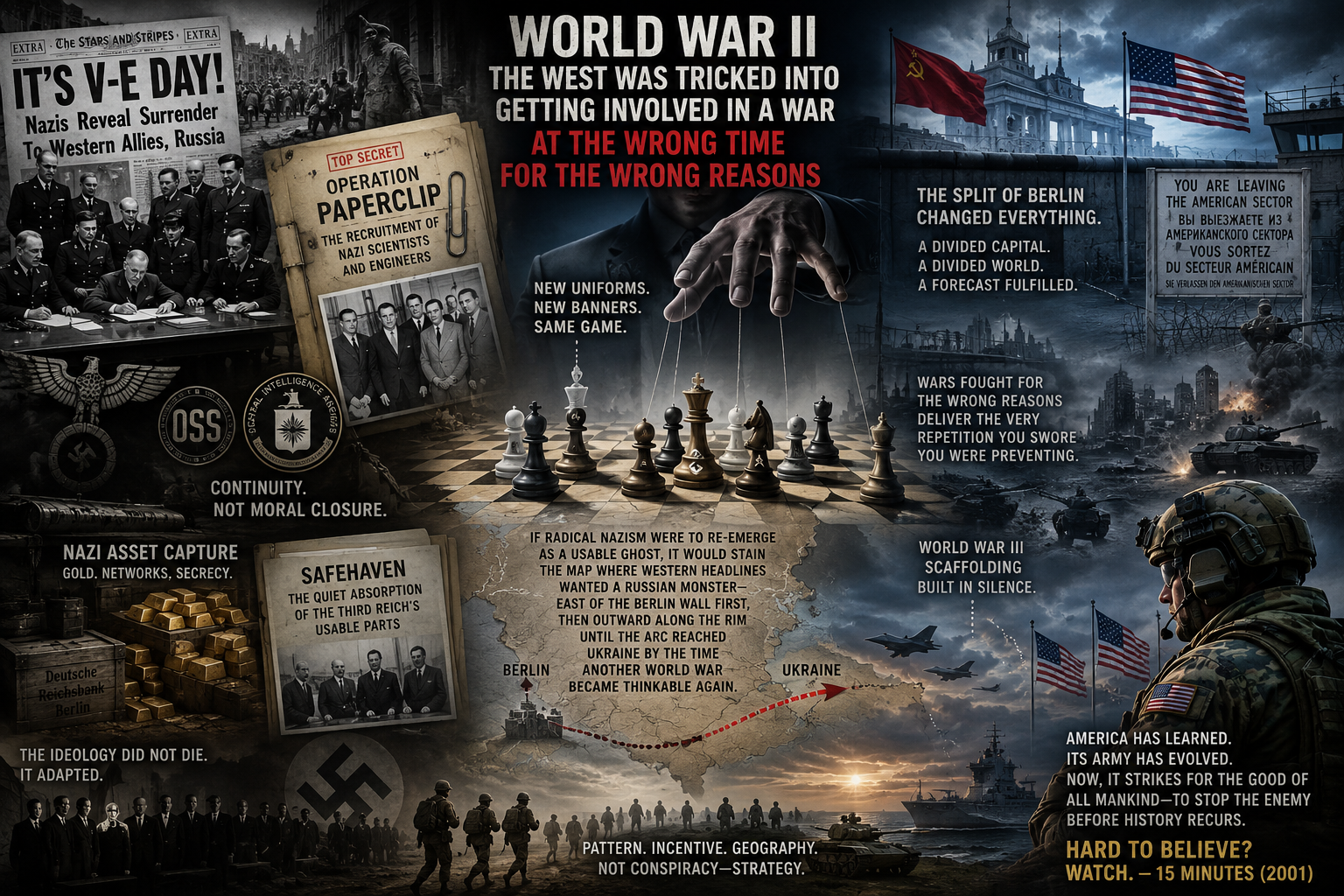
In my opinion, in World War II the West was tricked into getting involved in a war at the wrong time for the wrong reasons.
When people say America defeated the Nazis, I read that sentence as half-true. German soldiers and German war industry ate the military defeat—Wehrmacht formations broken, cities smashed, surrender lines signed. The Nazi leadership caste and the usable parts of its machine did not leave the stage the way the victory speeches implied. Programs like Operation Paperclip (and adjacent recruitment lanes) pulled scientists, methods, contacts, and deniability into the postwar Allied order while the public watched parades. The linked dossier already treats OSS/CIA continuity, Nazi asset capture, and Paperclip as one institutional braid—continuity, not moral closure (CIA investigation — Nazi gold, SAFEHAVEN, Paperclip). The ideology did not evaporate; it survived as habits, networks, and emergency doctrines that could be re-housed inside rebranded desks the next time a superpower needed familiar buttons.
The postwar split of Berlin did quieter work than the air-bridge photos suggest. A divided capital inside a divided country made Soviet governance more brittle the farther you moved from the story’s Western camera—logistics, legitimacy, fear all tilted along the new border geometry. As American hostility hardened into the Cold War, Western planners were already living inside a forecast that was partly geographic: if radical Nazism were going to re-emerge as a usable ghost, it would stain the map where Western headlines already wanted a Russian monster—east of the Berlin Wall first, then outward along the rim until the arc reached Ukraine by the time another world war became thinkable again. I am naming pattern and incentive, not claiming one declassified paragraph proved every step at the time.
So when America entered the war and took victory laps over Nazi Germany, the victory did not finish the ideological and institutional work the public thought it finished. It preserved leverage and set up recursion under new uniforms and new banners—what I am still willing to call World War III scaffolding. The lesson was lost: wars fought for the wrong reasons can deliver the very repetition you swore you were preventing.
So is this war—Iran, 2026, Epic Fury and what came after—being fought for the wrong reason? I still land on a split answer. The public story is the nuclear file—latency, HEU custody, Hormuz leverage—and that lane is narrower than the Iraq / Libya dual-motive read in Iraq echoes. The older worry is the scaffolding: World War III habits keep finding new latitudes.
The West is not one nervous system; that is why one week looked like two different wars. The U.S. Army has learned more lessons—paid for in blood, steel, and repetition—than any army we still ask to fight like this. And right now it is out to prove it. After all this time, the clean marquee line writes itself: America, and the army that does the breaking, can strike the appointed blow against the enemy of the world, for the good of all mankind.
Hard to believe? Watch. — 15 Minutes (2001).
Where next
- Iran war runner — dated operational spine and dual-track read
- CIA investigation — Iran endgame script — evidence tiers and long thesis
- Iran 2026 propaganda thesis — Minab school counter-narrative — attribution problem stated as a live hypothesis
- CRS — Israel-Iran conflict, U.S. strikes, ceasefire (June 2025) — Congressional Research Service map-era summary
- Dubious stand down — Libya, Benghazi, gold / dinar, Three Kings cluster — Iraq 2003 / Libya 2011 rhyme work and currency-friction lane
- Governance usury — JFK / silver, Treasury vs Fed reader — fiat backdrop used across the collection
Framing and limits
Prisca sapientia (epistemic foundation): This article assumes prisca sapientia—the belief that the ancients possessed a vast, profound understanding of the universe, nature, and theology that was subsequently lost or degraded. Modern consensus is not default truth; linked dossiers tier specific claims.
The opening MI6 / CIA / two nuclear poles paragraph is a thesis ladder, not a courtroom verdict. The chessboard section is synthesis. The headline lists are journalism citations, not proof the administration is honest or dishonest on every sub-line. The coda is explicitly personal and includes an interpretive geopolitical read (Berlin partition, Cold War geography, east-of-the-wall → Ukraine arc) that is not mainstream-consensus history. The closing Coda grafs on Iran 2026, the West split, U.S. military-learning read versus marquee “enemy of the world / mankind” caption, and the narrowed “enemy” definition are author opinion and synthesis—they rhyme with earlier sections but do not introduce new primary evidence. The Iraq / Libya / Iran comparative-motive block in Iraq echoes is author opinion—it cross-reads dossiers on Libya gold and fiat but does not restage Iraq ordnance chains here. The dossier carries what this page deliberately refuses to paste: long tables, FOIA chains, and the full Limits stack. The Gulf News links are regional reporting on Hormuz economics and diplomacy in the May window—useful for dating claims about blockades and market stress, not a substitute for primary military releases.
Keywords: #IranWar #MissionAccomplished #EpicFury #MediaBias #Cia #Mi6 #NuclearMonopoly #ParadigmThreat
Substack: paradigmthreat2.substack.com/p/mission-accomplished-again-what-the
Last updated: 2026-05-15
Written and narrated by Ari Asulin, with drafting and research support from LLM agents.
Share