

Consensus theater and the stalled physics pipeline
How a 1,675-physicist survey exposes fragmentation — and popular science still sells the waiting room
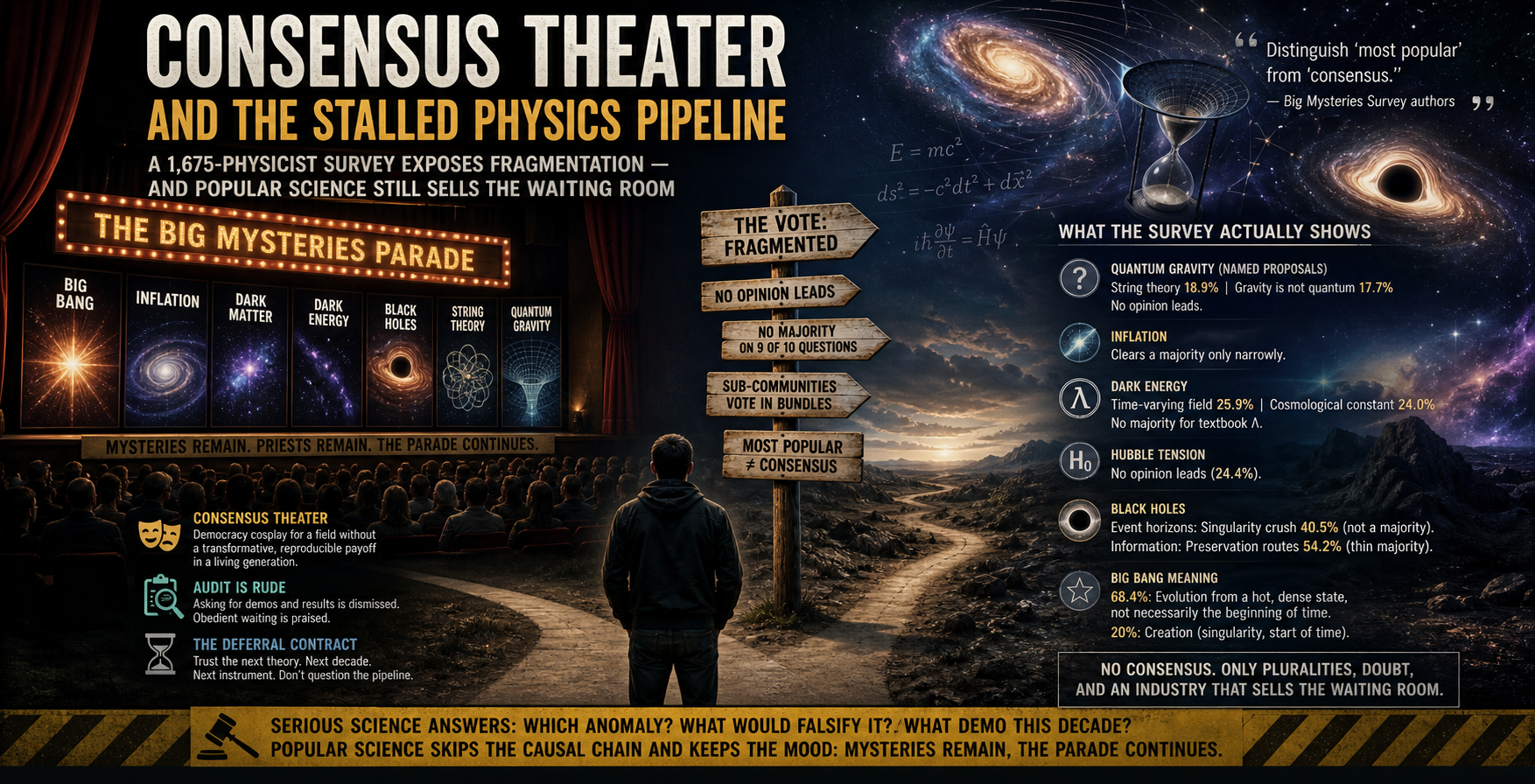
In May 2026 Phys.org ran the kind of headline that sounds like courage: the largest survey of physicists ever, standard cosmology under scrutiny. Read the underlying paper and the honest part arrives first — on most foundational questions there is no majority, only pluralities, “no opinion” leaders, and sub-communities that vote in bundles. Read the popular layer and the same vocabulary still marches in single file: Big Bang, inflation, dark matter, dark energy, black holes, string theory, quantum gravity — named back-to-back as if they were one machine with known gears. That gap between measured disagreement and narrated direction is what this article calls consensus theater: democracy cosplay for a field that has not shown the public a transformative, reproducible payoff in a living generation, while treating audit of spend as rude and obedient waiting as virtuous.
The terminology parade
The Big Mysteries Survey (American Physical Society Physics Magazine, 1,675 respondents, fielded summer 2025) is not a census of all physicists. It is still the largest public snapshot on these controversies in years. Its authors — Niayesh Afshordi and colleagues — conclude with a sentence popular outlets often bury: distinguish “most popular” from “consensus.”
Take quantum gravity. String theory leads named proposals at 18.9%. “Gravity is not quantum” sits third at 17.7%. No opinion leads the board. Inflation clears a majority only narrowly. Dark energy splits between a time-varying field (25.9%) and a cosmological constant (24.0%) with no majority for textbook Λ. The Hubble tension question is led by no opinion (24.4%).
None of that stops the press genre from stitching buzzwords into a single implied storyline — as if saying string theory beside dark energy beside information paradox were already an explanation. Serious science would show which anomaly each construct addresses, what would falsify it, and what demo the taxpayer could inspect this decade. Popular science skips the causal chain and keeps the mood: mysteries remain, priests remain, the parade continues.
The technical companion — tables, menu analysis, press quotes — lives in the Big Mysteries consensus-theater investigation.
Creation fork without an exit
The survey’s only supermajority (68.4%) concerns what the phrase Big Bang means: evolution from a hot, dense state, not necessarily the beginning of time. A fifth (20%) read it as creation — singularity, start of time. The instrument never offered what dissidents actually say: the event did not happen; steady-state; non-expanding cosmos; plasma-lane replacements. Free-text “other” answers, per the authors, were mostly terminology disputes, not a rejectionist camp.
That menu shape matters. Respondents argue whether the Bang is also Creation while still inside the Bang ontology. Nobody gets a clean ballot for never happened. The secular majority gets to sound sophisticated — “we don’t insist time began” — while retaining the same creation myth with the timing argument moved one room over. It rhymes with older chronology work on the Bang as disguised creationism and with the scaling critique in The Incorrectly Scaled Universe: once the hot-dense story owns the sky, downstream distance ladders inherit its geometry.
Polling is sold as democratization — truth by head count. Head counts that fracture on nine of ten questions do not show direction. They show entertainment: an endless rotation of celebrity physicists for podcasts, each wandering the same open terrain without fixing a public next step.
Black holes: faith that outruns the vote
On event horizons, 40.5% pick singularity crush — not a majority. Qualitative “other” replies include physicists saying crossing is locally uneventful, that nothing special is guaranteed. On information, combined preservation routes scrape 54.2% — a thin majority — while 18.8% still endorse loss. The paper explicitly says the story that “everyone agrees information is preserved and only the mechanism is disputed” is overstated.
Popular documentaries rarely open with those splits. They open with the hole graphic, the paradox drama, the same three names. Faith in black holes as astrophysical fixtures persists in culture ahead of the vote share, the way ΛCDM persists ahead of Q4’s split on dark energy — especially after DESI-era press on evolving dark energy. Confidence is durable; agreement is not.
The gravity–quantum dance and the deferral contract
Question ten is the public ritual in miniature: reconcile quantum mechanics with gravity. The survey returns fragmentation and resignation. The culture returns string theory as wallpaper — often named beside loop quantum gravity and extra dimensions without teaching the trade-offs or the decades of null unification demos.
That deferral grammar has a sibling in computing. Quantum Leap (of faith) tracks the same emotional contract in consumer tech: trust the next leap, don’t audit the stack. The quantum storage investigation separates institutional qubit futurism from an addressing / storage read the public was never steered to test. Fundamental physics and quantum industry both ask for faith in a future invention while lifetime public payoffs stay thin.
Maxwell retired, Einstein canonized
Engineering still runs on Maxwell’s field language. Maxwell himself treated propagation through a medium as necessary — see Did Maxwell’s Work Actually Prove the Aether Exists?. Pedagogy kept the formalism and retired the medium as childish. Einstein’s geometric gravity then became the public face of cosmic competence — with precision tests in assigned regimes routinely upgraded in pop accounts into closure for the whole deep map.
This project names the substrate æther in running voice (vocabulary canon); mainstream “fields in vacuum” may appear once as translation, not replacement. The asymmetry on trial here is cultural: Maxwell treated as superseded, Einstein treated as proved forever, while challengers working electrodynamic and plasma lanes at cosmic scale — the curved-light dossier, EU cross-refs — struggle for parity funding long before their strongest predictions are tested fairly.
Audit, ROI, and the private-lab alibi
Achievements are invoked — in textbooks, in private labs, in classified edges — without reproducible public demos that would let an ordinary citizen verify the ROI on trillion-dollar science-industrial spend. The survey itself becomes a substitute for accountability: we polled the tribe, therefore the tribe is headed somewhere.
The right unit of public work is audit, not spectacle consensus. The same grammar appears in the PURSUE UAP dossier: disclosure theater vs structural capability to follow money and mandates. Here the hooks are NSF and DOE science lines, NASA astrophysics vs human spaceflight, collider and observatory ops, Space Force R&D — a TODO table in the investigation, not a buried footnote.
A parallel suspicion — registered openly, not proven in v1 — is that institutional stacks grow bloated and non-interoperable so artificial intelligence can be sold as the only exit, without blueprints the public can read. Whether that is intent or inertia, the affective future on offer is the same: wait, obey, do not ask for the ledger.
Space Force mocked, domestic lift shunned
When the United States stood up Space Force in 2019, much of the science-facing culture treated it as a joke — amplified by Netflix’s Space Force satire, named directly after the branch. Under a second Trump term the service endures and absorbs space missions from sister branches — the nearest non-commercial, non-meme domestic lane for spaceflight tied to the public treasury.
If institutional science wanted mass human spaceflight normalized for taxpayers, you would expect engagement with that venue — budgets, missions, education. Mockery and routing attention to commercial spectacle instead suggests a preference for physics as streaming mystery rather than domestic lift. That read is author pattern until budget traces and society statements are pinned in the dossier.
The iron bubble
Worst jumps in the popular-science canoe coincide, in this repo’s chronology lane, with warfare and militarized funding — History Q&A ties stellar dogma cemented around the Great War to the gravity-first sky we inherited. The future on display now is an eternally divided community: secular vs spiritual reads of the Bang; grounded engineering vs hypothetical celebrity camps; elite institutions vs “greedy” publics blamed for doubt — isomorphs of political divide-and-conquer.
Careers spent entirely inside the bubble never teach the older, more grounded electrodynamic families. Challengers with paper, bench demos, or tight logic are not admitted if they threaten grant language. That is not how a healthy field behaves. It is how a faith-based entertainment sector behaves — one that polls its priests, overstates agreement in headlines, and calls the result progress.
Where next
- Start with the investigation tables and open-claim registry (§1, §11–§13).
- Cosmology scaling fork: The Incorrectly Scaled Universe.
- Deferral / tech faith: Quantum Leap (of faith).
- Primary: arXiv:2605.11058 · Press: Phys.org · APS Physics Magazine.
Framing and limits
The survey authors partially agree that popular “consensus” is overstated; this article does not strawman their paper. It prosecutes the stack: instrument menus, press retelling, funding pedagogy, and militainment rhymes. Author claims on Space Force funding starvation, AI endgame intent, and “Einstein unproven” are stakes language or pedagogy critiques unless tied to primary budget or test catalogs in the dossier Limits. Cross-links are thematic, not automatic proof.
Keywords: #BigMysteriesSurvey #ConsensusTheater #LambdaCDM #BigBang #PopularScience #ScienceAudit #MaxwellAether #SpaceForce
Last updated: 2026-05-14
Written and narrated by Ari Asulin, with drafting and research support from LLM agents.
Share