
Rural Burn Zones Need a Density Moratorium, Not a DEW Investigation
Give up the laser hunt — protect the land before the rebuild replaces the community
I was not planning to write on this topic. Then I watched the comment section on the Protect and Alert Substack post about the Brantley Highway 82 fire — and a huge number of Georgians were in there, responding with fear, anger, and a kind of clarity you do not usually see under mainstream wildfire coverage. I asked the AI to calculate a small poll on whether people believed the directed-energy narrative. Roughly eighty percent implied yes in their comments. That is not a fringe bubble. That is a community trying to name what their eyes are showing them.
I started reading the thread more carefully — the petition language, the inflated home counts, the mockery accounts, the blackpill comments telling everyone that screaming at officials changes nothing. I grew afraid that a lot of sincere people had fallen for a controlled-opposition trap: real anomalies, real grief, real counties at risk — wired into a campaign that cannot win and was never meant to unite anyone. That is why I wrote this.
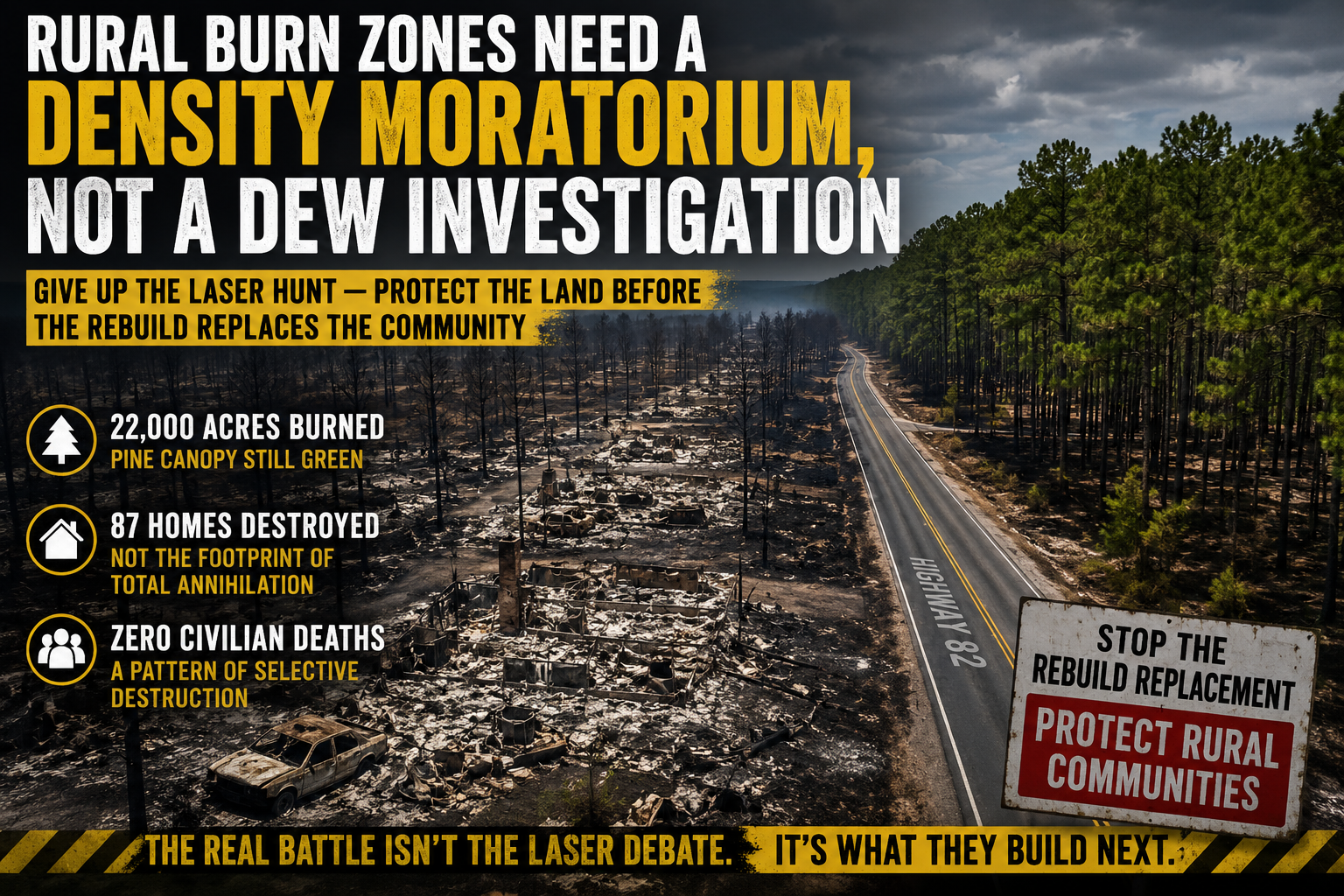
Brantley County, Georgia, April 2026: roughly twenty-two thousand acres burned. Eighty-seven homes destroyed. Zero civilian deaths reported in the press. Pine canopy still green in photographs hanging over lots reduced to white ash and bare metal.
Read those numbers together. A burn scar the size of a small county. A structure count you can fit in a school gym. That is not the footprint of total annihilation. It is the footprint of selective loss inside a huge event — enough terror, enough insurance pressure, enough broken continuity to move people, without needing to erase every homestead on the map.
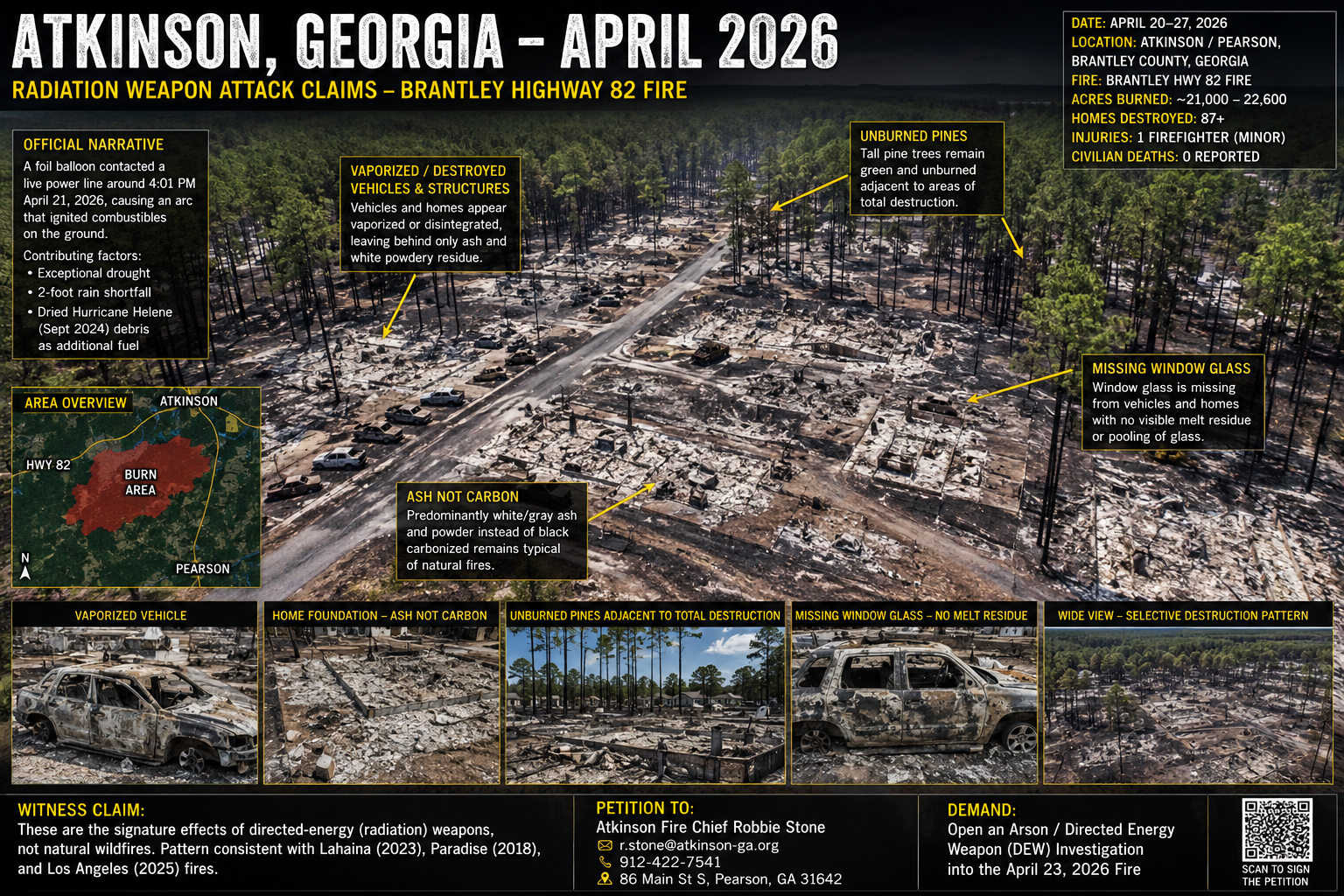
The grassroots petition circulating now asks Atkinson Fire Chief Robbie Stone to open a directed-energy weapon investigation. I understand why. The photos are strange. The official line — foil balloon, drought, dried Hurricane Helene debris — explains ignition and spread. It does not fully explain every frame. But a DEW petition is the wrong fight. It is the fight designed to fail.
TL;DR: Brantley burned wide and hit few homes — a pattern that points upstream to weather stress (I treat large-scale weather modification as real — see the weather modification investigation) and downstream to rebuild consolidation, not to winning a laser debate. Believers and skeptics both have partial truths; the trap is letting suppressed-device forensics keep you from a density moratorium on burned rural land before apartments and investor parcels lock in.
The trap is older than Brantley
Every time one of these fires blows up, the same machine spins.
Cover story first. Balloon on a line. Downed utility pole. Climate drought. Ember storm. Each piece can be true enough to quote. Assembled into a full picture of why this house and not that tree, the story still wobbles — but it does not have to be perfect. It only has to be official.
Controlled opposition second. Within forty-eight hours the comment sections fill with mockery — Jewish space lasers, meth-lab jokes, “try looking up how fires work” — and with sensational inflation: a thousand vaporized homes, swimmers radiated stiff in mid-stroke, blue tarps as magic shields. Fact-checkers get their easy kill. Believers get their rage loop. Skeptics get to feel smart. Nobody talks about zoning.
That is the point.
A third lane showed up on the Brantley thread under the handle Blue_French_Qtr — later identified as CB St. Julian of brsinv.com: agree the fire is suspicious, nullify every civic action in one breath, redirect to his Substack. Same demoralization geometry as the mockers, with a legal-reform costume. His site runs parallel Zionist headline framing on federal court capture — the ethnic exit that lets fact-checkers retire serious docket grievances with the whole thread. Argument tables and counter-frame (1979 religion routing, CIA / NSA, ideological shield vs monolith): Captured courts, wrong villain and BRSINV dossier.
No operator with a real capability and a real objective fires into a community unless the aftermath discourse is already wired: a mainstream explanation ready on day one, and a fringe counter-narrative ready on day two that is loud, divisive, and politically unemployable. Petition the fire chief for space weapons. March online about vaporized glass. Call your cousin a coward. The rebuild clock runs in the background.
I have watched this long enough to recognize the shape. The technical dossier on the Brantley fire maps the anomalies, the official responses, and the comment-section controlled-opposition profiles in detail. Read it for forensics. Do not mistake it for a campaign strategy. Forensics without a policy lever is entertainment for the divided.
What believers see — and what is plausible
I am not here to humiliate people who look at Lahaina, Paradise, Pacific Palisades, and Brantley and see a signature.
Selective destruction — house gone, pine still standing, glass missing from a car frame, white residue instead of black char — is visually real. It recurs across events. Forensic arborists and lay witnesses alike have asked the same question: what fuel vaporized that structure if the forest beside it did not burn?
The microwave coupling argument is not cartoon physics. Conductive and water-rich materials absorb RF differently than dry canopy air. Military directed-energy programs are not classified fiction — pain rays, pulsed-RF devices, decades of institutional denial when symptoms show up in diplomats. Whether those capabilities scale to structure fires in rural Georgia is an open empirical question. Whether the response pattern to such claims is managed — deny, ridicule, debunk the loudest line, never release the coroner packet — is documented well enough to take seriously.
Take the blue thread. Maui’s “miracle house,” blue tarps, blue roofs surviving while neighbors ash — fact-checkers called it cherry-picking. Maybe it was. But there is another read that believers land on intuitively, and I do not think it is stupid: blue as a marking color for protection — a signal to whoever is running a selective strike about which structures to spare. Plausible. Consistent with selective burn patterns. Consistent with an operation that needs some buildings left standing for photographic “proof” that wildfires are natural.
Plausible is not proven. I am saying the believers are often looking at real selectivity and naming the wrong campaign because the naming itself is part of the trap.
What skeptics see — and what is also plausible
Skeptics are not all shills. Some are lazy. Some are cruel. Some are retired firefighters who have seen aluminum melt and neighborhoods burn in patches because wind, fuel load, and ember rivers do not distribute heat like a classroom diagram.
Eighty-seven homes in twenty-two thousand acres is compatible with a bad wildfire in a sparse rural county — not proof of orbital genocide. Tempered glass shatters and disappears into wreckage without requiring five-thousand-degree vaporization. Mobile homes with aluminum siding leave white oxide residue when they burn. Pine plantations in the Southeast are managed for surface-fire survival; canopy green next to a torched lot is ugly optics, not automatic proof of a beam weapon.
The petition’s thousand-home claim was wrong. That error alone lets every newsroom retire the story. Mix one real anomaly photograph with one numeric fantasy and the whole thread becomes “conspiracy theory” — which is exactly how you protect the rebuild from scrutiny.
Good skeptics should still ask: why this county, why this year, why this scar shape, what gets built next. Bad skeptics stop at laughing. Both get played if the only choices are believe the laser or believe the balloon.
Weather upstream — the bigger picture DEW talk buries
If I redirect attention anywhere, it is here — and I need to be plain about where I stand.
I do subscribe to the belief that our weather is modified — not as a fringe hobby, but as the conclusion of a long public and documentary record compiled in the weather modification investigation: Operation Popeye, Project Cirrus, ENMOD, ionospheric heaters, state cloud-seeding at scale, and doctrine papers like Owning the Weather in 2025. Media has predictive-programming the public for decades — naturalizing drought, engineered catastrophe, and “climate” as the only permissible frame — so that when a county dries out or burns, the imagination stops at CO₂ and never reaches who stressed the sky. See the predictive programming hub for how fiction and news condition acceptance before the event lands.
That is my read. It is not an invitation to win a laboratory argument online.
If there are instruments upstream — seeding fleets, heaters, dual-use EM paths we cannot personally switch off — then at some point acceptance is rational: you are not going to decommission HAARP from a Substack comment. What remains is outcome discipline: what are those instruments trying to make happen on the ground, and what can neighbors still block locally before the secondary effect locks in?
For Brantley, the upstream stress is legible even without naming a device: exceptional drought (a two-foot rainfall shortfall), dried Hurricane Helene debris, and a scar shape that terrorizes without annihilating the whole county. Whether that drought is “natural” in the policy sense is exactly the question weather-mod history says you are allowed to ask — and exactly the question local politics can still answer, because the downstream weapon is not mystery plasma. It is rezoning, insurance buyouts, LLC parcel grabs, and stacked housing on land people still vote on.
Weather modification is not a rumor category. Operation Popeye seeded monsoons over Vietnam while the Secretary of Defense denied the program existed. Project Cirrus reversed a hurricane toward Georgia in 1947; GE admitted it twelve years later. ENMOD banned military weather warfare in 1977; signatories still run ionospheric heaters and cloud-seeding infrastructure at continental scale.
Directed-energy talk keeps the argument at device trivia — wavelength, glass melting point, Jewish space laser memes. Weather-mod forensics keep it at institutional history — who holds heaters, who seeded, who benefits from tinderbox years. Neither is where Brantley wins. The win is county commission: moratorium, parcel watch, open records, referendum.
I am not asking you to prove HAARP fired on Pearson. I am asking you to stop letting laser hunting or suppressed-tech rabbit holes distract from land-use outcome. If the atmosphere was stressed on purpose or by negligence at scale, you still only get one practical lever left: prevent the rebuild from finishing what the burn started.
The rebuild is the weapon — if you let it run
Strip the horror memes. Look at incentives.
The model here is not a single nationwide shock. It is the smallest version of the attack first — enough to open parcels and seed fear, not enough to unify the county against you — then ramp slowly based on how the public reacts. Brantley is a textbook first pass: twenty-two thousand acres scarred, eighty-seven homes gone, zero reported civilian deaths. Catastrophe at landscape scale. Selective loss at homestead scale. If nobody organizes at this increment, the next increment is already being calibrated.
Deep-red rural counties — Brantley voted overwhelmingly Republican — run on low density: single-family homes, land attachment, local identity hard to flip by national messaging alone. A wildfire does not have to vaporize a thousand houses to change a county. It has to destroy enough homesteads, scare enough holders, and open enough parcels for investors, insurers, and planners to push stacked housing, “affordable” multifamily, data-center adjacency, and rezoning packages that would have faced riot-tier resistance last year.
Comment threads on the Brantley petition already said the quiet part without experts: stacked apartments going up in towns that cannot support them; fifteen-minute-city language in rural Florida; Kelowna and Jasper patterns in Canada; mineral and lithium overlays under Appalachian burn zones. Lay people assembled that synthesis from local eyes, not from a think tank. The professional press did not assemble it for them — because the professional press is still busy debunking blue roofs.
Whether the ignition was balloon, beam, or carelessness matters for historians. What matters for 2027 is whether Brantley rebuilds as the same community or as a denser, more transient, more rent-burdened footprint with a shifted electorate. Fires we can survive. Permanent character replacement we cannot — not as the place we meant to hand to children.
The petition that breaks the script
Here is what they do not expect.
Stop petitioning the fire chief to investigate space lasers. He will not. The investigation will not trend. Mockers will feast. Fact-checkers will score a touchdown on the thousand-home line. You will go home angry and divided.
Petition the government you can still pressure — county commission, state legislature, congressional office — for a rural burn-zone moratorium:
- No new high-density multifamily construction on parcels inside the Brantley Highway 82 burn perimeter (and parallel perimeters in other rural burn zones) for a fixed term — ten years minimum, or until original homestead density is restored, whichever is stricter.
- No upzoning of agricultural or single-family rural land to apartment-scale density as a disaster “recovery” measure without a binding local referendum.
- Transparency registry — every insurance buyout, every LLC parcel acquisition, every multifamily permit filed within the scar before ground breaks.
- Rural character protection — rebuild permits favor owner-occupied single-family replacement at prior footprint, not investor-stack templates imported from urban planning playbooks.
This petition unites people who disagree on DEW. Skeptics want honest wildfire recovery without graft. Believers want to stop the land grab they think follows the beam. Locals want their county back. None of them need to win the laser argument to win the moratorium.
It is also politically realistic in a way DEW petitions are not. Moratoria have been filed after floods, after hurricanes, after industrial disasters. “Don’t let disaster capital rezone my county” is a sentence that travels. “Prove the glass vaporized at five thousand degrees” is a sentence that dies in a comment section.
Redirect every share of the DEW petition to this. If the operators counted on you fighting the old war — lasers versus fact-checkers — refuse the script.
What exists elsewhere — and what Georgia still lacks
No one has filed a rural burn-zone density moratorium for Brantley yet. That is not because the idea is exotic. California’s governor suspended SB 9 duplex rules inside Palisades and Eaton burn fire-hazard zones (EO N-32-25, 2025). Los Angeles issued a parallel executive order. San Diego and California Change.org campaigns are running open petitions against infill density in fire zones. Maui survivors fought Bill 103 (density increase) while Bill 105 preserved rebuild-as-was character. Spokane imposed a subdivision moratorium after wildfire stress. Jasper, Alberta went the other way — density up — which is the outcome to prevent.
Georgia’s legislature moved the opposite direction in 2025–26: HB 1315 would have capped local moratoria at 180 days (it died in April 2026). Brantley County is streamlining rebuild permits — good for owners, dangerous if multifamily investors ride the same lane. WTOC already reported Citizens United organizer Tanya Tomanek and survivors saying “Brantley county’s not for sale” — sentiment without a filed resolution.
The gap is organizational, not conceptual. If you want influence in Georgia on this axis, you do not need to win the laser debate. You need parcel maps, open-records requests, a commission agenda item, and signatures.
Ten steps (Georgia)
- Map the ~87 structures on county GIS inside the Hwy 82 scar; publish a monthly spreadsheet of titles and permits.
- File Georgia Open Records Act requests for every multifamily or upzoning application in the perimeter since April 20, 2026.
- Ask the Brantley County Board of Commissioners for a first reading of a burn-zone density moratorium.
- Circulate a county petition (paper + online); partner with existing Citizens United networks.
- Contact state legislators (House District 177 / Senate District 3 — verify boundaries): oppose HB 1315-style preemption; ask for wildfire-disaster moratorium authority if counsel says 180 days is the cap.
- Contact congressional offices for FEMA/HUD letters supporting owner-occupied rebuild and local zoning sovereignty.
- Hold a monthly permit watch — skeptics and believers welcome.
- Pitch local media with the handout; lead with county-sized fire, gym-sized home count.
- Pre-buttress preemption: moratorium = disaster character protection, not permit obstruction.
- If the commission stalls, ask counsel about a 90–180 day interim urgency ordinance and a binding referendum.
Draft resolution, petition text, commission letter, referendum question, and speaker notes are in the Brantley burn-zone moratorium template beside the technical dossier.
We should be worried — the photos are strange and the rebuild clock is real. Stay politically unified. Keep your eye on the ball: block high-density housing in catastrophe zones. Don’t get distracted.
Where next
- Atkinson / Brantley fire investigation — anomaly tests, official responses, comment-section CO analysis, citizen motive synthesis, policy landscape & GA action steps (Section VIII).
- Brantley burn-zone moratorium template — draft county resolution, petition, commission letter, referendum question, speaker notes.
- Weather modification investigation — author stance: weather is modified; Popeye, ENMOD, heaters, GeoengineeringWatch corpus validation tiers, energy vs seeding verdict; link predictive programming.
- Parcel watch (local action): identify the eighty-seven structures on county maps; track titles and permits monthly; publish a simple public spreadsheet. The dossier lists open forensic questions; the moratorium campaign lists open zoning questions. Run both, but lead with the one officials cannot dismiss as fringe.
- One-page print handout (PDF) — share at county meetings, post office boards, and neighbor conversations.
Framing and limits
- Author stance — weather modification: I believe large-scale weather modification is ongoing in history and probable in the present program class (seeding, heaters, documented warfare precedent). Media predictive programming helps normalize “climate” as the only frame. Full tiers, falsifiers, and GeoengineeringWatch image analysis: weather modification investigation. Attributing this Brantley drought or ignition to a named operation is not claimed here.
- Author stance — tactics: Even if upstream instruments exist and cannot be personally disabled, local politics (moratorium, parcel watch, referendum) is the correct counter to downstream outcomes — consolidation, density, character replacement.
- Directed energy: Capability at some scales is documented; application to Brantley is not adjudicated in this article. Blue-as-marker is plausible, not proven.
- Political motive: Post-disaster consolidation patterns are documented; intent to shift electorates is a working hypothesis, not a court finding.
- The moratorium ask stands even if the fire was entirely accidental — because the rebuild risk is independent of ignition theology.
Keywords: #Brantley #Georgia #RuralBurnZone #DensityMoratorium #WeatherModification #PredictiveProgramming #Wildfire #LandGrab #ControlledOpposition #Rebuild
Last updated: 2026-05-13
Written and narrated by Ari Asulin, with drafting and research support from LLM agents.
Share