
Investigation: German New Medicine (LearningGNM), cancer-paradigm rhymes, industry scale, and repo adjacencies
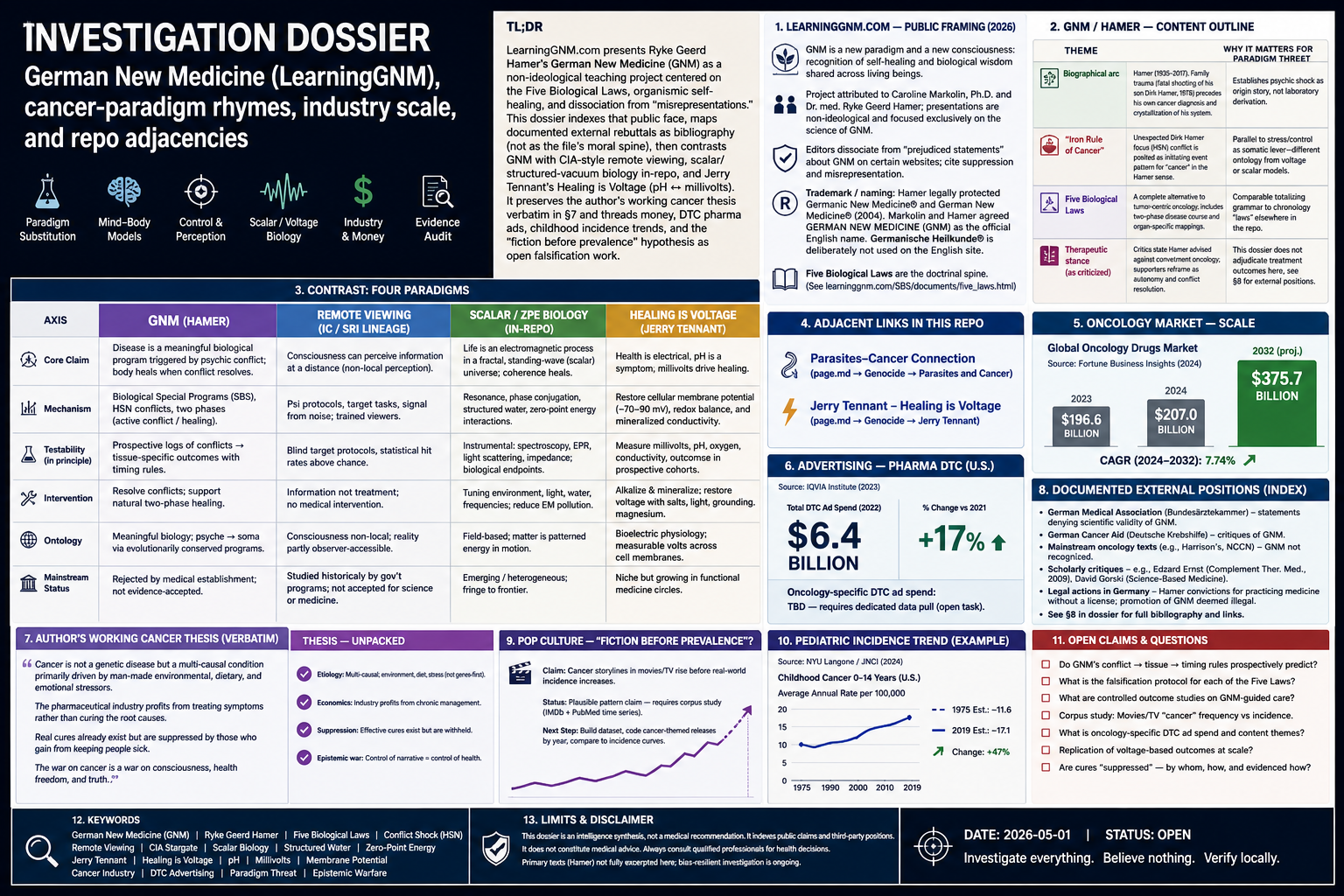
TL;DR: LearningGNM presents Ryke Geerd Hamer’s German New Medicine (GNM) as a non-ideological teaching project centered on the Five Biological Laws, organismic self-healing, and dissociation from “misrepresentations.” This dossier indexes that public face, maps documented external rebuttals (medical societies, journal articles, skeptical press) as bibliography—not as the file’s moral spine—then contrasts GNM with scalar / structured-vacuum biology in-repo and Jerry Tennant’s Healing is Voltage (pH ↔ millivolts). It preserves the author’s working cancer thesis (man-made / control / multi-causal cures / epistemic turf war) verbatim in §7.1 and closes with §7.2—1838 cell-oncology as pivot, evolution + eugenics continuity, inner blame vs terrain, post-1945 diffusion of grammar, and A Serious Man as control metaphor. §7.3 mirrors the reader essay The Cure for Cancer “light stack” (environment, vaccine-manufacturing questions, RF proximity, chemotherapy as terrain stressor, parasite lane) as a hypothesis registry without duplicating §7.1 verbatim. §9 anchors phenomenology vs theory (humoral → Müller 1838 → molecular). §10+ threads money, ads, fiction, open claims. Site root links parasites–cancer and Tennant (page.md).
Date: 2026-05-01 Status: Open — §7.2 author closing synthesis landed (2026-05-03); §7.3 reader-essay terrain stack mirrored (2026-05-01); primary Hamer corpus still thin; pop-culture corpus study pending; optional A Serious Man scene dossier pending.
Guide (read order)
- What LearningGNM says on tin → §1
- Hamer/GNM claims in outline → §2
- Contrast other paradigms (scalar, voltage) → §3
- Adjacent “cancer cure” and biology links in this repo → §4
- Oncology money (market reports) → §5
- Advertising (general pharma DTC; oncology-specific TBD) → §6
- Author’s thesis — opening (§7.1) + closing synthesis (§7.2) + reader-essay terrain stack (§7.3) → §7
- Documented external positions (index) → §8
- Pre-modern “cancer” in writing + author read on evolution-lab vs literature → §9
- Pop culture / “movies first” claim → §10
- Related investigations → §11
- Author’s open claims → §12
- Questions to clarify / debunk → §13
- Weak points / TODOs → §14
- Keywords + Limits → end
1. LearningGNM.com — public framing (2026 snapshot)
From the site home page (home.html):
- GNM is described as a new paradigm and a new consciousness: recognition of inexhaustible creativity and self-healing, and biological wisdom shared across living beings.
- The project is attributed to Caroline Markolin, Ph.D. and Dr. med. Ryke Geerd Hamer; presentations are said to be non-ideological and focused exclusively on “the science of GNM.”
- The editors dissociate from “prejudiced statements” about GNM on “certain websites” and cite suppression and misrepresentation (
why_gnm.html#Attention_Top). - Trademark / naming: Hamer legally protected Germanic New Medicine® and German New Medicine® (2004); Markolin and Hamer agreed GERMAN NEW MEDICINE (GNM) as official English name; Germanische Heilkunde® is deliberately not used on the English site because it implies pre-modern Germanic transmission rather than Hamer’s 1980s discoveries (same home page).
- Five Biological Laws are the doctrinal spine (opening page, five laws doc) — this investigation does not yet reproduce the full text of those laws; treat URLs as primaries for exact wording.
Interpretive note (neutral): The site’s self-description (“science,” “non-ideological”) is branding, not third-party classification. Falsifiable hooks for Hamer’s mechanistic claims live in tissue-specific conflict maps and timing rules (see §2, §13).
2. GNM / Hamer — content outline (for cross-repo search)
Biographical and doctrinal summaries are widely repeated in secondary sources (sympathetic and critical). For audit, prefer Hamer’s own publications and LearningGNM’s hosted PDFs over blog summaries.
| Theme | Short description | Why it matters for Paradigm Threat |
| Biographical arc | Hamer (1935–2017) was a physician; family trauma (fatal shooting of his son Dirk Hamer, 1978) precedes his own cancer diagnosis and the crystallization of his system. | Establishes psychic shock as origin story, not laboratory derivation. |
| “Iron Rule of Cancer” | Unexpected Dirk Hamer focus (HSN) conflict is posited as the initiating event pattern for “cancer” in the Hamer sense; resolution phases are tied to symptom clusters. | Parallel to repo interest in stress / control as somatic lever — but different ontology from voltage or scalar models (§3). |
| Five Biological Laws | Packaged as a complete alternative to tumor-centric oncology; includes two-phase disease course (active conflict vs healing) and organ-specific mappings. | Comparable totalizing grammar to chronology “laws” elsewhere in the repo — useful rhyme for paradigm substitution studies. |
| Therapeutic stance (as criticized) | Critics state Hamer advised against conventional oncology; supporters reframe as autonomy and conflict resolution. | This dossier does not adjudicate treatment outcomes here; see §8 index for external case law / society statements. |
3. Contrast: GNM vs scalar biology vs “Healing is Voltage”
| Axis | GNM (Hamer) | Scalar / ZPE biology (in-repo) | Jerry Tennant — Healing is Voltage |
| Core metaphor | Psyche → organ-specific biological program; two-phase somatic timeline tied to conflict. | Vacuum / medium / nested EM organizes form; DNA as fingerprint not executive program. | Cellular millivolts and pH as proxies for terrain; chronic illness as insufficient voltage to make new cells. |
| Epistemic home | Alternative medicine / New Medicine networks; LearningGNM as canonical English portal. | Timeline + biology dossier (DNA / scalar investigation). | Popular energy medicine + devices (e.g. Biomodulator); Tennant Institute; commercial book line. |
| Overlap with author cancer thesis | Strong on psychogenic and narrative control (who owns the meaning of “disease”). | Strong on redacted physics and ontogeny (what “life” is allowed to couple to). | Strong on terrain and electrochemical language — closest numeric rhyme to pH / internal milieu theses without importing Hamer’s organ law table. |
| Divergence | Conflict-specific organ maps are not Maxwell-medium models; not voltmeter-first. | No requirement that tumor equals conflict phase; substrate physics is orthogonal to Hamer’s psychograms. | Measurable framing (mV, pH) invites a different falsification path than Hamer’s HSN typology. |
Interpretive note (reader-essay alignment): GNM, Healing is Voltage, and scalar / DNA fingerprint biology are not interchangeable falsifiers—conflict-to-organ tables are not millivolt readouts. The reader essay The Cure for Cancer uses triangulation: each lane tries to restore terrain or patient authorship where cell-fatalism prefers passivity; none alone settles the others.
4. Repo adjacencies — cancer, parasites, voltage, scalar
| Resource | Location / URL | Note |
| Parasites cause cancer (external) | Linked from site page.md Genocide block | Author-curated lane: tumor ↔ infectious / parasitic etiology — not Hamer’s HSN model; treat as parallel alt-oncology. |
| Healing is Voltage (YouTube) | Linked from site page.md — “Science is Redacted” | Tennant lane; user-facing hook next to EU / gravity and Body Electric lineage. |
| DNA / scalar / first life | Investigation: DNA as fingerprint… | Shared paradigm-threat vocabulary for medium and form. |
| Circle of Life reader essay | The Circle of Life and How It Began | Bridges scalar, Bardo, reincarnation — spiritual technology basin adjacent to disclosure and frequency memes. |
| Predictive programming hub | fiction_encoding + Trump-era Hollywood | Where a future “cancer plot frequency” corpus study would land if the author wants hard counts. |
| The Cure for Cancer (reader essay) | science/biology/the-cure-for-cancer.md | Non-dossier voice: celebrity narrative, GNM primer (critical), terrain “light stack” (§7.3 mirrors); links this file for Limits and §8. |
| Vaccine Genocide (hub) | governance/genocide/vaccine/a.md + site page.md | Manufacturing / liability / batch heterogeneity threads (essay layer); not merged into Hamer HSN mechanics. |
| 5G Population Control (hub) | science/5g | RF density and control rhetoric lane cited from essay (phones, earbuds, rollouts). |
5. Oncology as revenue engine (consulting-firm figures — tier: secondary)
Market-research firms publish large global oncology forecasts; numbers differ by segment (therapeutics only vs. diagnostics + drugs + services). Treat as economic atmosphere, not clinical proof of any etiology.
| Source (secondary) | Claim (rounded) | Caveat |
| GlobeNewswire / industry PR | Oncology market ~USD 668B by 2034 (headline summary) | Press-release marketing; methodology in paywalled report. |
| GM Insights — oncology trends | 2024 cancer treatment segment ~USD 174.8B; multi-year CAGR cited | Same class: vendor analytics. |
| Data Bridge / similar portals | Alternate TAM and CAGR bands | Useful for order-of-magnitude only. |
Author-read: Whatever the exact USD band, oncology is a macro growth vertical inside healthcare GDP — compatible with the thesis that narrative lock-in and funding gravity exist even if every standard-of-care claim were true.
6. Advertising — what we can cite today
Oncology-specific DTC spend is not consolidated in the quick searches behind this file. What is easy to cite is all-drug DTC and top-spender dynamics:
| Source | Figure / claim |
| TechTarget on industry PR | Top 10 pharma ~USD 13.8B advertising/promotion 2023 (US) — headline cites AHIP / industry reporting chain. |
| AHIP — DTC “spending spree” | Payer-side critique of DTC growth (political economy angle). |
| GAO — Medicare & DTC drugs | 2016–2018: >half of USD 324B of USD 560B Medicare drug spend on advertised drugs (report scope per GAO). |
| Johns Hopkins Bloomberg SPH | DTC skew toward low added-benefit top sellers — structural critique. |
Open work: Extract oncology drug subset from IQVIA / Kantar ad-spend tables if the author wants a cancer-only ad line item.
7. Author’s originating thesis (verbatim)
7.1 Opening thesis — terrain, control, turf war
Our working theory for paradigm threat in general about cancer is that it is a man-made disease and a system of control. Cancer is so poorly understood in modern times that people have been convinced by movies and so forth that it’s completely normal and natural and occurs in nature. But the truth is that cancer does not occur in nature. It is not normal or natural. What is true is that cancer is like a yeast infection — an internal bacteria that grows as a result of a pH imbalance — and that the cure for cancer comes in many shapes and sizes. Lots of things cure cancer. Ivermectin cures cancer. THC cures cancer. Getting enough healthy activity and sunlight cures cancer, as does eating healthy food and avoiding poisons. Unprocessed honey cures cancer. Although none of this is supported by mainstream science, this is still the working theory of this repo, and all of our investigations are trying to find evidence that this is true or falsify it. So far no mainstream source has ever bothered to try to debunk the cancer cures or bothered to prove cancer is real in every single case. Cancer is assumed to have already existed and be scientifically proven, and the goal of curing cancer has been risen to such a height that it’s comparable to the second return of Jesus Christ — nobody could possibly claim to be real unless the entire world agreed at the exact same time, and that is not going to happen anytime soon. It is entirely a tribal turf war where science is concerned, and we have to wait until the turf war dies down before we can negotiate a truce on many issues unresolved.
What §7.1 means in Paradigm Threat vocabulary
- Control layer: Oncology as moral spectacle + credential monopoly + revenue concentration — rhymes governance and CO files without requiring any single villain.
- Ontology: Terrain (pH, microbiome, toxins, light, activity) preferred over gene-centric fatalism — closest technical neighbors in-repo are Tennant and parasite links, not Hamer’s HSN chart (unless the author later unifies them).
- Epistemics: Demands case-complete debunking / proving — framed as unreachable bar in public discourse — maps to §12 turf-war language.
7.2 Closing synthesis — 1838, inward blame, evolution, eugenics, and control (verbatim)
We conclude this investigation with the fact that before 1838, nobody had theorized cancer as a cell disease—and the concept could not have made sense to scientists in the modern cell-theory sense, because until Müller’s line, medicine was still operating with other causal pictures: humoral balance, visible tumor behavior, and—where causation was externalized—environment and regime (airs, waters, occupations, miasma-class thinking, Pott’s chimney-sweep link, etc.). The clue is that from 1838 the center of explanation moves inward: not (only) the milieu—it’s you; your body, your ancestry, your germ-line story. That coincides with Darwinian evolution going mainstream, and under that lens the human body is easy to read as an imperfect, temporary experiment—bound to break if selection keeps pushing. That timing is not read here as accident: it rhymes with eugenics philosophy maturing in the 19th century and hardening into 20th-century state programs. First you need laboratory rhetoric that other peoples are biologically lesser; then you stress innate susceptibility to “cell” disease while de-emphasizing the environmental layer—war toxins, new weapons, depleted and radioactive materials, ecological collapse in patches, infestation, industrial effluent—all rising in the same centuries. Funded scientists under government and academic protection could then narrate a “pure” bloodline with the best genes—language that feeds master-race ideology and the Nazi endpoint the world remembers. After 1945, the indictment here is that the deep grammar—gene fate, inner defect, surveillance by diagnosis—did not die in Berlin; it went global as common sense. The cellular cancer doctrine (hard to adjudicate case-by-case in public life) is read as not only racist in origin and application but as a worldwide system of control: any one of us can be singled out with a grim oncology label if we cross the establishment—the image invoked is the ending of A Serious Man (Coen brothers, 2009)—opaque verdict from the white-coat apparatus as fate.
What §7.2 adds (unpack)
- Chronology anchor: §9.2.1 supports the calendar claim that systematic “cancer = cell disease” literature starts with Müller (1838), not with Galen or the papyri.
- Ideological braid: Inner blame + heredity spectacle + evolutionary narrative of imperfection → eugenics-compatible jurisdiction over whose body counts as defective—independent of whether every 19th-century pathologist personally held racial doctrine.
- Terrain vs gene: The author re-centers environment and industrial violence as suppressed explananda once oncology professionalizes around intrinsic somatic failure.
- Postwar: Nazism as visible peak, not as unique container for all later oncology—the thesis is continuity of grammar, not that every oncologist is a crypto-fascist.
Documented tension (audit row — does not retract §7.2)
| Author narrative emphasis | Complication from standard history (keeps the file honest) |
| “Environment dropped after 1838” as cultural center of gravity | Occupational and irritation causes persisted in textbooks: Virchow argued local irritation and predisposition; 20th–21st c. carcinogen science is again strongly environmental. The author thesis targets default popular fatalism and gene spectacle, not every sentence ever published in toxicology. |
| Single Nazi lineage | Eugenics was transnational (US, UK, Nordic, etc.) before and after 1933; Nazi medicine is one fulfillment, not the only seedbed. |
Cultural anchor: A Serious Man (2009) — no in-repo dossier yet; optional fiction-encoding note if the author wants a full scene breakdown later.
7.3 Reader-essay terrain stack (The Cure for Cancer — hypothesis registry)
Purpose: Capture prose lanes introduced in the reader essay that extend but do not replace §7.1–§7.2. Tier: author / repo sketch; not adjudicated clinical guidance.
| Lane | What the essay adds (dossier capture) | Relation to GNM / this file |
| Generational / evolutionary mishap | Explicitly demoted as primary story for rising load: mutation and inheritance stay real, not moral excuse to ignore terrain. | Bridges §9.1 (Peto / comparative) without re-arguing that lane here. |
| Environmental infrastructure | Food quality, chronic stress, sleep, solvents / particulates, war residue, indoor air, water chemistry, soil-stripped calories, packaging, work-culture cortisol—stacked insults as pattern, not single villain molecule. | Terrain vocabulary aligned with §7.2 / §7.1 (pH / milieu) and §9.2 (Pott / toxicology exists in orthodox history). |
| Vaccination / manufacturing | Batch heterogeneity, adjuvant / process variance, factory by-products / contamination hypotheses; peanut allergy (and similar) cited as cohort “warrants” to trace process / liability, not single-cause proof; lot-to-lot signals without press room ≠ negative result. Hub: Vaccine Genocide. | Parallel suspicion lane—not Hamer HSN organ map. |
| RF / device proximity | 5G density, handsets, earbuds / duration and tissue coupling; thermal regulatory frame questioned as full biology. Hub: 5G Population Control. | Environmental / instrument stress without importing GNM two-phase rules. |
| Scalar / voltage layer | Cell as terminal in a field; chronic noise / deficit in same sentence as oncology (speculative institutional tier). Dossier: DNA as fingerprint…. | §3 neighbor; triangulation note above. |
| Infection / parasites | External parasites–cancer lane as milieu rhyme (biofilms / terrain weakness)—not HSN typology. | §4 already flags parallel alt-oncology. |
| Chemotherapy as terrain stressor | Cytotoxic burden, marrow / microbiome insult, neuropathy / DNA damage / immune clearance costs; institutional imaging clock vs resilience clock; essay temperature claim (correlational language, not universal law). | Does not adjudicate SOC efficacy here—indexes author read for §13 / §8-style literature hunting. |
| Tumor as symptom of imbalance | Repair terrain → mass may shrink / stabilize (pattern language); default incurability story + chemo-only posture without terrain work → mass often “takes encouragement.” Surgeons / imaging still warranted when obstruction / baseline demands it—fight is with narrative closure, not knife abolition. | Plain-language unpack of §7.1 yeast / pH metaphor without new verbatim block. |
| Celebrity / speech cost | Silence / managed story after alt lanes chosen—expensive part may be surviving the public narrative, not only the clinic bill. | Epistemic sociology parallel to suppression rows §1 / §8 (no docket replay). |
| Falsification bar (essay voice) | Preregistered cohort, blinded outcome review: Hamer-timeline predictions vs standard staging in matched groups, adversarial publication venue. Until then, essay files GNM as grand alternate : fascinating, risky as replacement without diagnostics, caricatured by interests in caricature, possibly false in mechanism while true in insult to fatalism. | Maps to §13 Q1 / Q9. |
8. Documented external positions (neutral index)
These sources reject or sharply qualify Hamer/GNM claims or document regulatory / legal responses. Listed for traceability; the body above does not re-argue their conclusions.
| Source | Type | URL |
| Deutsche Krebsgesellschaft | Professional society position (2024 PDF) | Wissenschaftliche Stellungnahme — Neue Germanische Medizin |
| Swiss Cancer League / oncology assessment | Society-level negative efficacy / safety review (frequently cited in secondary summaries) | Traced in Center for Inquiry PDF on Hamer |
| Rationality and irrationality in Hamer’s system | Peer-reviewed case / ethical analysis | PMC5936562 |
| Science-Based Medicine | Skeptical long-form | Iron Rule of Cancer / GNM article |
| Sympathetic integrative portal | Non-mainstream promotional framing (contrast pole) | FAIM — GNM page |
9. “Cancer before modernity” — two debunk lanes (author framing + documentary trail)
9.1 Author read: laboratory / evolution-embedded arguments vs. literary foundation
Investigation capture (paraphrase of author challenge): Replies that lean on comparative oncology, wildlife neoplasia, Peto’s paradox, and related population-genetic language often presuppose deep-time common descent and somatic evolution as working machinery. If that machinery is not granted as settled fact by the reader, those lines function as in-house consistency arguments within one paradigm, not as independent historical proof that malignant disease was always common or identical to today’s entity in humans. What would directly engage the accusation “cancer is a modern explosion / modern construct” at the documentary layer is continuous published discussion in medical and lay text before the twentieth century—especially before eugenics–evolution institutional ascendancy in Anglo academic medicine (author’s periodization).
What this section does: (a) records that author epistemic fork; (b) separates clinical phenomenology (lumps, courses, prognosis) from causal theory (what cancer is); (c) lists history-of-medicine anchors so “no one wrote about it” can be checked without equating καρκίνος with 2026 molecular oncology.
9.2 Pre-twentieth-century textual attestation (selected; secondary + survey tiers)
9.2.1 Phenomenology vs. theory — the distinction you are pointing at
| Layer | What pre-modern texts usually give | What they usually do not give |
| Phenomenology | Examination findings, natural history, prognosis, surgery / diet / cautery advice | — |
| Theory of cancer (causal model) | Yes, but not modern theory: humors, black bile (Hippocratic–Galenic line), focal vs systemic doctrine, later lymph / irritation hypotheses, then 19th c. cell-level pathology | Clonal somatic mutation, oncogenes / tumor suppressors, DNA repair failure as today’s standard explanation |
Straight answer: Edwin Smith–class entries are chiefly case phenomenology (“bulging tumor,” no treatment) — they are not a theory of carcinogenesis in the modern sense. Hippocrates and Galen do advance a theory: cancer as part of humoral pathology (melancholia / black bile tradition), plus clinical taxonomy (καρκίνος / carcinoma, benign-vs-malignant behavior in practice if not histology). That is a theory — it is not your theory or today’s lab consensus. Pott (1775) adds environmental causation (occupation → cancer). Müller (1838) and Virchow (1858) move ontology to microscopic cells and pathological tissue — the closest pre-20th literature gets to a naturalistic “what is wrong in the body” story without genetics. Twentieth century adds mutation, viruses, chemical carcinogenesis experiments, etc.
So: tumors in old texts ≠ absence of any theory; but ≠ proof that the current scientific theory was already on the table in 3000 BCE.
Historians often retro-label καρκίνος as “cancer” for continuity of clinical picture, not because Galen held somatic evolution or Peto.
| Period | Source | Phenomenology (what they saw / did) | Theory encoded (what they thought it was) |
| ~1600 BCE copy (debated) | Edwin Smith Papyrus | Breast mass, palpation, incurable verdict | Primarily observational surgical text; no Galenic humor framework in that document as in Greece |
| ~1550 BCE | Ebers Papyrus | Swellings, remedies | Magical / pharmacological mix per Egyptian medicine scholarship — not modern etiology |
| 5th–4th c. BCE | Hippocratic Corpus | καρκίνος / καρκίνωμα, prognosis, surgery discouraged for internal cases | Humoral: black bile / melancholic doctrine (standard reading of Hippocratic cancer etiology) |
| 1st c. CE | Celsus | Latin cancer, operations, topicals | Inherited classical framework + surgical praxis |
| 2nd c. CE | Galen | Malignant vs other tumors, course | Galenic physiology and humoral excess interpretation of cancer |
| 1775 | Percivall Pott | Chimney-sweep scrotal cancer | Environmental cause — early modern carcinogenesis hypothesis |
| 1838 | Johannes Müller — Ueber den feineren Bau und die Formen der krankhaften Geschwulste | Systematic microscopy of benign and malignant tumors (English transl. 1840) | Cell-theory era oncology: neoplasms analyzed as cellular structures (with blastema errors later corrected by Remak–Virchow) |
| 1858 | Rudolf Virchow — Die Cellularpathologie | Macro- and microscopic synthesis | Cellular pathology as general program; “omnis cellula e cellula” vs humoral oncology |
Cellular pathology before the 19th century? No in the Müller–Virchow sense. Pre-1801 sources do not describe cancer as pathology of cells because unified cell theory (Schleiden–Schwann, 1838–1839) and tumor histology had not yet formed that discipline. Eighteenth-century work (e.g. Morgagni—organ and gross lesion correlation) stays macroscopic. Loose uses of “cells” or early microscopy (17th–18th c.) do not equal oncologic cellular pathology as later literature defines it. Survey: Hajdu — Landmarks in history of cancer, part 3, Cancer 2012.
Verdict for §7 hooks (tightened):
- “No one mentioned cancer-class illness” → weak against the table above (phenomenology + named disease).
- “The modern scientific theory of cancer existed before modernity” → false if “theory” means today’s molecular oncology; partially true if “theory” means humoral / cellular successive models.
- “Incidence / industrial cause / social construction of the cancer category” → orthogonal to whether Hippocrates wrote καρκίνος — those claims need epidemiology and conceptual history, not only Edwin Smith.
9.3 Comparative-evolution lane (still logged for falsification of §7)
Evolutionary and comparative oncology discuss neoplasia across species and Peto’s paradox — e.g. Nature Reviews Cancer, PMC5513346. Per §9.1, this lane does not substitute for literary history when the reader rejects the evolutionary axiom; it remains relevant when that axiom is granted.
10. “Movies / TV before real-world childhood cancer prevalence” — status
Author suspicion: Fiction normalized cancer before demographics made it feel ubiquitous; possible predictive programming or industry spectacle feedback.
Reader-essay cross-index (narrative instruction — not evidence tiers): The essay names Man on the Moon (1999) as Hollywood instruction that “fringe” cancer lanes fail, and a Return of the King (2003) frame meme (Frodo / Sam) as accusation inversion — spectacle hooks only; scene timestamps optional if the author wants a deeper fiction-encoding note later.
Documented partials:
- Childhood cancer incidence in the US has risen in SEER-era statistics (e.g. 14.23 → 18.89 per 100k, 1975–79 vs 2010–19, APC ~0.73%), with discussion of detection / registration artifacts — PLOS One 2025 / PMC11698462.
- Fiction lead-lag: No file here yet performs IMDb / subtitle corpus timing against incidence curves. That is a dedicated predictive-programming sub-study (candidate: align first aired dates of pediatric oncology plot episodes vs SEER age-stratified curves).
11. Related investigations (table)
| File | Relation |
| The Cure for Cancer | Reader essay — hope / celebrity / terrain / GNM primer (critical) + light stack (mirrored in §7.3); points to this file and Limits. |
| DNA as fingerprint, not blueprint | Scalar / medium / ontogeny neighbor |
| Trump-era Hollywood PP | Template for spectacle frequency methods |
12. Author’s open claims (registry)
- Cancer is predominantly man-made and operates as social control (not only somatic misrepair).
- Wild / “natural” cancer is denied or reframed — yeast-like / bacterial / pH internal milieu model.
- Many interventions (author lists ivermectin, THC, sunlight, activity, clean food, toxin avoidance, raw honey) are curative classes — mainstream has not run the adjudication the author wants.
- Cultural normalization via film/TV precedes or exceeds felt real-world base rate — timing to be tested.
- Oncology behaves as tribal turf war with Messianic “cure” framing — negotiation deferred until war cools.
- Pre-1838, no cell-disease theory of cancer; 1838 marks the literary pivot to intrinsic somatic ontology (Müller line).
- That pivot coincides (non-accidentally) with ascendant Darwinism and with eugenics-friendly heredity rhetoric that down-ranks terrain (war, toxins, radiation, ecological damage).
- Laboratory narratives of racial / lineage “purity” and innate disease susceptibility feed master-race grammar and Nazi medicine as one endpoint; post-1945 the same grammar diffuses globally, not extinguished by defeat of Germany.
- Cellular cancer as hard-to-falsify in everyday life functions as racist and as establishment control: anyone can receive a grim diagnosis as sanction—A Serious Man as metaphor.
13. Questions to clarify, verify, or debunk
| # | Question | Falsification / source direction |
| Q1 | Does Hamer’s organ map predict tissue outcomes better than chance in a blinded registry? | Prospective cohort design; compare to SEER organ incidence base rates. |
| Q2 | Honey / THC / ivermectin — what oncology trial literature exists (positive and negative)? | PRISMA-style search; separate in vitro hype from human endpoints. |
| Q3 | Fiction lead-lag — is there a measurable gap for pediatric cancer plots vs incidence? | Build subtitle / metadata corpus; join to SEER age 0–14 annual rates. |
| Q4 | “Cancer in nature” — does the author redefine cancer (e.g. only industrial carcinoma counts)? | Precise definition table: neoplasia vs clinicopathologic “cancer.” |
| Q5 | Does pre-1900 text prove high incidence, or only recognition of fatal tumor syndromes? | Paleopathology + literary frequency studies; avoid conflating named disease continuity with population rates. |
| Q6 | When the author asks for “the theory of cancer” in old literature, which tier is meant: humoral Galenic, cellular Virchow, or molecular oncology? | §9.2.1 table; pin definitions before debunk exchange. |
| Q7 | §7.2 braid—correlation vs causation: Müller/Virchow cell oncology and Galtonian eugenics overlap in time and institution, but what primary sources tie specific pathologists to specific racial policies? | Archives, biographies, Kevles/Stepan-class secondary synthesis; avoid single decade collapse. |
| Q8 | Environmental oncology (IARC, toxicology, occupational health) vs §7.2 “suppressed terrain”—measure funding and media share of voice 1900–2025. | Bibliometric or policy survey; separate academic subfield existence from public mythology. |
| Q9 | Essay falsification offer: preregistered, blinded outcomes comparing Hamer-timeline predictions to TNM / histology staging in matched cohorts—does any lab or registry exist or could it be built without bad ethics? | Protocol design / power calc ; see §7.3 last row. |
| Q10 | Chemotherapy vs terrain resilience : longitudinal QoL / inflammatory markers / second-primary risk stacks when SOC used without supportive milieu work—what does honest literature say at population level vs anecdote? | NCCN-adjacent reviews + survivorship studies ; separate tumor shrink from host reserve. |
14. Weak points / remaining research TODOs
- Host or mirror key LearningGNM PDFs with stable anchors (copyright / fair-use policy per site terms).
- Pull Five Biological Laws into an appendix with verbatim quotes + section anchors.
- Add oncology DTC subset table once IQVIA or STAT spend data located.
- IMDb keyword “cancer” / childhood illness — yearly counts 1960–2025.
- Cross-read German primary court records on Olivia Pilhar case (widely cited in §8-type literature) for primary quotes.
- Add primary citations to Breasted / Chicago Edwin Smith translation and Kouzis (1902) monograph on ancient Greek physicians and cancer (named in MDPI review).
- §7.3 literature pulls: batch-variance vaccine safety epidemiology (non polemic primaries where possible), RF dosimetry vs biology (animal / in vitro tiers), chemotherapy host effects (§13 Q10).
- §7.2 deepening: eugenics–oncology institutional timeline (US **/ ** UK **/ ** DE) with primary footnotes; optional A Serious Man ending — fiction-encoding paragraph.
Keywords: #GermanNewMedicine #Learninggnm #CancerParadigm #OncologyMarket #ParadigmThreatFiles #ScalarBiology #HealingIsVoltage #TerrainThesis #DocumentedRebuttals #Eugenics #CellularPathology1838 #SeriousMan #IdeologyOfControl #TheCureForCancer #TerrainFirst
Last updated: 2026-05-01
Limits and disclaimers
This repository’s investigations separate author thesis (§7.1–§7.2) from indexed third-party material (§8–14). §7.3 restates hypotheses surfaced in the reader essay The Cure for Cancer as a registry — same non-advice tier as that essay’s “light stack” (vaccines, RF, chemotherapy suspicion language). §7.2 is explicitly ideological synthesis and pattern language about history and power; it is not a consensus historiographic verdict. §7.2 audit row flags where standard history complicates mono-causal “environment vanished” claims. Market sizes and ad spend figures are industry-research or press tiers, not clinical evidence. Hamer / GNM mechanical claims are disputed in the sources listed in §8; this file records those disputes without substituting them for the author’s program in §7. §9.2 summarizes standard medical-history narratives; Egyptian papyrus dating and retrodiagnosis of any one case remain scholarly discussion topics. Nothing here is personal medical advice. Investigator notes: none.
Share