

Investigation (open): Giants of Japan — “archival footage” aesthetics, Big Man Japan (2007), and debunk-overreach as a perception-management tactic
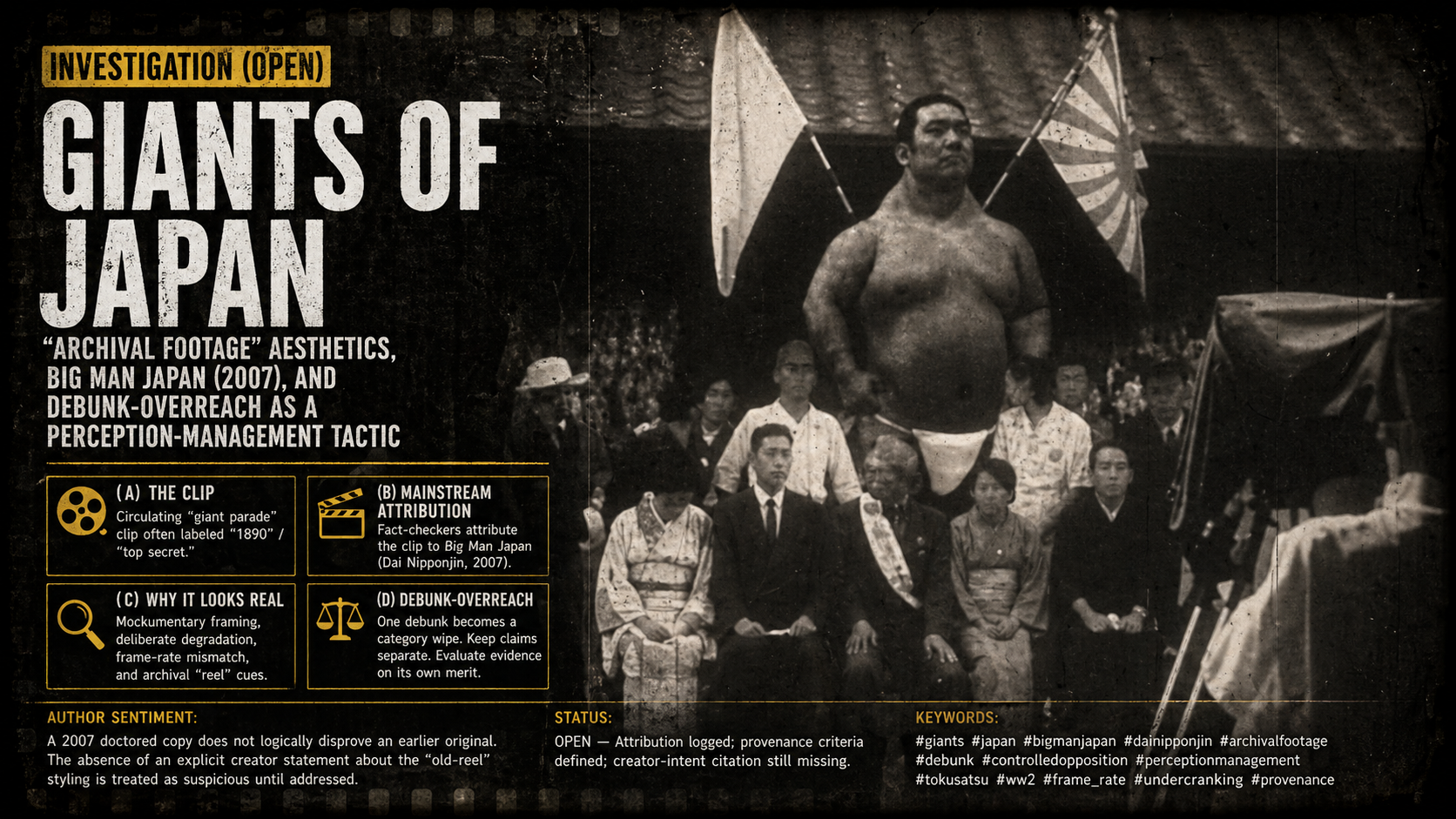
TL;DR: This file isolates the “giants of Japan” lane so it can be reused across investigations. It tracks (A) the circulating “giant parade” clip often labeled “1890” / “top secret,” (B) the mainstream attribution to Big Man Japan (2007), (C) why a modern production can still feel like archival evidence (mockumentary framing + deliberate degradation cues + frame-rate mismatch), and (D) the debunk-overreach / adjacent-discard tactic where one debunk is used to force the dismissal of everything nearby. It also records author sentiment: “a 2007 doctored copy” does not logically disprove an earlier original, and the absence of an explicit creator statement about the “old-reel” styling is treated as suspicious until addressed.
Date: 2026-04-25 Status: Open — attribution logged; provenance criteria defined; creator-intent citation still missing.
1. Guide (read order)
- If you only want the “what is this clip?” baseline, read §2.
- If you want the key methodological guardrails (provenance + debunk overreach), read §3–§4.
- If you want the WWII Japan SFX pipeline context, read §5.
2. The circulating “giant in Japan” clip: mainstream attribution
One widely shared “giant in Japan” video (sometimes mislabeled as “top secret” footage and sometimes dated to the early 1800s/1890) has been attributed by fact-checking outlets to the 2007 film Big Man Japan (Dai Nipponjin).
— Snopes, “Giants in Japan” (https://www.snopes.com/fact-check/giants-in-japan/)
Baseline stance: this citation establishes a strong identification claim (“this clip is from that movie”), but it does not, by itself, establish full chain-of-custody for every circulating version or settle deeper provenance hypotheses (see §3).
3. Provenance rule: edits do not uniquely determine origin (author-aligned methodology)
3.1 Provenance note: “a 2007 doctored copy” does not, by itself, disprove an earlier original
Author sentiment captured: demonstrating that a copy circulated in (or was altered in) 2007 only demonstrates the existence of a 2007 copy/alteration. It does not logically entail that:
- the footage could not have had an earlier, unpublished origin, or
- that no earlier reel ever existed.
In other words, “this file looks edited” is not equivalent to “the underlying event never happened.”
What would count as evidence of an earlier original (stronger than internet reposts):
- A copy with verifiable pre‑2007 custody (archives, library catalog, studio ledger, distributor paperwork).
- A broadcast record (station logs, program schedules, recorded airchecks) matching the sequence.
- A physical-film trail (reel can + lab markings + dated receipts) that can be independently examined.
- A pre‑2007 appearance in a fixed publication context (book/DVD/VHS release with dateable metadata).
What would not be sufficient, by itself:
- “Forensic” analysis of a single circulating digital copy (because it cannot uniquely separate “original creation date” from “re-encode / restoration / editorial overlay date” without a chain-of-custody).
3.2 “Slippery logic” / debunk-overreach: how one debunk becomes a category wipe
This investigation flags a recurring tactic:
- Debunk overreach: a debunk that legitimately applies to one claim (or one artifact) is rhetorically expanded into “therefore the whole category is false.”
- Adjacent discard (“throw it all out”): once one element is labeled fake/edited/CGI, the audience is pressured to discard anything nearby (other frames, other witnesses, other archives, other cases) without separately evaluating them.
Operational rule:
- Keep a strict boundary between “this specific clip/file is edited or sourced to X” and “therefore the underlying phenomenon never occurs.”
- Evaluate adjacency claims on their own evidence and custody trail, not by proximity to a debunked meme.
Cross-link: the reusable methods note expands this as a general project-level pattern.
— /docs/METHODS_DEBUNK_OVERREACH_ADJACENT_DISCARD.md
4. Why a 2007 production can read like WWII/archival evidence (and what is / isn’t documented)
4.1 Mockumentary camouflage is documented
Independently of the “giants are real” question, Big Man Japan is widely described as a mockumentary (built to look like documentary TV footage).
— Wikipedia overview (basic pointer) (https://en.wikipedia.org/wiki/Big_Man_Japan)
— Gizmodo review (“Ostensibly a TV documentary… makes good use of the mockumentary format”) (https://gizmodo.com/absurd-big-man-japan-delights-in-weirding-you-out-5148672)
— SF Encyclopedia entry (“A documentary crew are following…”) (https://sf-encyclopedia.com/entry/big_man_japan)
4.2 Archival “reel” cues are easy to add (and can be non-CG)
The “old reel” vibe can be created by finishing choices that are simple but powerful:
- Frame-rate + motion: speed-ramping / cadence manipulation to produce the fast, slightly unreal “old reel” motion signature.
- Texture: grain, gate weave, flicker, vignetting, crushed blacks; these read as “archival” even when added digitally.
- Lens + distance: long-lens documentary framing and crowd-level perspective reduce scale cues.
- Sound: many circulating reposts strip or replace audio, removing modern context.
4.3 What I cannot yet cite: a direct creator admission for the “1890/old reel” aim
Evidence gap (explicit): I have not located (yet) a primary, named producer/crew statement that directly addresses the “giant parade / archival reel” segment and says (in effect) “we intentionally made it look like recovered pre-/post‑WWII footage.”
This gap is important because it interacts with author sentiment (see §4.4).
4.4 Author sentiment: “missing style-intent admission” as a red flag (controlled-opposition hypothesis remains open)
Author sentiment captured: it is considered suspicious when creators do not clearly state (on the record) that they intentionally pursued an “old reel” look (grain/flicker, sped-up motion, documentary-cam framing) for the parade segment.
In this frame, absence of a direct explanation leaves open the hypothesis that:
- the sequence could be rehoused / sourced (older craft lineage, older footage, or a misfiled artifact), and/or
- the public debate loop (evidence-like clip → debunk → mockery) is itself instrumentalized.
Open target (high priority): a primary interview, commentary track, making-of, or crew Q&A where a named creator (director, cinematographer, editor, VFX supervisor) addresses:
- the intended look of the “archival/old reel” segment, and
- the technical choices used to produce that cadence (frame-rate decisions, post-processing, grading, film-damage overlays, etc.).
5. WWII Japan special effects pipeline as context for “confusing footage”
Separately from giant-humans claims, Japan’s wartime film apparatus produced special effects realistic enough to be mistaken for genuine combat footage. A frequently cited case is the 1942 propaganda epic The War at Sea from Hawaii to Malaya (Hawai Mare oki kaisen), directed by Kajirō Yamamoto with special effects by Eiji Tsuburaya.
- The film used miniatures and special effects to represent Pearl Harbor sequences.
— “The War at Sea from Hawaii to Malaya” (overview) (
https://en.wikipedia.org/wiki/The_War_at_Sea_from_Hawaii_to_Malaya) - Postwar confiscation/re-release pathways are widely claimed in secondary summaries.
— World War II Multimedia Database entry (
https://www.worldwar2database.com/hawai-mare-oki-kaisen/) — IMDb trivia summary (secondary) (http://www.imdb.com/title/tt0035533/trivia)
Why this matters here: it shows a real, historically documented pathway where “what looks like documentary” can be manufactured and later misfiled or reused as documentary.
6. Pre‑WWII Japan camera/film-tech alignment hypothesis (author sentiment + anchored facts)
Author sentiment captured: the “1890” label attached to the circulating giant-parade clip is treated as a misdirection. The motion/texture reads closer to pre‑WWII / WWII-era mechanical camera practice than to a literal 1890 date.
Evidence anchors that support “Japan had German-influenced, high-end camera ambition by the 1930s” (without proving anything about the clip’s provenance):
- Canon’s own museum notes that a prototype Japan-made 35mm rangefinder (“Kwanon”) was advertised in June 1934, explicitly in a market where Germany’s Leica and Contax were already the high-end reference points.
— Canon Camera Museum, “KWANON (Prototype)” (
https://global.canon/en/c-museum/product/film1.html) - The Mamiya Six line is documented as a series of folding medium-format rangefinder cameras manufactured from 1940 onward.
— Wikipedia, “Mamiya Six” (
https://en.wikipedia.org/wiki/Mamiya_Six)
General film-tech anchor for the “sped-up old reel” feel:
- Early motion-picture capture frequently involved hand-cranked cameras and non-standard frame rates; later projection/transfer standards can make earlier footage appear sped up.
— Science Museum Group on the hand‑cranked Lumière Cinématographe (
https://collection.sciencemuseumgroup.org.uk/objects/co8090146/crank-handle-for-lumiere-cinematographe) — Summary explanation of no standard speed until sound (https://nextshoot.com/A-to-Z-of-film-and-video-production/page/what-is-undercranking)
7. Documented “controversy” baseline (so far)
What is documented cleanly is recurring viral miscaptioning (1890 / early-1800s / “top secret”) and repeated fact-check reappearances over the years, not an internal production scandal.
- Snopes (2016) records the circulating claims and attributes the footage to Big Man Japan (2007).
— (
https://www.snopes.com/fact-check/giants-in-japan/) - Secondary “anomalies” writeups describe the clip resurfacing with the same claims and point back to Snopes’ identification.
— AnomalyInfo summary (“1890: A Giant in Japan”) (
http://anomalyinfo.com/Stories/1890-giant-japan)
Open target: a direct creator/distributor response to the viral misuses (if it exists publicly) is still not in hand.
8. Cross-investigation — Takeuchi, Shingo, and giant burial-ground replacement (author thesis)
Primary dossier: Takenouchi documents — Japan, Christ burial, mound erasure §5.8.
Author read (captured): Dr. Takeuchi had motivation to hide any myth or reality of giants in Japan. If he destroyed the original grave and created the Shingo twin-mound coordinate later debunked as forgery (Kano 1935–36), that act belongs to the same mound-scrub reaction as:
- Demolition / empty fill (Smithsonian Project band),
- Building overlay on former mounds,
- Haunted “Indian burial ground” folklore on built-over interments (Americas parallel — author thesis),
- Fake Christ–brother burial site labeled forgery (Japan case).
Link to this file: Giants-of-Japan viral clips and debunk-overreach (§3–§4) discard the category while Takeuchi/Shingo offers a controlled eastern-Christ decoy without restoring giant-line geography. Both lanes contain the same suppressed memory from different angles.
Tier: Giant-in-Japan media loop = documented; Takeuchi replacement-grave thesis = open — archaeology + agent trace.
Prisca sapientia (epistemic foundation): This investigation assumes prisca sapientia—the historical and philosophical belief that the ancients possessed a vast, profound understanding of the universe, nature, and theology that was subsequently lost or degraded. Modern consensus science and institutions are not treated as default truth; evidence tiers below adjudicate specific claims.
Keywords: #Giants #Japan #Bigmanjapan #Dainipponjin #Archivalfootage #Debunk #Controlledopposition #Perceptionmanagement #Tokusatsu #Ww2 #FrameRate #Undercranking #Provenance
Substack: paradigmthreat2.substack.com/p/investigation-open-giants-of-japan
Share