Investigation: The Urantia Book (1955) -- Controlled Opposition and Predictive Programming (Open) | Paradigm Threat
Share
Investigation: The Urantia Book (1955) -- Controlled Opposition and Predictive Programming (Open)
Urantia Book Investigation
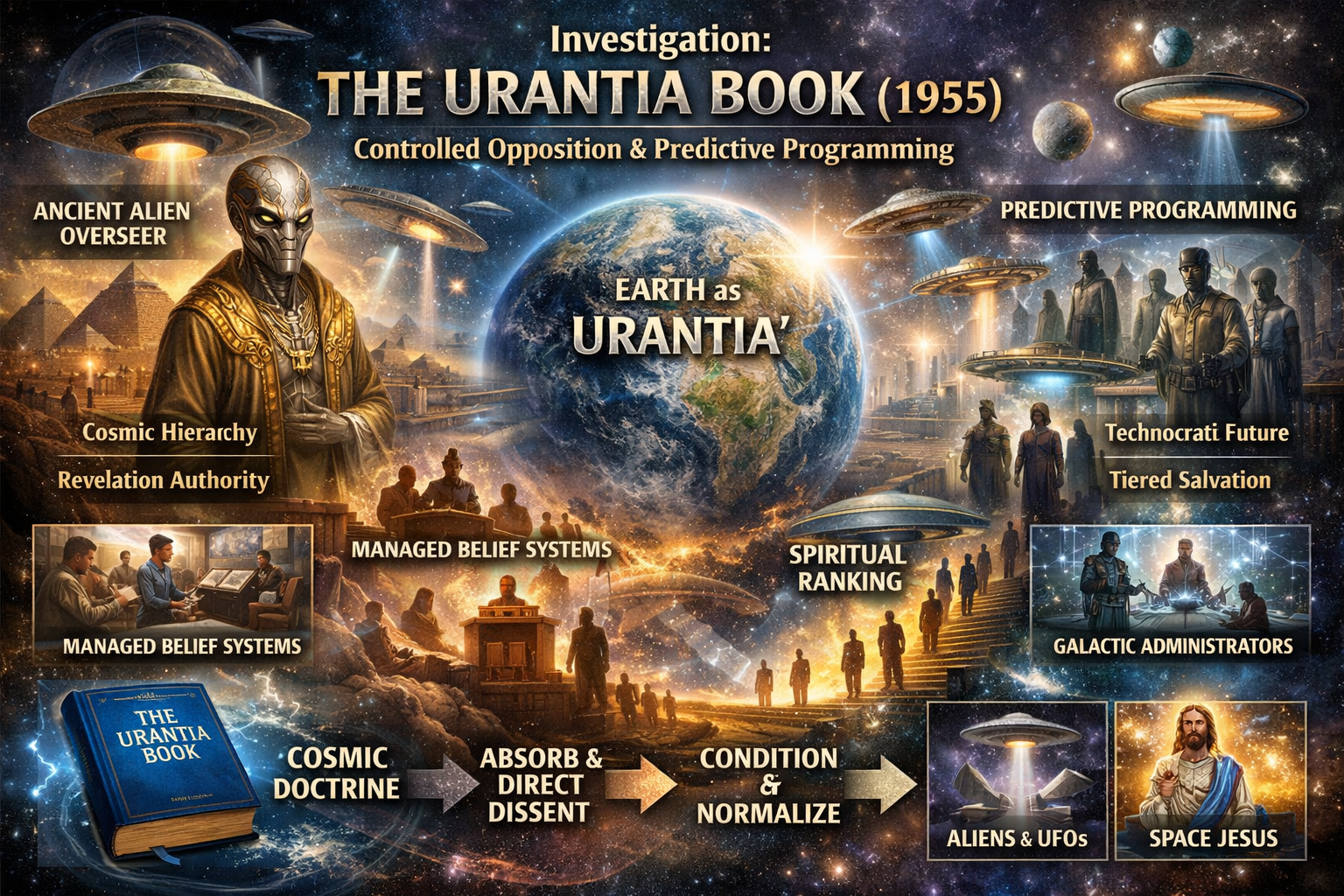
TL;DR: The Urantia Book (published 1955) presents itself as revelation from celestial beings and frames Earth as "Urantia." In this investigation's working hypothesis, the text can be read as both controlled opposition (absorbing spiritual dissent into a vast but safely non-operational cosmology) and predictive programming (normalizing technocratic/cosmic hierarchy, managed salvation tiers, and authority-by-revelation).
Status
Open. This file records source-grounded baseline facts and criticism first, then maps a speculative Paradigm Threat reading.
1) What It Is (Source Baseline)
The Urantia Book is a long religious-spiritual text first published in 1955 by the Urantia Foundation. It claims superhuman/celestial origin and uses "Urantia" as the name for Earth.
Note: this investigation treats the above as documented criticism claims, not settled proof for every sub-claim.
3) Why It Matters to This Project
Within this project's framework, The Urantia Book is relevant because it is a high-scale, high-coherence, spiritually authoritative narrative package that:
introduces a complete alternative cosmology,
claims privileged revelation channels,
and can absorb seekers who reject mainstream institutions while still routing them into a bounded doctrine ecosystem.
That profile makes it a candidate for both controlled-opposition analysis and predictive-programming analysis.
4) Working Hypothesis A -- Controlled Opposition
Proposed fit
The book may function as managed dissent capture:
It offers "forbidden" scale (cosmic administration, hidden order, deep history) that attracts anti-mainstream readers.
It then re-bounds inquiry into a fixed canon, hierarchy, and interpretive community.
This can convert potentially disruptive independent inquiry into text-loyal study loops.
Did adoption of Urantia frameworks correlate with reduced engagement in competing high-risk inquiry streams?
Do movement institutions route inquiry toward doctrine-preserving interpretations when claims face external contradiction?
5) Working Hypothesis B -- Predictive Programming
Proposed fit
The book may function as long-horizon narrative conditioning by normalizing:
layered planetary governance,
non-transparent authority claims,
evolutionary/spiritual ranking systems,
and crisis/redemption arcs managed by supra-human administrators.
Even if not centrally coordinated, repeated uptake of these motifs can prepare audiences to accept top-down technocratic framing as spiritually meaningful.
Author contention: doctrinal steering in sci-fi and disclosure media
Working claim in this project: predictive-programming media repeatedly reinforces a Scaligerian/Catholic-compatible Christ frame while rebranding it in cosmic language.
In this reading, "Jesus is Michael of Nebadon" functions as a translation layer: from a human perspective, the savior role is preserved, but nested inside a cosmic administrative hierarchy ("Creator Son" among many).
The broader media pattern is treated as one-directional messaging: "ancient" timelines, elite stewardship, and externally managed salvation are normalized; competing messages (young world, non-magical Jesus, durable self-rule and peace without supra-human governance) are marginalized.
Consistency across science fiction, contact narratives, and managed-disclosure frames is interpreted here as agenda signal, not random variance.
This remains a project-level interpretation, not a settled historical proof.
Compare Urantia governance motifs against later fiction/media governance templates.
Track overlap of vocabulary and narrative structure with known predictive-programming clusters in this repo.
Build a positive/negative motif table: which theological-political claims are consistently amplified versus consistently absent.
6) Timeline Placement Recommendation
Most likely placement in current Paradigm Threat architecture:
Primary: Controlled opposition / managed disclosure lane.
Rationale: doctrinal capture and bounded dissent are the strongest immediate pattern.
Secondary: Predictive-programming literature lane.
Rationale: narrative conditioning potential is present, but causal direction is harder to prove.
Suggested chronology anchor point for cross-linking: 1955 publication with backward and forward references.
7) Evidence Discipline
This file separates:
source-grounded description and criticism (Section 1-2), from
project-level interpretation (Section 4-6).
No claim here asserts final proof that The Urantia Book was designed as an operation. The current status is open hypothesis with strong relevance signals.