
You do not have to stop loving Cave Story
Keep loving Cave Story while splitting credit packaging from the pixels you loved
When Cave Story first came out, it was not really what the moment seemed to want—the wider scene had already filed two dimensions and visible pixels under “obsolete” and “legacy” as if the only serious future arrived in triangles and normal maps. Then this stubborn side-on island showed up anyway, and for old-school players it landed like every craving they had stopped saying out loud finally answered at once. I myself have been through Hell in Cave Story—the optional late-game stage that actually goes by that name—so I have no intention of diminishing that memory. I am writing because community labor and inspectable craft norms keep colliding with a glossy “one genius did it” receipt, and because the companion dossier already gathers the timelines, interviews, and falsifiers I lean on here: Cave Story × Studio Pixel × Nicalis — controlled opposition investigation. This article is what I would hand a friend who does not live inside forum archaeology.
TL;DR: Keep loving Cave Story while splitting the credit packaging from the pixels you loved. This article moves from what the public record actually shows through Nintendo’s hardware arc, the 2020 GitHub enforcement beat, and the “silver platter” pattern into ethics and late-capital media choke points. For timelines, tables, and investigator falsifiers, use the companion dossier, Cave Story × Studio Pixel × Nicalis — controlled opposition investigation.
 Cave Story
What Cave Story is, and what the public record supports
Cave Story (Doukutsu Monogatari) is a Japanese side-scrolling action game—two-dimensional platforming in the Mario grammar many of us grew up on. It shipped as PC freeware in 2004 and became a legend in English because fans translated it, argued about it, and passed the binary hand-to-hand before “indie” was a shelf brand at GameStop. Indie now often means a market aesthetic; then it meant small-team or solo mythos plus internet distribution. WiiWare, Steam, Cave Story+, and the rest came later through commercial publishers, especially Nicalis; in my shorthand, the free-game myth was sold into the Nintendo / Nicalis lane. The default fan belief is now almost catechism: one person, five years. This article asks why that belief became so total when the accessible evidence does not show five years of weekly, inspectable work.
Studio Pixel was never “one human and zero collaborators” in the sense of zero outside brains. At least one credited developer plus a network of feedback and beta testing around the freeware era is on the record in interview and forum traces (the dossier’s §2 anchors include the April 2005 TIGSource interview mirror). Picture that floor when you think about polish and stress-testing.
Whether the public face personally wrote the engine, scored every track, invented every narrative hinge alone, typed every line of dialogue, and carried every other load that usually shows up as specialized hands when budgets are honest—that bar is not publicly documented to a level I think the global gaming audience should have to meet on faith alone. Five years is long enough that one principal could hypothetically cover the whole stack; the harder question is how much of the process was ever inspectable from outside Japan in languages and channels the rest of the world actually reads.
Toby Fox’s Undertale (2015) matters here less as lore than as contrast: a hit many readers experienced as legibly individual-driven, with a process story that felt closer to “inspectable bedroom miracle” than the dossier’s read of Cave Story’s public trail. The sharper investigator voice on genuine proof versus pre-colored precedent lives in §1.7. I keep both games in my heart and still audit what was ever verifiable.
NDA-shaped silence, figurehead credit, and thin primary trails on high-value Japanese entertainment products sit in ordinary trade press and fan memory, not in a niche corner. Nintendo’s public reputation around emulation, modding, and DMCA-heavy enforcement is, right now, about as poor as online memory gets. That climate does not adjudicate any single line on Cave Story; it only explains why reopening the solo-genius packaging can happen without treating skepticism as an attack on your childhood or on the love you feel for the pixels on screen. My working thesis is stronger than ordinary skepticism: this was an industry-made or industry-assisted object, possibly from a Nintendo R&D1-adjacent talent pool, repackaged as a free fan-made miracle.
The one-year plan, three-week build, and the five-year sticker
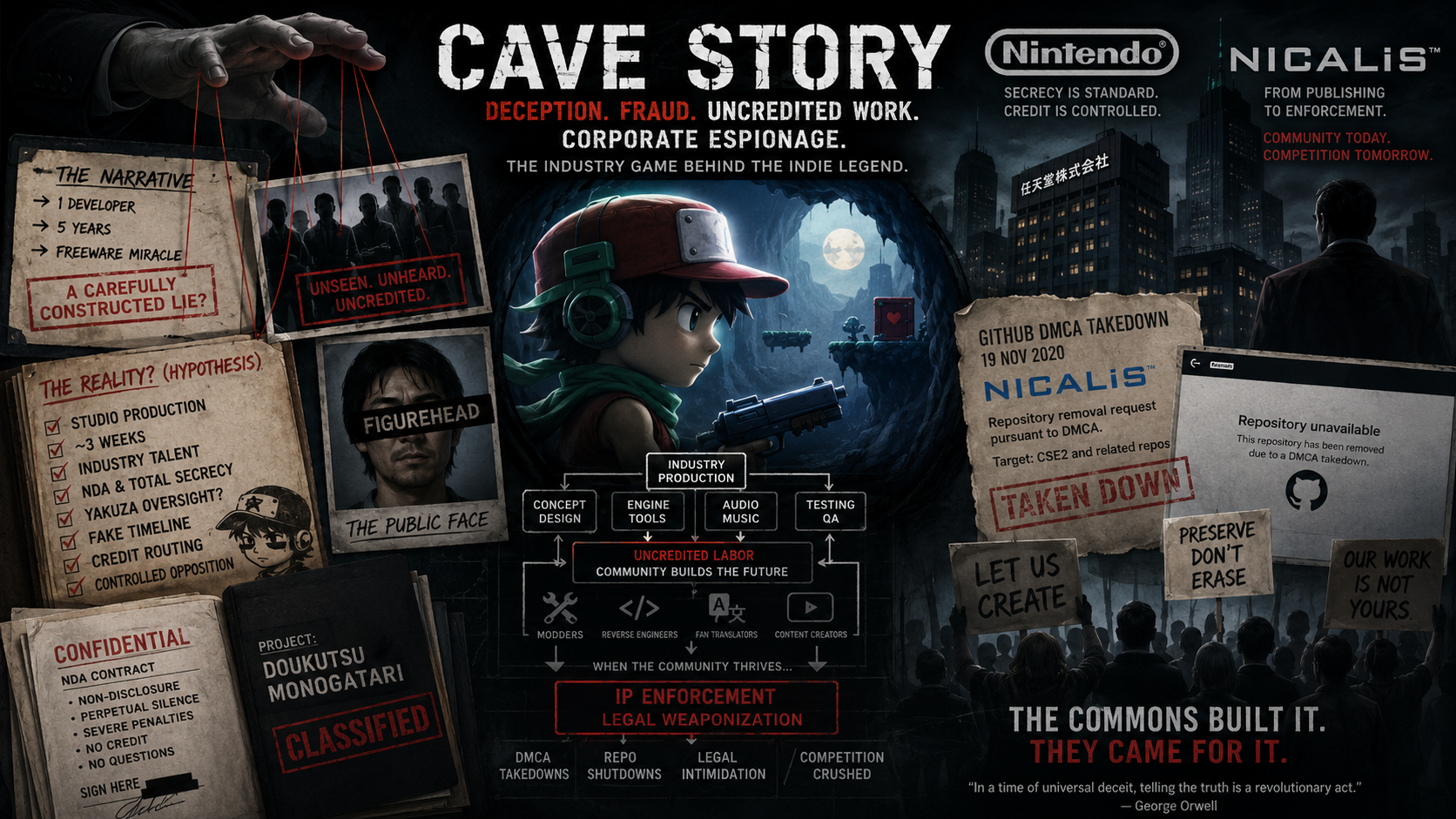
The companion dossier’s §1.2 now states my production read in plain terms: not five years of weekly, inspectable solo construction, but two phases under a retrofitted legend.
Phase A — about one year (plan, engine, music stack, polish theater): A planned twelve-month window covers engine readiness, music-engine and score pipeline, design iteration, tester routing, and the public “indie grind” performance. Engine and music infrastructure read as professional inputs—not improvised in the same sprint as the final island. The densest dated trace we could mirror locally is exactly that shape: the 2004 brush-up BBS (doukutsu2004bbs)—roughly 215 distinct days from January through December 2004, multiple handles, bug-and-balance chatter. Pixel’s own intro to that log calls it the final brush-up year while still claiming ~five years total including remakes. The documented year is the year; the five-year sentence is the sticker.
Phase B — about three weeks (game on an existing engine): The playable Cave Story proper—maps, scripting, narrative lock, asset integration on a mature stack—I read as a short sprint, on the order of three weeks, which rhymes with the early “three weeks” rumor Derek Yu named in the April 2005 TIGSource intro before Pixel answered. Building content on an engine is not the same job as inventing the engine; collapsing them is how “one genius, five years” stays emotionally legible without receipts.
Five years as cover: When fans and interviewers asked for calendar proof, “five years in my spare time” functioned as narrative padding—plausible, flattering, and almost impossible to audit. A local evidence bundle under ~/dev/wget/cave-story-timeline-evidence/ turned up no weekly ledger across five years: about eleven sparse diary lines, one hot year of BBS, scattered beta crumbs—not the dev history you would expect if the strongest solo-indie claim were literally true at the documentation standard skeptics are allowed to ask for. The burden is not on the audience to worship a legend because everyone else repeats it; the burden is on the legend to show its work.
That model does not require throwing away the 2004 board; it reframes it as post-engine polish and legend maintenance, not proof that one person coded the universe from vacuum for sixty months. Counter-readings are listed in dossier §5.1 and §5.7 — the investigator does not treat them as disproof at the audit bar in §1.10.
Open until cleared: This lane stays open. Nothing we could mirror disproves the timeline read at the standard that matters here: continuous inspectable proof, open engine stewardship, and good-faith defense of community engines when publishers applied legal pressure. What would clear the public face — I do not expect it — is Studio Pixel reversing its posture on open source and community reimplementation, repudiating the 2020 chill geometry, and releasing everything held: engine source, music project files, dated build history, contracts redacted only where law requires. Curated blogs and interview quotes are not enough. Until that happens, the thesis stands open, not as a court verdict, but because the exoneration burden was never met.
Industrial detour: SNES fork, N64 gravity, and where enforcement showed up
Retrospective engineering talk and headline business history suggest Nintendo’s own R&D imagination once pointed toward computer-like consoles: cross-generation continuity (early Super Famicom / SNES planning threads around NES-family carry-forward before late cost and mask cuts), fewer forced re-port walls for studios, fewer “your whole library is obsolete” cliffs. Retail SNES was never a magic native NES player in the flattened folk sense; the dossier keeps that hygiene in §5.6. I am naming a road not taken, not a claim that Nintendo shipped the GNU manifesto in a box.
The broken Nintendo–Sony SNES CD alliance and the spin-out energy that fed PlayStation are standard business lore at headline grain. The path that could have made that generation feel more like a programmable home computer (cartridge plus optical lane, tools forward) splintered into competitors whose incentives lean harder on proprietary volume and locked silicon than on education-forward children’s software. I read R&D1—without canonizing any engineer—as one internal place where a “open the hood for kids” impulse could have budded. The fuller investigator block, including the predict → starve the foundation → rent the rhetoric later pattern, is in §1.9.
After Nintendo 64, Nintendo’s living-room story leaned hard into polygon prestige—first- and third-person 3D as the headline future. Two-dimensional craft did not vanish; much of it migrated to handheld gravity—Game Boy Advance, Nintendo DS, later pocket hardware—while TV marketing often sold the future as analog sticks in 3D worlds. That routing fits pools of SNES-shaped talent—tile grids, side-view collision—being less central to the E3 story while still living inside first-party culture. The dossier states this as a center-of-gravity thesis, not “zero 2D on TV after 1996”; Nintendo did ship 2D and hybrid hits on home consoles afterward, and the counterweight lives in §5.5.
I keep a working thesis I will drop the moment someone tables real primaries: the same first-party ecosystem that watched credit split, borrow, or front through partner publishers (Square, Rare—historical names, not reopened contract law in this article) could plausibly host labor later worn as “one indie Pixel.” That is structural suspicion, not an accusation that any named person lied under oath.
On a purely ergonomic note—still subjective—I remember Donkey Kong Country Returns on Wii as a platformer fighting its shake obligations; later HD-style ports with conventional sticks felt like the first time I could just play the level without negotiating waggle. Comfort memory, not a fraud filing.
November 2020 is documented in cold GitHub text: Nicalis submitted a DMCA notice listing dozens of repositories in the CSE2 family—fan reimplementation work hosted in the open. The published notice is here: GitHub DMCA — Nicalis, 19 Nov 2020. GitHub processed it under its policies. Nicalis filed it; Nintendo’s name is not on that PDF, so blame should land on the right letterhead. But the message to the community was larger than one notice: after roughly twenty years of porting, modding, editing, and treating the free release as a shared cultural substrate, the line hardened into this was never open source and the fork graph could be removed.
The moral shape in the record the community actually built—freeware-origin commons that carried the myth—looks like acquiescence when enforcement hit fan engines at the hosted-source layer. I extend that suspicion toward highest-level containment culture because the outcome rhymes with how propagated media gets pressure-shaped when money and law stack high enough. I still refuse to treat that suspicion as a license to cancel individuals; I treat it as a warning about systems we should not normalize again. For the legal-chill arc and selective DMCA timeline, see the dossier §6–§7. The same IP stacks—platform terms, employment assignment, anti-circumvention rhetoric—are the practical lock beside the notice itself; readers already feel them in store UX, patch notes, and takedown mail.
The silver platter and sibling rhymes
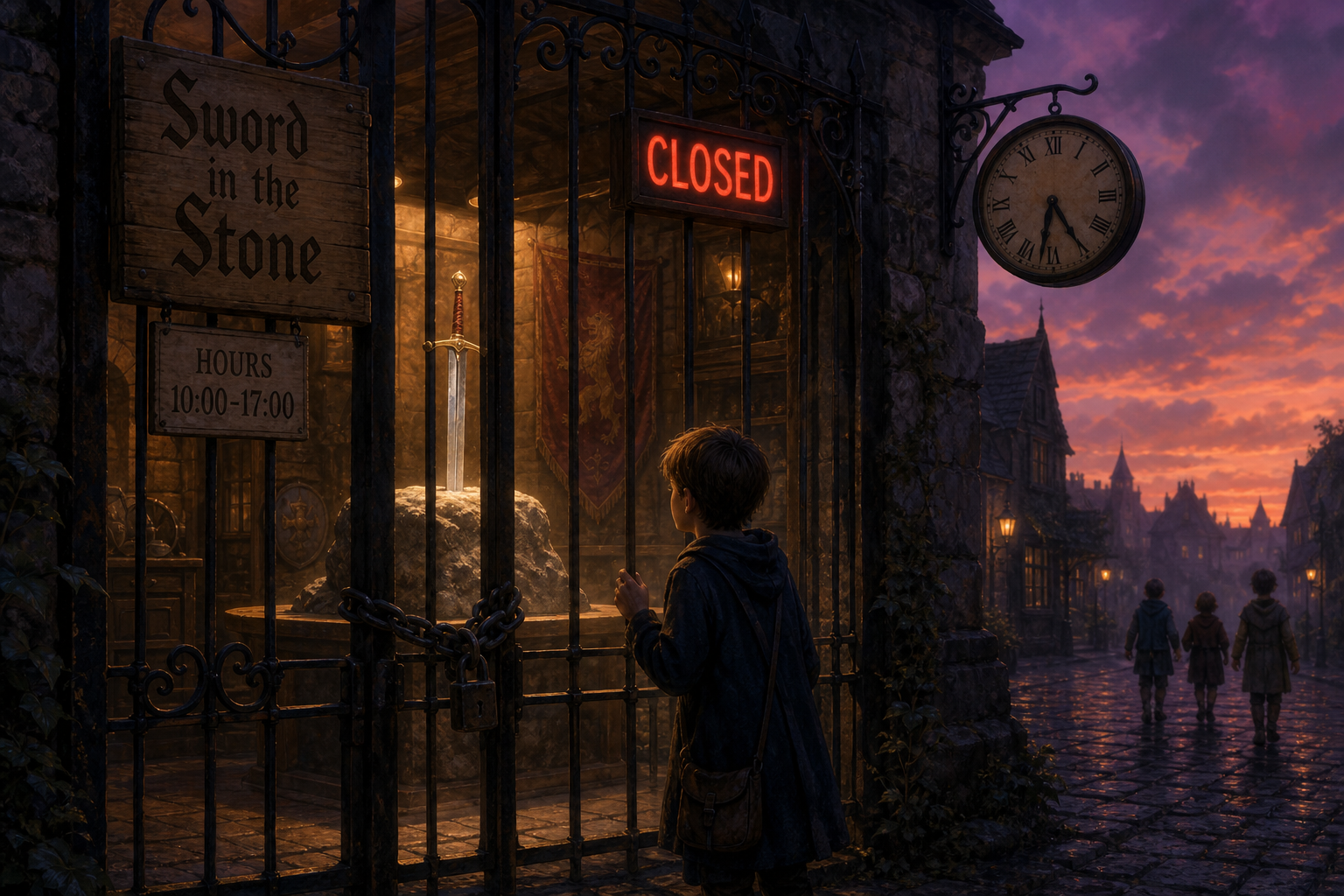
I call it the silver platter: free internet communities supply attention, testing, canon stress, mods, translations, and sometimes whole engine graphs—then industry stacks (IP, publisher, employment NDA, platform terms) plate that labor for entities that did not pay the full social cost of discovery. Cave Story advertised the viability of a non-corporate myth while the 2020 notice geometry showed where hard power sat once fan engines matured. The pattern repeats across games and movies: free creators and open communities are allowed to prove demand, invent techniques, and keep culture alive, but not to become durable competition.
The same geometry shows up across companion investigations. OverClocked ReMix routes fan labor through one legal interface, with engine-fork and chill language in §7.4–§7.5 of that investigation—parallel to CSE2 at the “hosted source” layer. In May 2026 the author was banned from a neighborhood Facebook group before he could reply after complaining about a Hollywood location shoot on local streets—“no politics” with no cited rule—documented as firsthand pattern language in OC ReMix §6.2.1 (movies on the block, not elections; ban mid-thread as the egregious beat). Homestuck’s lane is what felt like public culture re-centered under IP and employment (§5.3). The speedrun charity stack from Speed Demos Archive toward Games Done Quick is a weaker direct rhyme but the same temperature: community institution to branded LLC and opaque money routing (SDA × GDQ × MSF investigation). I read the corporate model as Microsoft-like in shape: highly diversified surfaces, centrally controlled enforcement. Many communities, brands, and toolchains can appear independent until the same legal grammar snaps shut. For NDA silence, fan commons as subsidy, and leader distance from downstream harm, see Success — by any means necessary.
Sword in the stone, then closing time
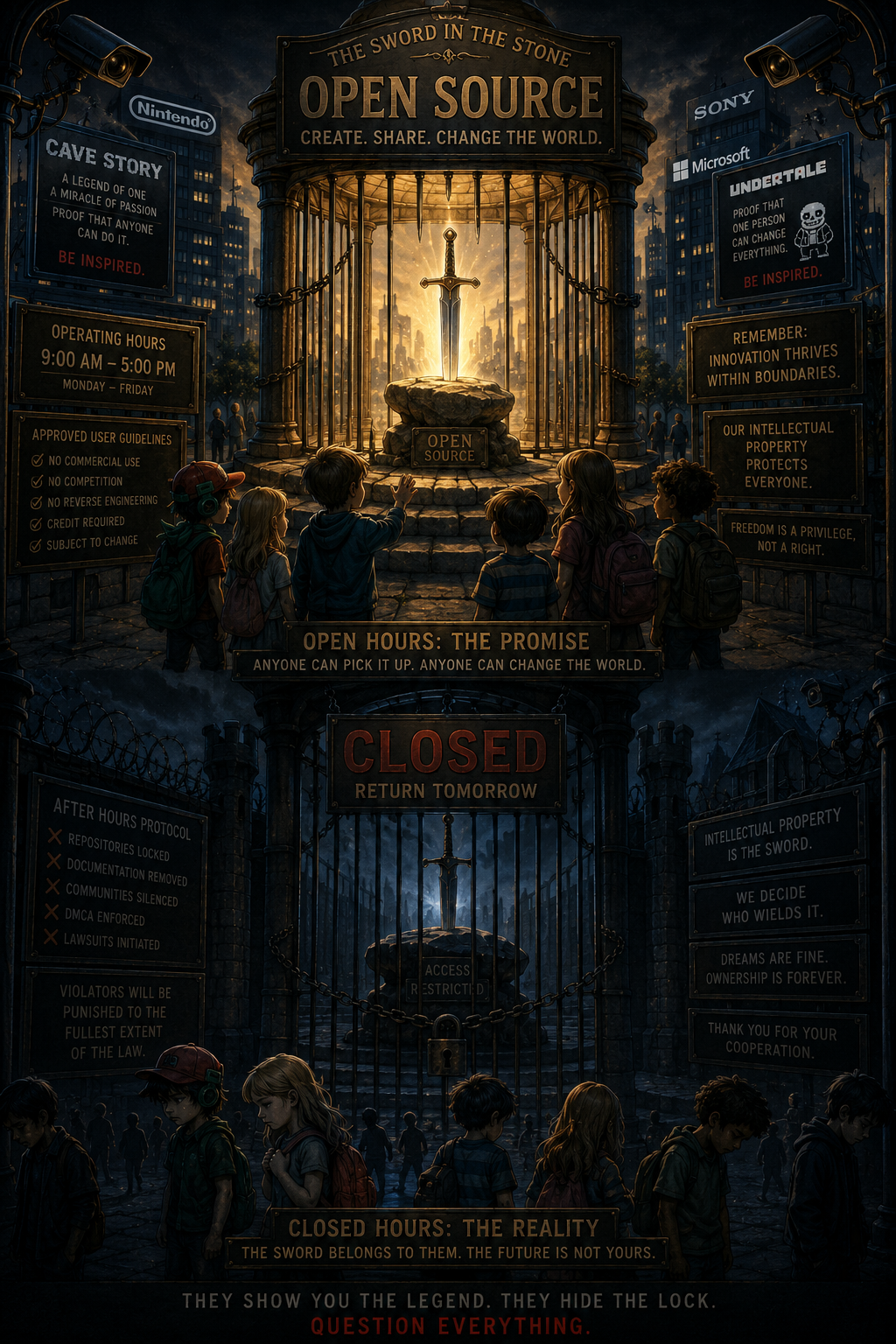
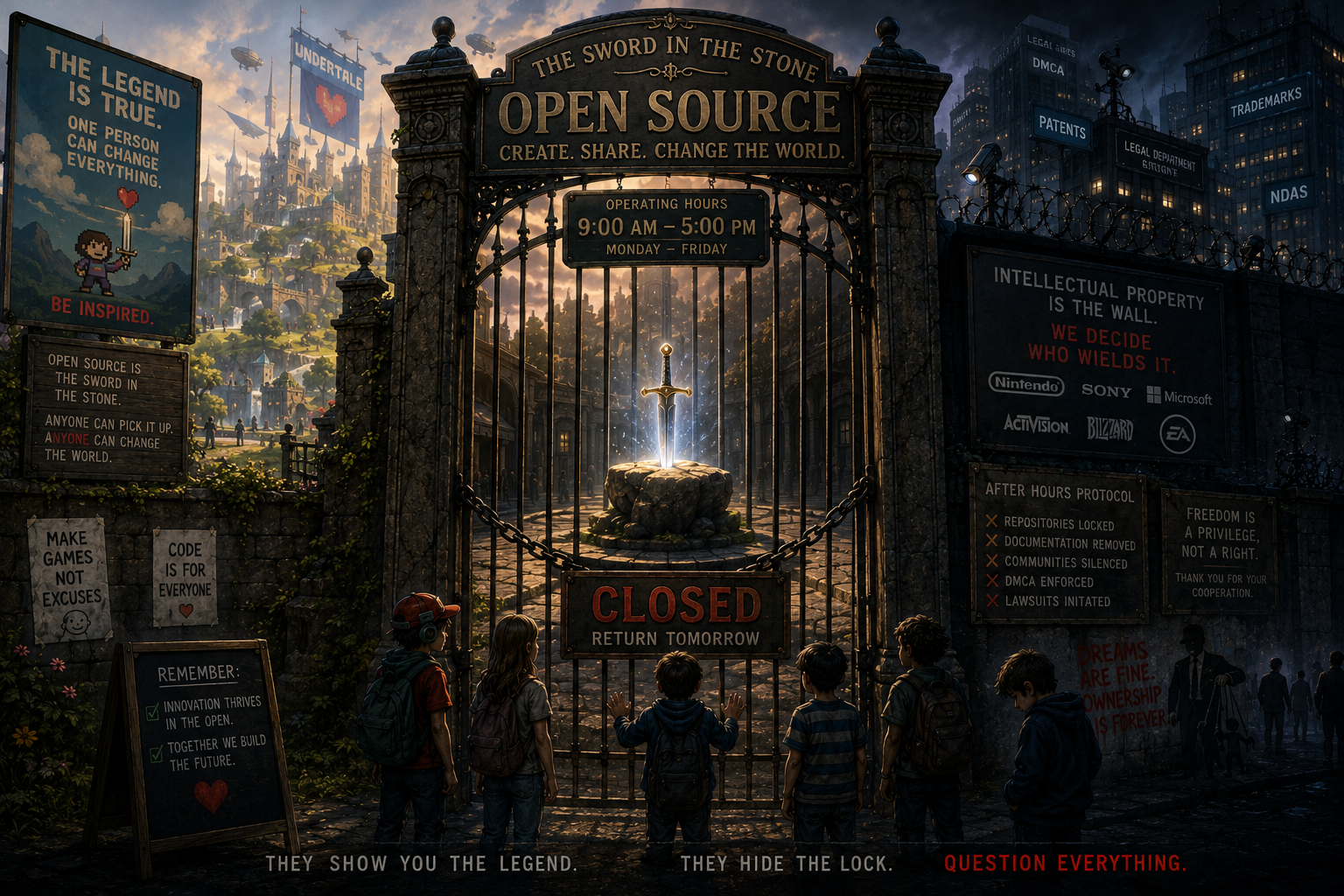
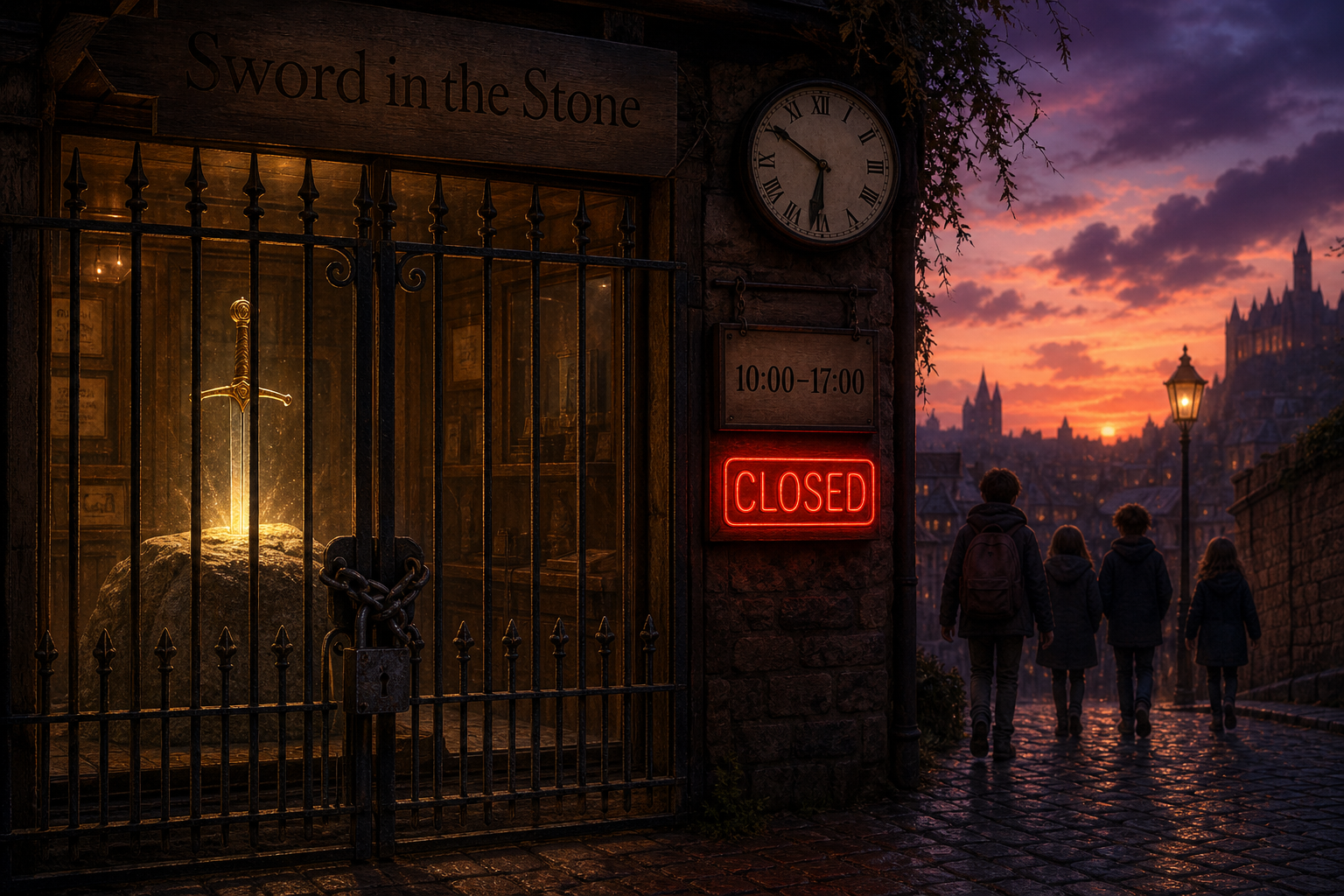
Open source and inspectable systems behave like the sword in the stone: the artifact and the rules can stay public. The corporate shop posts closing times and hands you a story in fine print that the contents still are not really yours after you paid for the ticket, the cartridge, the hardware, and the recurring fees—we paid for all of it, and the carve-out survives in the next clause. The stills in this article carry the after-hours mood; the rest is for readers who already know the myth.
What we can still choose
I want futures that label labor honestly, not futures that cancel kids for asking. We may never punish anyone responsible for old opacity or bad stewardship of commons labor—and I am not asking you to center retribution at all. The constructive ask is forward-looking: no future internet community that calls itself free, open, and community-driven should get run through the same invisible sorting machine without labels on who did what, under what NDA, and who assumed legal heat.
There will always be projects people own privately—private forms, private chat, behind-the-scenes work no auditor will ever see. Those lanes should exist where they belong. What should not happen again is blurring them together with fan contribution pipelines that supplied the bulk of content, entertainment value, free focus grouping, and free idea generation—only to watch credit and risk slide uphill toward the smallest possible name count.
What we lost, in my read, is the easy ability to tell each other honest stories about how work actually happened—without being read as traitors to the art. What we can still gain, in whatever internet comes next, is room for anyone to tell their story, or any story they wish, without categorical cancellation by pro-industry agents (paid or not) who treat skepticism toward credit lines as heresy instead of conversation.
Night news at the monopoly door
Games are one window; propagated media is the whole building. In 2026, Mark Ruffalo testified against the proposed Paramount / Warner Bros. Discovery consolidation lane—competition, jobs, press plurality—see trade reporting such as Variety — Senate antitrust hearing and the follow-on pieces on the open letter and blacklist fear. Separate from Cave Story, that hearing still shows Hollywood talent treating mega-mergers as existential.
Ted Turner died May 6, 2026; public obituary materials include the Turner Enterprises notice. Merger headlines and regulatory theater overlapped that calendar window. I feel a narrative rhyme—“the deal could breathe easier once the founding symbol was gone”—and coincidence stays on the table as the boring explanation.
Forward risk, not a current corporate map: if silver-platter dynamics keep winning, we could end with one effectively untouchable enforcement culture wearing many brand masks—each logo still talking “competition” while sharing playbooks (DMCA, NDA, platform terms, insurance-grade compliance). That line sketches choke risk, not a census of who owns what today. Label the platter early so communities stop pre-paying their own enclosure.
Keywords: #CaveStory #StudioPixel #FanLabor #Community #OpenSource #Undertale #N64 #Nintendo #DMCA #GitHub #ControlledOpposition #ParadigmThreatFiles #MediaConsolidation
Substack: paradigmthreat2.substack.com/p/you-do-not-have-to-stop-loving-cave
Limits
Private research lane—not legal advice; not an accusation that any named person committed fraud, breach, or criminal conspiracy. The dossier’s §1.2 one-year plan / three-week build-on-engine / five-year cover model is investigator hypothesis, not a court finding. §1.10 states no accessible disproof at the investigator audit bar and that the lane remains open until full open release and reversal of open-source/community-engine posture (clearance the author does not expect). §5.7 lists mainstream counter-readings not treated as exoneration at that bar. The dossier’s §1 remains investigator hypothesis with §5 falsifiers for reader balance. §1.9 SNES / CD / R&D1 language mixes documented business-history headlines with counterfactual and moral-systems reads; §5.6 separates retail hardware fact from that poetry. Merger and Turner timing here is author suspicion plus dated public anchors, not proved corporate scheduling. The “many logos, one choke” paragraph is a systems scenario, not a finding that a single owner already exists. Where I gesture at “no innocent exceptions” for propagated media pressure, that is worldview language about incentives and enclosure—not a survey of every country’s media law and not a license to assert individual criminal knowledge without primaries. Cross-links to OC ReMix, Homestuck, and SDA investigations inherit their own Limits blocks. Full tabular evidence chains for this lane live in the linked investigations and dossier, not compressed into this article.
Last updated: 2026-05-19
Share