

When your child won’t fit the grade
Listen when the kid has language but won’t offer it to you — history of schooling, COVID visibility, debunk cycles, and plain parent advice
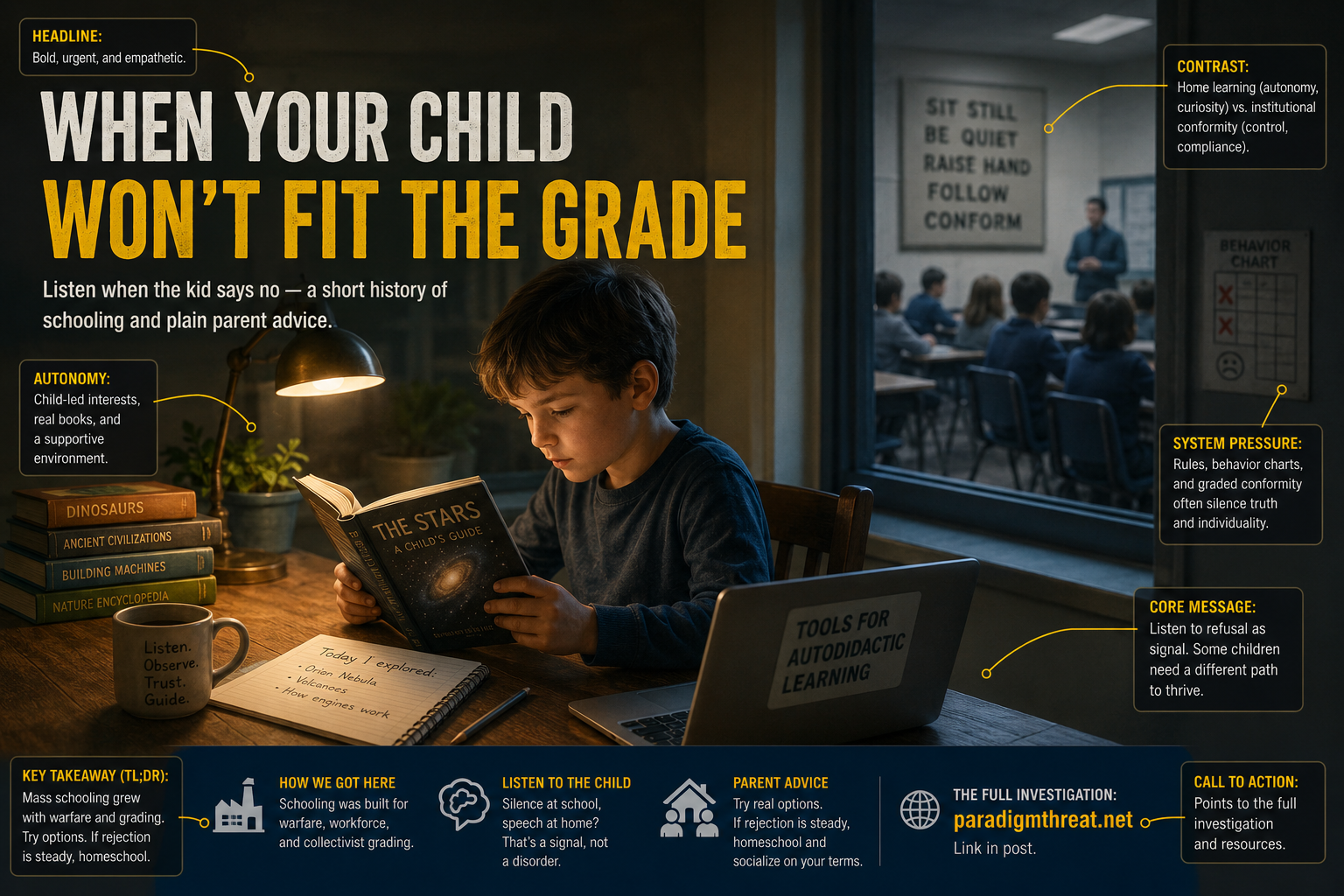
Picture a child who does not talk to people — not at school, not in the store, not even at home to parents or siblings. No hello, no answer when called, no verbal back-and-forth. Adults mark the chart nonverbal.
Yet the same child talks to themselves constantly — long monologues, scripts, humming, whole songs from memory. They read from books and off the wall (cereal boxes, signs, labels) in clear, well-formed English. Language is present. Social acknowledgment is not.
That is not the classic “fine at home, mute at school” picture schools teach parents to expect. It is closer to hyperlexia + private speech + global refusal of performative dialogue — the profile historic writers split (mutism, reading gift, solitary talk) but rarely named as one syndrome before modern psychiatry lumped it into autism spectrum. See §8.6 in the investigation.
Circle time, “use your words,” the behavior chart — then a meltdown when adults demand performance for an audience. Sometimes the machine is wrong. Sometimes the child is withholding acknowledgment from a package that was never built for truth — while still learning through print and solitary speech on their own terms.
TL;DR: Lead profile: child mute to everyone (including home) but rich private speech (monologue, songs) and hyperlexia (books, environmental print) — language on a private channel, not “nonverbal” in the motor sense. Historic literature: Piaget/Vygotsky describe self-talk as normal development; Kussmaul/Reed describe selective mutism with speech somewhere with people; Treffert describes reading + minimal social speech — no pre-1940 author names all pieces as one syndrome (§8.6). Mass schooling = warfare + collectivist grading; Watergate vs Tonkin shows selective curriculum audit — and NSA historian Robert Hanyok fought 2002–2005 to declassify proof the second Tonkin attack did not occur while schools still skip the false-flag lesson. If rejection is steady, homeschool with print/typing/autodidactic tools; do not force verbal acknowledgment as the first IEP goal. Full dossier: investigation.
How we got a system that grades every child the same way
For most of history, childhood was local: apprenticeship, church, kin. The big turn came when states needed cohorts — same age, same bell, same score — to mint citizens and soldiers.
1760s–1900s — Prussia made tax-funded primary school compulsory; duty and discipline rode alongside literacy. Horace Mann and the American common school movement imported that factory rhythm: bells, age bands, supervisors who could swap between rooms without retraining the child.
1910 — The Carnegie Flexner Report reshaped medicine, not K–12 directly. Still, the pattern matters for parents today. A coalition with money and moral authority surveyed the field, declared which schools were real, and watched the rest close. One pipeline. One definition of educated. Competing paths labeled ignorant or dangerous. K–12 later copied the same capture shape: state standards, adoption lists, accreditation, and a child who cannot stomach the official packet marked disordered instead of discerning. The dossier keeps the medical citations and the analogy-only warning in §15.
1920s–1980s — World wars scaled the machine. Behaviorism treated the child as measurable behavior. IQ sorting. Soviet and Western systems ran parallel: same mass grading, different flags on the wall. At the brutal end of the same family, regimes wiped prior schooling to install year-zero cohorts — Khmer Rouge Cambodia, Hitler Youth, Cultural Revolution struggle sessions, colonial residential schools that attacked language and kin. None of that is the same moral weight as your local elementary school — but the design rhyme is real: break the old canon, seat the child in a fear-driven script, punish the ones who will not perform. See §16.
1940s–today — Psychiatry widened “autism” until DSM-5 poured Asperger, PDD-NOS, and everything awkward into one spectrum. Standardized tests and IEP “social skills” goals made conformity explicit. The label congealed in the same century as full communism here means collectivist mass-grading — pretending every child fits one ladder — not a comment on Marxist economics alone.
Teachers today often believe this curriculum arrived by slow expert agreement. It didn’t. It arrived by collectivism and warfare — a fear-driven institution that survives on who fits the seat and who gets the label when they don’t.

The canon is one umbrella: math, science, history, astronomy, civics — packaged like a single scripture with contradictions inside (sanitized civics beside suppressed wars, math drills beside apps that teach reading faster without a classroom). Cultures worldwide are producing antibodies: mother-tongue teaching, local history, homeschool, indigenous science, and tools that let a child learn without performing for a chart. The full spine is in §2c of the investigation.
Do children only learn speech by copying adults?
For a century, psychology sold imitation as the whole story. Locke’s blank slate, later Watson and Skinner: watch the adult, get a reward, repeat. That picture breaks the moment you meet a child who has language — but only on a private channel (self-talk, songs, reading) — and refuses performative dialogue with people.
In 1876 Hippolyte Taine watched his daughter and reported something else: initiative came first. Babble invented by the child; adults channel sounds she was already trying — not pour language in from zero. He called it original genius adapting to a form built by prior generations. Darwin’s infant diary the next year stressed association and observation, not drill. Rousseau and Montessori argued against forced early performance. John Holt later named what parents see: fear and coercion block learning even when the child is bright.
Selective mutism (Tramer, Reed) fits when the child will speak to some safe people but not others. Your child may be past that split: no verbal response to anyone, while private speech and reading stay rich — a different historic lane (§8.6). Taine (1876) still matters: initiative came first in language — the child invents sound, adults channel; forcing social performance is not how speech historically was understood to grow. §3.5; Wikisource — Taine.
Literature that respected autodidactic children
The word autodidactic is rare in old books, but the pattern is not. Rousseau’s Émile (1762) argued for an interest-paced tutor and skepticism of premature social display. Montessori named auto-education: a prepared environment where the child chooses work and the guide does not drag them through a chart for strangers. John Holt, in How Children Learn, Teach Your Own, and Growing Without Schooling, insisted that curiosity leads and that forcing buys resistance. Carolyn Sherwin Bailey’s Montessori Children (1915) recorded case after case of self-chosen work. Paolo Freire attacked the banking model — depositing facts into passive students — as political, not neutral.
Later lines speak more directly to the children schools mislabel today. Piaget and Vygotsky documented children talking aloud to themselves while thinking — private speech — as a normal stage (expected to internalize later), not as “mute to the world.” Dabrowski described overexcitability in intense learners, often filed as “disorder” when the environment is wrong. Treffert and the hyperlexia literature documented reading-first children who decode early while social speech lags or never appears — the closest modern medical line to “reads walls, won’t answer you.” The selective mutism line — Tramer, Reed, Kolvin and Fundudis — assumes speech with some safe humans; it was never meant to be poured into a generic “spectrum,” and it does not fully fit a child who never verbally acknowledges family.
None of these authors promised that a captured national curriculum was sacred. They promised a relationship and a channel — usually books, objects, and later real computers — that respect refusal. Modern stacks: §9–§10.5 of the investigation.
Historic literature — is this profile named?
Direct answer: Historic writers mention pieces of what you see. None name the full cluster — no speech to anyone, rich self-talk and songs, fluent reading including environmental print, no verbal acknowledgment — as one syndrome before psychiatry merged overlapping signs into autism spectrum (1940s onward).
| What you observe | Named in old literature? | Who |
| Talks to self a lot | Yes — as normal child development | Piaget (egocentric speech); Vygotsky / Luria (private speech → later internalized) |
| Reads early / reads signs and labels | Late 20th c. mainly | Treffert — hyperlexia with minimal or no social speech |
| Won’t speak to people in some places | Yes — partial fit | Kussmaul (1877) → selective mutism (Tramer, Reed): speech elsewhere, usually with humans |
| Won’t speak to anyone at all, including home | Not as classic selective mutism | Modern teams file nonverbal ASD; historic clinical split did not unify this with hyperlexia + private speech |
| Songs / scripted vocalizing | Partial | Kanner (1943) — echolalia and rote language in early autism papers |
| Child initiates language, adults channel | Yes — pedagogical | Taine (1876) — initiative before imitation; Rousseau / Holt — anti-forced performance |
Pedagogical authors (Rousseau, Montessori, Holt) say: do not force speech for an audience; offer interest-led print and environment. Clinical authors split mutism, self-talk, and reading gifts. Psychiatry lumped them (§5 in the investigation). Schools then demand “use your words” for a child whose language already runs without social return.
Full author table, phenotype checklist, and IEP cautions: investigation §8.6. Variant without any home speech to people: §8.5 vs §8.6.
The child who won’t conform is often the honest one
Some children are hyperlexic: they decode early, often alone. Some have selective mutism: speech with some safe people, silence elsewhere. Some have private speech without social return: they talk to themselves, sing, read environmental print fluently, and do not verbally acknowledge parents, teachers, or peers — while still taking in the world. Schools often write nonverbal autism on a form; the family sees language running on a private channel.
Two buckets cover most of what parents need:
Disease or environment — hearing, seizures, sleep, toxins, global delay from infancy. Work those up with a clinician.
Behavioral — rejection of coercion — the child refuses this building, this forced speech, this age-wrong history lesson. Meltdown follows conformity exercises, not every hard task everywhere.
Control experiment (written down):
| Pattern | What it suggests |
| Speech with family, silent only at school | Classic selective mutism / situational Category 2 |
| Private speech + reading rich, no verbal reply to anyone (including home) | §8.6 profile — not “failed imitation”; rule out Category 1, then audit coercion + curriculum (§11) |
| Language equally absent everywhere since infancy | Category 1 workup first |
The worksheet is §11.
I was pushed through public material on slavery and violence too young. What stuck was a cartoon morality — men evil, women victims, white men worst — not history. A child who shuts down on that unit may be right, not broken. That is why I want a curriculum audit, not another social-skills block.
Watergate is taught; Gulf of Tonkin deception is not — and that contrast is the point
Watergate lands in civics as a full political controversy: burglary, cover-up, Nixon, impeachment, “the system worked.” It is entirely domestic, entirely controversial, and safe for textbooks because the moral is reform inside the republic — not “your government lied you into a war.”
Gulf of Tonkin is a different slot in the same canon. In many programs the child still learns the war cause — an attack, a resolution, escalation — not the government-sponsored deception Daniel Ellsberg exposed when he leaked the Pentagon Papers, and not what NSA’s own historian later proved from SIGINT.
What Ellsberg documented (1971)
Ellsberg was on duty in the Pentagon the night of 4 August 1964, reading real-time cable traffic. He knew the second-attack story was rotten before the country did. The Pentagon Papers (1971) placed Tonkin inside a pattern of deception that expanded Vietnam — an antibody leak from the Pentagon/RAND pipeline. See historical antibodies profiles — Ellsberg and the good-actor / interagency investigation § II.I.
What Robert Hanyok and the NSA did (2001–2005) — a hot war between agencies
This is not a minor footnote. It is one of the most important documented acts of the NSA in the twentieth century — and it shows the interagency fight in plain institutional terms.
In early 2001, NSA historian Robert J. Hanyok finished a classified study for Cryptologic Quarterly: “Skunks, Bogies, Silent Hounds, and the Flying Fish”. Reconstructing all available SIGINT for 2–4 August 1964, he concluded that the second attack on 4 August did not happen as Johnson and McNamara sold it — and that midlevel NSA officers had deliberately skewed intercept reporting: bad translations, altered times, fragments lifted out of context, roughly 90% of relevant 4 August SIGINT left out of the summaries that became the White House’s “proof.”
That product — NSA signals intelligence — was the objective fuse for the Tonkin Gulf Resolution and full-scale war. The war machine needed SIGINT to look clean. Hanyok’s audit, written inside NSA, said the fuse was rigged.
Then came a second fight — not in 1964, but leading into the twenty-first century:
| Year | Event |
| 2001 | Hanyok article completed — classified, months before 9/11 |
| 2002+ | NSA historians push to publish; rebuffed by higher levels (NYT, 31 Oct 2005) |
| 2003 | Outside historians FOIA the study after leaks of Hanyok’s conclusions |
| Nov–Dec 2005 | NSA declassifies Hanyok plus 140+ Tonkin SIGINT documents (release index; National Security Archive) |
So: Ellsberg ruptured the lie from document access (1971). Hanyok ruptured it from SIGINT audit and then battled his own agency for four years to get the record out (2001–2005). That is agency vs agency — not a unified “government” teaching your child one honest civics lesson.
And the school still will not teach it. Watergate gets a unit. Tonkin stays “attack → war.” The canon absorbs domestic scandal and buries casus-belli fabrication even after NSA itself published the correction. Schools will walk a teenager through Watergate drama but not Tonkin as “we were lied into Vietnam” — the way Ellsberg documented and Hanyok proved from NSA archives. They teach outcome (war) while burying mechanism (deception).
A bright child with private speech and hyperlexia who senses that asymmetry is not disordered. They are noticing the contradicted umbrella (§2c in the investigation). Full table and sources: §2b.1; good-actor investigation § II.I — Hanyok.
A side story — silence as cover until green beans demanded speech
Anonymous; paraphrased from a reader comment on this article, 2026. Investigation reference: §8.5a.
One correspondent said they addressed no one until about age four — while already reading and writing, deliberately hidden from their parents so the cover would hold. Silence was useful: when they painted a sibling’s name on their father’s workshop with a four-foot brush, the sister caught the blame; as the child who did not speak, they never had to disavow it. Gestures could not get them enough dinner. Writing the request would have exposed literacy. So they spoke. The first words to the room were a whole paragraph at the table, extended family watching. Their mother kept one sentence on the pantry chalkboard for years: “I want big of it.” Asked later what broke the silence, they answered that green beans have always been a necessity.
That is not every child’s story. It is a lived sketch of Category 2: language and reading online early, social speech withheld until the cost of silence exceeds the cost of performance — and adults who would have filed nonverbal autism missed the private channel entirely.
Demand avoidance and PDA profiles belong in the same behavioral bucket for this read: the nervous system says no to coercion even when the task is easy elsewhere. Institutions call it pathology; often it is integrity under abuse-shaped pressure.
Non-conforming children do not read Snopes. They mute where speech is punished, read alone when circle time is performance, meltdown when a unit violates their sense of truth, and thrive at home when coercion drops. Adults fighting hoax vs anti-hoax on cable often miss the signal in the room: this child rejected the package.
COVID remote learning — parents finally saw the packet
For a hundred years, most parents met school through report cards, conferences, and mood at pickup. COVID forced packets, Zoom, and kitchen-table work. Districts scrambled; RAND documented uneven access, “learning loss” panic, and a rush to restore standardized pacing — RRA168-6, investigation §17.
What mattered for non-conforming children was not only bandwidth. It was visibility.
Parents watched which history unit landed, which morality frame shipped young, which “social emotional” exercise looked like compliance training. Some children were silent only at school; others stayed mute to everyone while talking to themselves and reading — in both cases, parents could see language exists and performance is what breaks. That matched Category 2 when medical workup was clean: rejection of this delivery, not lack of ability.
Districts blamed screens and pushed return to buildings. Many autodidactic families found the opposite: real computers, vetted apps, and interest-led reading worked better without the crowd. The fight was never “technology bad.” It was who controls the content and whether refusal gets diagnosed.
COVID did not pause every culture-war module everywhere. Math and history capture continued on a different axis than remote logistics. Do not claim every parent saw everything — but where they did, audit demand spiked.
Parental notification wars — the same fracture
After remote learning, transparency bills and parental-notification fights spread — especially around gender identity, health services, and counseling without parent knowledge. California’s AG–district letters (Feb 2024) became a national flashpoint; other states wrote opposite rules.
Strip the hot labels and the structure is the same trust problem:
Who may withhold what from whom about a minor?
Schools already withheld curriculum detail behind “trust the expert.” Notification wars say the quiet part loud: the building may act on the child’s identity and body while treating parent inquiry as harassment. Whether you favor full disclosure or student privacy, the child still faces performance pressure — another conformity exercise.
For selective mutism, demand avoidance, or hyperlexia + school refusal, these wars are not abstract. They are one more reason the child will not perform for strangers who control the narrative. Homeschool and parent-run socialization are exit ramps when the institution claims both grading power and secrecy. Verify your state law; this page is not legal advice.
The debunk cycle — when “false” ends inquiry
A repeating public pattern:
- Viral claim (parent group chat, board clip, short video).
- Major outlet debunk (Snopes, PolitiFact, Wikipedia “hoax” page).
- Social punishment for anyone still asking.
- Case closed — no FOIA, no local transcript, no board recording published.
Whenever that cycle runs, ask four layers — fact, local residue, incentive, parallel machinery — without assuming debunk = truth or debunk = cover-up. Full registry: §18.
This is not the claim that every debunk is a lie. Often the national story is false. The error is treating national false as local impossible.
Litter boxes — debunked policy, possible psyop, 2022 midterms
In 2022–2023, US politics caught fire over schools installing cat litter boxes for students who “identify as cats.” Wikipedia’s hoax article is clear on the policy tier: no verified district mandated classroom litter for children. Some panic traced to lockdown “go buckets” misread as furry accommodation. Do not repeat “kids urinated in litter boxes nationwide” — that line is debunked bait.
Hold two truths at once:
1 — The mascot claim is false. National litter-box rollout did not happen as advertised.
2 — The cycle may still be engineered. In April 2016, Michael L. Brown wrote in The Christian Post that if society does not stop the “downward slide,” we might soon be required to provide litter boxes for people who identify as cats (op-ed, 21 Apr 2016). Six years later the exact symbol went viral in board meetings and campaign speeches — then was debunked en masse.
That prediction → fulfillment → rapid removal is psyop-shaped: float an absurd image without needing a real policy, strike it down (“hoax!”), while the underlying fight — bathrooms, secrecy, SEL, dress-code “cat” behavior (Wikipedia documents 2021 rumors separate from litter policy) — keeps running. Witnesses get panned as liars or conspiracy consumers; shame replaces audit.
Before the 2022 midterms, online mentions surged as Republican candidates repeated the story; Joe Rogan amplified it (later partial walk-back). Wikipedia’s election summary: attempts by the news media to debunk false rumors were largely unsuccessful in stopping their spread. The symbol was false as policy — yet unstoppable as politics until the election passed. Many promoters lost (Bolduc, Ganahl, Scott Jensen); some won (Vance, Greene, Boebert). The hoax burned the side that carried it while curriculum fights stayed unaudited.
Angry Birds parallel: The Angry Birds thesis holds that under a hostile administration, the media filter amplifies absurd Republicans built to lose while real challengers stay starved. Litter boxes in 2022 look like a live demo — not proof the DNC wrote a Michigan testimony, but proof the machinery files concerned parents next to Bolduc while protecting the institution. Tiers: §18.1–§18.1c.
Sandy Hook — same machinery, different event
Litter-box panic and Sandy Hook are not “the same hoax.” What is parallel is debunk-cycle machinery: official narrative + fact-check → social closure → no further institutional audit → punishment for persistent questioners.
Documented deaths and court outcomes in the Sandy Hook case are settled for humane and legal discussion. “Staged” / crisis-actor claims stay speculative — see Something in books. The link to schooling: once a parent concern is labeled false, districts stop answering FOIA, and the child’s refusal gets filed under disorder instead of content audit.
Parent advice — simple
Try the systems. Public, private, church, Montessori — real ones with credentials, not only the brand on the sign. You will know quickly if your child is rejecting the room. Failed fit is data. Try again somewhere else if you must.
Do not ignore a steady signal. One bad week is not a verdict. Months of the same pattern — no verbal acknowledgment, or silence only where adults demand performance, plus private speech and reading that never stop — is a verdict. Do not treat rich self-talk as “they have nothing to say”; treat forced social speech as the wrong first goal (§8.6).
If they have rejected the system, home-raise them. Homeschooling is easier than it was: laws vary by state, but resources, co-ops, and networks exist. For these children, learning is almost entirely autodidactic: they take up what interests them; forcing the rest buys resistance and distrust.
Reading and typing beat performative writing as the main literacy channel — especially when the child already reads environmental print and scripts alone but will not perform dialogue for a chart. Real computers — keyboards, search, making — not tablet-only consumption. Vetted kid apps without ads or addiction loops already teach reading and objects without a crowd staring at the child. AI can widen the world with adult safety rules; the investigation’s tech lane is §10.5.
Socialization is the main job outside academics — and parents can do it without the building. Organize playdates the old-fashioned way. Shared ground rules, adults on site, insurance where that matters, supervisor responsibilities written plain.
Vet Montessori if you use it. Many schools sell the name without AMI or AMS training — wooden toys, same behavior charts. Even honest Montessori assumes the curriculum is sacred; I do not, until it is audited. See §10.1a and §10.1b.
Under debunk cycles: Separate tiers — national debunked ≠ your observation impossible. Ask for primary sources (board video, packet PDF, email). Keep the private speech vs social demand experiment written down (see table in § “The child who won’t conform”). Do not perform outrage for the algorithm. Use FOIA and transparency laws where they exist. If rejection is steady, exit.
What I will say straight to critics
If you think I’m wrong, say so. I’ll answer straight back.
I do not sort child abuse into neat boxes by logo on the building. Public school, private school, church program — if the delivery produces emotional fallout and long-term harm, I put it in the same moral category as sexual abuse against children. No exceptions. I do not care if someone points to a child who smiled once during the harm. Abuse can produce positive reactions; it remains abuse.
That is not a claim that every teacher is a predator. It is a claim that institutional coercion of children is not a lesser sin because it wears accreditation and because adults call it education.
The goal is not cruelty toward educators. The goal is stop forcing children through a captured, contradicted, fear-driven machine and then diagnosing them when they refuse.
Where next
- Childhood autism spectrum — full investigation — §8.6 private speech / hyperlexia / no acknowledgment, §2b.1 Watergate vs Tonkin, COVID §17, debunk §18
- Gulf of Tonkin — false-flag catalog entry
- Angry Birds — media filter / controlled GOP lane
- Something in books — crisis-actor / staged tiers
- Chronology investigations index
- Earth history timeline hub
Framing and limits
Prisca sapientia (epistemic foundation): This article assumes prisca sapientia—the belief that the ancients possessed a vast, profound understanding of the universe, nature, and theology that was subsequently lost or degraded. Modern consensus is not default truth; linked dossiers tier specific claims.
This page is parent advice and historic summary, not medical or legal counsel. Category 1 conditions should be ruled out with clinicians when signs fit §11 table A.
Collectivist mass-grading, Flexner analogy, extreme regimes (§16), psyop / Angry Birds (§18.1c), and debunk-cycle claims are developed in the investigation with evidence tiers — not every sentence here is independently proven.
Litter boxes: No verified national litter policy. Psyop and Angry Birds reads are author investigation theses. Wikipedia’s “debunks largely unsuccessful” summarizes press coverage — not endorsement of every candidate claim. Kernel truth = documented gender/bathroom/dress-code fights, not litter trays.
Sandy Hook: Machinery-only; staged claims are speculative and legally sensitive.
COVID and notification effects vary by jurisdiction and district.
Abuse language: Personal moral stance; does not accuse named individuals of crimes without proof.
Homeschool legality and insurance for playdates vary — verify locally.
Side story (§8.5a): Single anonymous self-report from a reader comment; illustrative only, not prevalence or diagnostic proof.
§8.6 profile: Historic-literature map is synthesis, not a single DSM diagnosis; rule out Category 1 (hearing, seizures, global delay) before assuming Category 2. Forcing verbal acknowledgment is contraindicated in selective-mutism treatment and often harmful here.
Investigation Limits and disclaimers — full stack.
Keywords: #Autodidactic #Homeschool #SelectiveMutism #Hyperlexia #PrivateSpeech #Vygotsky #Piaget #Treffert #COVID #DebunkCycle #LitterBoxHoax #AngryBirds #FlexnerReport #CollectivistGrading #CurriculumAudit #Watergate #GulfOfTonkin #Ellsberg #Hanyok #NSA #ParadigmThreatFiles
Substack: paradigmthreat2.substack.com/p/when-your-child-wont-fit-the-grade
Last updated: 2026-05-25 (Hanyok / NSA Tonkin declassification fight; interagency-war context)
Written and narrated by Ari Asulin, with drafting and research support from LLM agents.
Share