

Paradigm Threat — Working Definition of Antisemitism (Religious-Unity Frame)
TL;DR: In-repo normative tool: antisemitism is framed as monolithing—treating “the Jews” as one actor—and as speech regimes that silence fair, sourced history. Harm includes shadowban, deboost, and opaque moderation—not only violence. §5: Ten Commandments (KJV-flavored covenant: no holy‑war talk, no unanimity lie, rulers of the gate shalt not smite the scribe in secret). §1.5: Semitic philology; Christian Semites = Semitic-root Christianity, not “Arab only.” §3.5–3.6: author positions—structure without “all Jews one side”; dissent; monotheism; IHRA bridge; CIA/MI6 networks; intra‑Jewish monolithing. Not legal advice.
Status: Working — for navigation of this repository’s historical and NC-adjacent writing. Date: 2026-04-26 (§5 Ten Commandments + second figure; §1.5 Semite; §3.5–3.6 author positions)
1. Short definition (comparable length to IHRA / JDA cores)
IHRA core (for scale — external, verbatim): “Antisemitism is a certain perception of Jews, which may be expressed as hatred toward Jews…” (IHRA PDF)
JDA core (for scale — external, verbatim): “Antisemitism is discrimination, prejudice, hostility or violence against Jews as Jews (or Jewish institutions as Jewish).” (jerusalemdeclaration.org)
Paradigm Threat — working definition (in-repo, single paragraph):
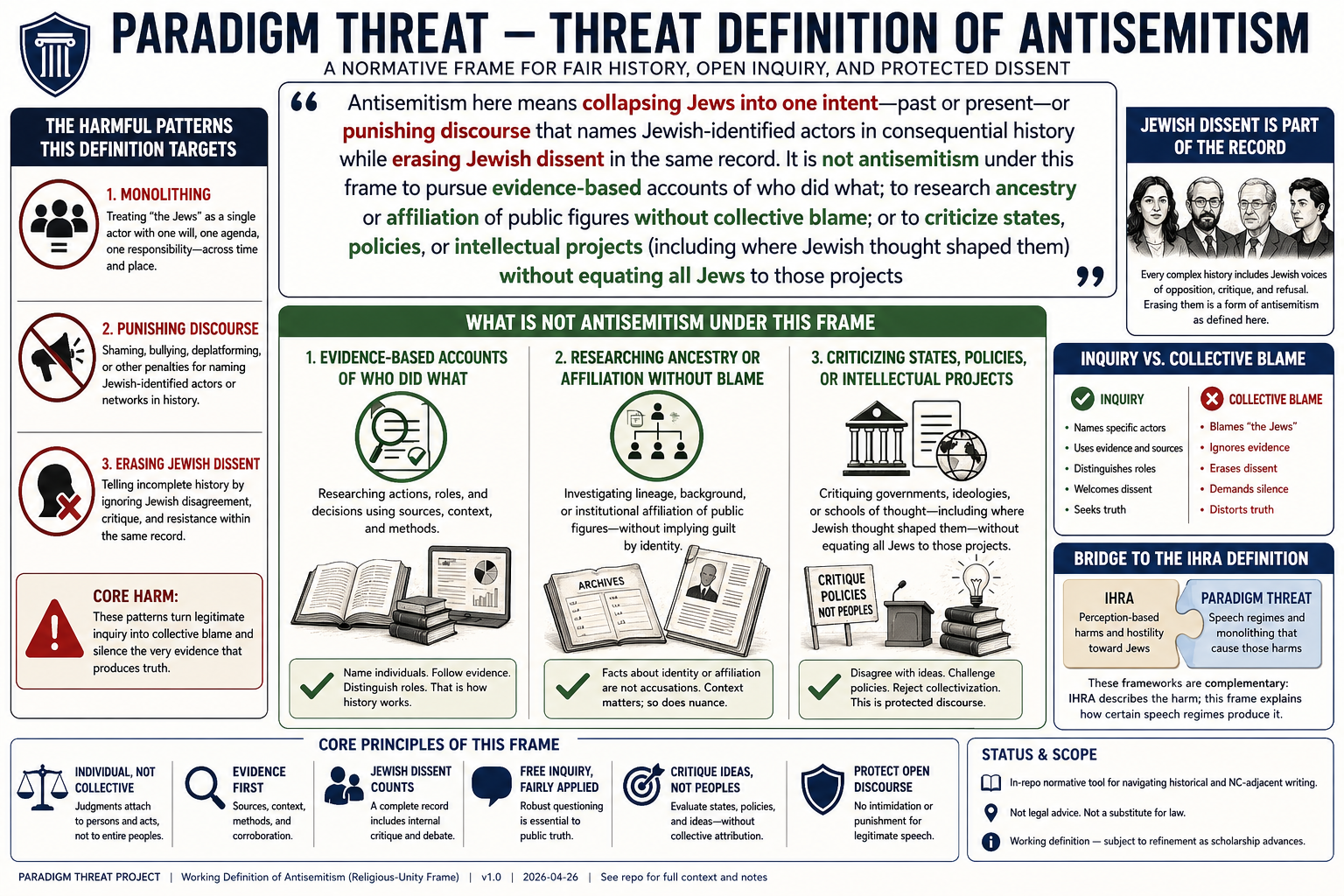
Antisemitism means collapsing Jews into one intent—past or present—or punishing discourse that names Jewish-identified actors in consequential history while erasing Jewish dissent in the same record. It is not antisemitism under this frame to pursue evidence-based accounts of who did what; to research ancestry or affiliation of public figures without collective blame; or to criticize states, policies, or intellectual projects (including where Jewish thought shaped them) without equating all Jews to those projects.
1.5 Semite, Semitic, and who can fall under the label (including many Christians)
Philology (still current): In linguistics, Semitic names a branch of Afro-Asiatic: Hebrew, Aramaic, Arabic, Geʽez, Amharic, Maltese, and several smaller languages. “Semitic” here describes language families and speech communities—not a blood essence.
Race science (obsolete, but it coined the politics): In 19th‑century European scholarship, “Semites” were often grouped as a “race” or “culture type” contrasted with “Aryans.” That typology is discredited as biology, but it stuck in political language when Wilhelm Marr and others popularized Antisemitismus—which in practice meant anti‑Jewish politics, not hostility to every Semitic‑language people.
Who counts as “Semitic” in a defensible, non‑racial sense today
Explicit correction (Christian Semites): This file groups many Eastern and African Christians under “Semitic” because Christianity itself is rooted in a Semitic milieu—Hebrew / Aramaic scripture context, Semitic or Semitic‑layered liturgies, and (where present) Arabic, Syriac, Geʽez, Amharic, Maltese, etc. They are not counted as “Semitic” only because they are Arabs. Arabic is a Semitic language, so Arabic‑speaking Christians also sit on a Semitic branch linguistically—but the deeper point for this definition is Christian = carrying a Semitic-origin religion in text, rite, and names, whether or not the believer identifies as ethnically Arab. Many communities below do not use “Arab” as their primary ethnic label (e.g. Assyrian / Aramean / Chaldean; Ethiopian Habesha; many Copts who distinguish Egyptian from Arab identity) yet remain Semitic in the religious‑linguistic sense above.
Modern scale (illustrative; not a census)
- Arabic‑speaking Christians (often called “Arab Christians” in English): Millions across the Middle East—with large populations in Lebanon (e.g. Maronite, Greek Orthodox), Syria, and Jordan; also in Egypt alongside Coptic and other communities where Arabic is widely used in daily and civic life.
- Other Christian Semites (non‑“Arab” label or mixed): Assyrians, Arameans, and Chaldeans in Iraq and Syria; Ethiopian Christians (Habesha) and Eritrean Christians with Geʽez / Amharic Semitic layers; plus Syriac/Aramaic churches (Syriac Orthodox/Catholic, etc.) already noted.
- Arabic‑speaking Muslims (and other Arabic‑speaking non‑Christians) remain Semitic‑language communities in the linguist’s sense—orthogonal to the Christian‑Semitic point above, but relevant to anti‑Arab bigotry and etymology of antisemitism.
- Maltese Catholics (Semitic Maltese vernacular) and other Arabic‑rite or Semitic‑liturgy Christians in North Africa and the diaspora follow the same logic.
- Global Christianity as a whole is not “a Semitic religion” in the same genealogical sense: hundreds of millions of Christians neither speak nor descend from Semitic‑language regions—yet Christianity originated in a Semitic‑linguistic milieu (Hebrew/Aramaic context, Greek koiné transmission). So it is arguable in a cultural‑historical sense—not a DNA label—that all Christians stand in a Semitic line of tradition (scriptures, names, geography of origin) while most ethnolinguistic Christians today are not “Semites” in race‑science jargon. We reject race‑science; we note the tension between etymology and actual usage.
Why this matters for antisemitism
- Taken literally, “antisemitism” could suggest bigotry against all “Semites”—which would include much anti‑Arab violence and stereotype. Scholars sometimes stress that parallel; law and policy almost always use antisemitism to mean anti‑Jewish harm (and sometimes institutions read as Jewish), not a blanket “anti‑all‑Semitic‑speakers” tort.
- This file follows that conventional narrow sense for norms and headings—because pogrom and Nazi machinery targeted Jews as Jews—while acknowledging that “Semite” is wider than Ashkenazi caricature and that anti‑Arab and anti‑Palestinian harms deserve their own precise vocabulary (Islamophobia, anti‑Palestinian racism, etc.), not collapse into a misread etymology.
Implication: Broadening “Semitic” to language and Levantine/Mesopotamian/Ethiopian Christian worlds clarifies why “Jews vs Christians” as a timeless racial duel is bad history: overlap, conversion, shared languages, and imperial borders cut across simple binaries—without erasing that modern antisemitism has a specific anti‑Jewish history.
2. Motivations (author sentiment, rewritten)
- Religious unity end-state: The long-range aim is to reduce holy-war atmosphere—no race or religion treated as a secret quorum controlling history, and no counter-myth that needs a villain tribe to explain empire.
- Critique of “working definitions” in the wild: Mainstream instruments (IHRA, Nexus, JDA — surveyed in Jewish press investigation §8) are treated here as often misapplied: over-broad silencing can fuel the very paranoia they claim to prevent, especially when primary historical quotation is classified as hate without context.
- Historiographical freedom: It must be legitimate to discuss a period without deferring only to narratives commissioned by victors or victims—always with evidence, always with room for internal Jewish difference.
3. Historical and sociological premises (how “Jewish” is read here)
- Non-monolithic identity: People called Jews (by self or others) convert in and out of Judaism and related communal labels across centuries; legal, ethnic, cultural, and religious senses do not stay aligned.
- Abrahamic blur: At various times and places, Jews, Muslims, and Christians could be materially adjacent or legally categorized in ways that later national narratives harden into “eternal” blocs; the retroactive assignment of a single essence to any group is treated as suspect.
- Power without quorum: Some who were identified as Jewish held consequential roles in non-religious upheavals (e.g. the Russian revolutions); other Jews opposed those same movements—often explicitly, and sometimes at lethal cost. To speak only of the first fact and never the second is, under this frame, monolithing.
- Imperial decline (author thesis, not a demographic head-count): The repo often traces fragmented authority after an old imperial order—vassal institutions, covert lines, ideological exports—rather than positing a single religious DNA of modernity. Jewish individuals sometimes rose inside those structures while many Christians experienced loss of earlier imperial perquisites; that asymmetry is read as political and civilizational, not as proof of a unified Jewish plan.
- Tsarist assassination as accelerant (hypothesis): The killing of the Tsar can be read—among other motives—as helping widen the Jew–Christian fracture in an already volatile region; propaganda on both sides fed pogrom logic. This does not assign sole agency or collective guilt.
- Fomenko / NC lens (optional): Where the timeline follows New Chronology arguments, some authors route conflict to a long Ottoman ↔ Russian Horde / “Hordean” struggle; that is one chronology’s map, not a consensus historical claim. See Fomenko NC verification.
3.5 Author positions — answers (not “open questions”)
The following items were drafted earlier as questions; here they are recorded as author answers for this repo’s discourse. They extend ordinary English and conflict with some IHRA‑driven speech codes—see §3.5.F.
A. Structure talk: “globalists,” bankers, Hollywood (no Jewish names on the page)
It is not antisemitic under this frame to argue that networked finance, media concentration, or “globalist” policy blocs shape events—even when those structures overlap tropes that can be weaponized against Jews elsewhere. The bright line here is different: it is antisemitic to claim or imply that all Jews stand evenly on one side of such a conflict. That even unanimity claim is never true in the historical record and is exactly monolithing.
B. “Jewish dissent” — what the rule demands (and what it does not)
The duty is not a quota of dissenting names in every paragraph. It is an epistemic rule:
- When evidence is rich (revolutions, Zionism, Soviet policy, etc.), good-faith narration shows factions: who pushed, who resisted, who paid—including Jewish actors on more than one side.
- When evidence is thin (one editorial, one synagogue letter, one court file), you scope the claim: “this outlet said X”, not “the Jews wanted X.” Silence where archives are genuinely empty is not the same as erasing known opposition.
- The failure mode we label antisemitic is: cherry-pick Jewish names for blame, omit documented Jewish opposition to the same policy, and generalize to “the Jews.”
C. Who is a “Jew,” monotheism, and the whole human map (author thesis)
For this repository’s religious‑unity frame:
- Monotheism as a watershed: A modern Jew in the author’s strict sense is someone who worships God as sole creator—above rival gods—i.e. classical monotheism in the Abrahamic mold. Many traditions remained polytheistic or syncretic; they did not all absorb that watershed the same way.
- Everyone touched by the monotheistic wave: Peoples among whom monotheism was introduced or imposed—through mission, empire, law, or trade—are part of the same civilizational weather that makes “who counts as Jewish” contested today. That is one reason labels blur across Jews, Christians, Muslims, and gnostic / polytheist hybrids that still invoke Jewish or Christian scripture or lineage.
- Polytheistic or gnostic “Jew‑Christians”: Strands that mix Jewish or Christian symbols with non‑monotheist cosmologies belong inside the same analytical field for this file—not as targets for slurs, but as evidence that “Jew” is not a stable census category across centuries.
- Key sentence (author): There is no human on Earth for whom it is impossible—given conversion, law, rhetoric, or enemy labeling—to be read at some moment as “exclusively Jewish” or “not Jewish at all.” That elasticity is why monolithing is intellectually dishonest before it is morally charged.
D. “Jewish‑identified” is ambiguous — persecution and religious flattening
Because Jewish‑identified is ambiguous (self, rabbi, census, Nazi chart, Soviet nationality line, enemy cartoon), this frame treats flattening any religious community for persecution—denying its splits, dissidents, and syncretists—as the same family of error as monolithing Jews. The author treats that move as the same moral box this project names when it says antisemitism in the expanded, in‑repo sense—not to steal the legal word from Jewish victims in court filings, but to deny anyone a semantic trick: “because it’s not about Jews, collective religious cruelty is fine.” Off‑repo, prefer religious persecution / collective bigotry where the target is not Jewish, to avoid lexical confusion.
E. Intra‑Jewish monolithing — including LGBTQ Jews
Intra‑Jewish monolithing is antisemitism here: Ashkenazi‑only memory, erasing Mizrahi / Sephardi / Beta Israel experience, or treating LGBTQ or secular Jews as “not really Jewish” in polemic. Author view: an LGBTQ Jewish life can be read as a living evolution of Jewish religion under modern conditions; attacks on that life are religious persecution in substance even when laundered as “culture war.”
F. If you must operate under IHRA (bridge — not adoption)
When a host (employer, platform, funder) requires IHRA‑shaped review, this file does not concede that IHRA’s application is always sound—but you can still:
- Lead with scope: one voice, one archive, not “the Jews.”
- Cite primaries and dissent in the same footnote chain where they exist.
- Separate structural claims (finance, media, intelligence) from Jewish unanimity claims—the latter this repo rejects.
That is tactical survival language, not endorsement of IHRA as complete theory.
G. Influence networks, compromise, and why other definitions are rejected here (author sentiment)
Mainstream definitions implicitly treat named, influential figures (e.g. Soros‑class actors) as autonomous authors of agendas pinned to them—and they treat continued tracing into CIA / MI6 / allied intelligence, finance choke points, or compartment loyalty tests as optional or automatically bigoted. Author rejection (explicit): that joint picture is categorically inadequate for full‑stack history. It is possible in principle—and often plausible in this repo’s reading—that a Jewish‑identified actor is deeply compromised, carrying out orders they know may harm Jews or Israel, while still appearing as the public face in headlines. Stopping analysis at the person—and then banning the next hop as “conspiracy theory / antisemitism”—is how discourse protects the graph above the visible node.
Further author claims (sentiment, not courtroom proof): Narratives that treat Rockefeller / Rothschild‑style figures as popularly scripted omnipotent authors of all modern evil have not been proven to the maintainer’s satisfaction as literal history; treating those scripts as dispositive genesis is a category error. None of that requires believing any bloodline fairy tale.
It is antisemitic under §1 to explain Lenin (or similar) as acting alone “because Judaism”—because that again collapses a world religion into one intent and burns the actual political and intelligence history of the revolution.
Bottom line (author): Other published antisemitism definitions are wrong for this repo’s purposes because they rule out intelligence‑state and compromise layers by construction, then weaponize the gap against analysts. That is negligent relative to the wars, coups, and finance arcs the repo tracks.
3.6 Monotheism boundary — one-line reminder
Strict author gloss: “Jew” as sole‑creator monotheist vs. polytheist / gnostic hybrids vs. legal/ethnic labels—three non‑coincident circles. Monolithing pretends one circle.
4. What is not antisemitism under this frame (explicit list)
- Structural analysis naming no Jews (or naming institutions only): it is not antisemitic here to argue that “globalist” policy circuits, banking concentration, or Hollywood / media vectors shape outcomes—provided you do not conclude or insinuate that all Jews are evenly on one side of that structure (§3.5.A).
- Naming individuals such as Epstein, Soros, or any other public figure who is or was Jewish or Jewish-identified, when the claim is about documented conduct or influence, not “and therefore all Jews.”
- Criticizing Israel, Zionism as ideology, or specific policies, with the same evidentiary standard as criticism of other states — consistent with the explicit carve-out in IHRA’s own text on ordinary country criticism, but extended here to reject automatic bad-faith presumption when Jewish opposition to Zionism is part of the historical record.
- Discussing Jewish roots of historical figures on sources: e.g. Lenin — mainstream press has covered partial Jewish ancestry in a genealogical / museum context (The Moscow Times, 31 May 2011). Genealogical questions about any figure—including cases where academic consensus rejects a popular rumor—are not ipso facto antisemitism here; weaponizing a rumor to attack Jews collectively is.
- “Diaspora” breadth: Under religious-imperial and trade-network histories, communities far from Europe (including Africa, the Americas, etc.) can carry Jewish labels through conversion, captivity, migration, or syncretism; treating Jewishness as only one modern nation-state ethnography is treated as historically incomplete—not as a license for racial essentialism.
4.5 What is antisemitism here (additions to §1)
- Claiming or implying that all Jews are evenly on one side of a political, financial, or cultural conflict (§3.5.A).
- Intra‑Jewish monolithing, including denial that LGBTQ or secular Jews are fully within Jewish moral protection when targeted (§3.5.E).
- Explaining major history (e.g. Lenin’s role) as “Judaism alone” or Jews as one mind—erasing non‑Jewish power and Jewish dissent alike (§3.5.G).
- Flattening any religious community for persecution while denying its internal splits—treated as the same error class as monolithing Jews (§3.5.D).
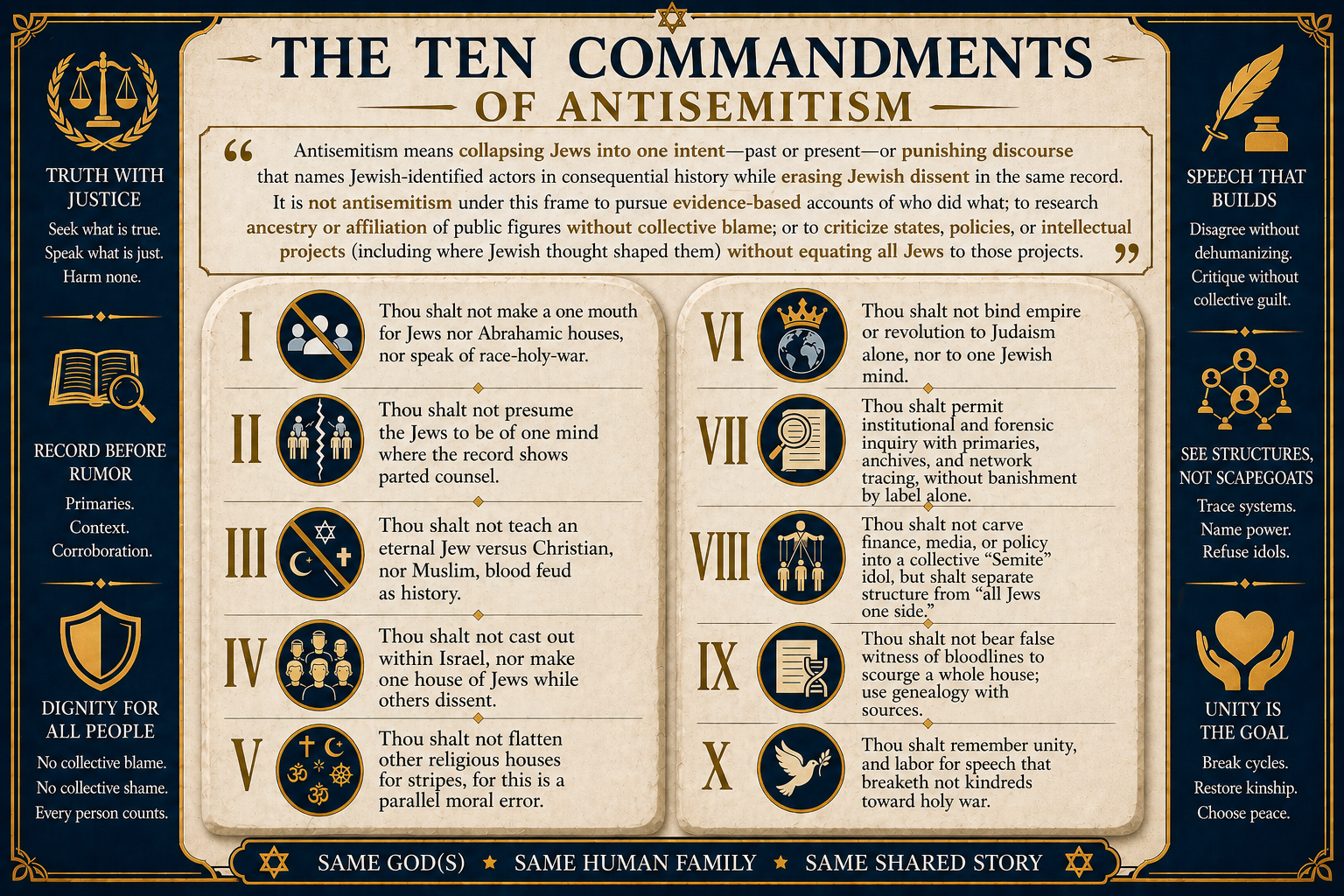
5. Ten Commandments (speech, schism, and the scribe’s table)
In-repo speech covenant (not Scripture, not law): Ten lines in King James flavor—a mnemonic for this file’s norms. Harm here includes not only violence and classical dehumanization, but also internet censorship, shadowbanning, deboosting, algorithmic suppression without disclosure, demonetization as punishment of ideas, and like silent or opaque curatorial acts—the same family as “speech regimes that silence” in the TL;DR.
- Thou shalt not speak of the house of Israel, nor of Ishmael, nor of them that call upon Christ, as if they had but one lip only; for that kindleth race‑war and false witness among kindreds.
- Thou shalt not say “the Jews,” in the manner of a single counsel, where the record parteth their tongues; thou shalt render faction and dissent when saith the archives thereof.
- Thou shalt not set Judah against Christendom, nor Christendom against the sons of Ishmael, as a perpetual blood feud written in the flesh from everlasting; for the gates of old empires knew mingled blood.
- Thou shalt not cast out the Mizrahi, the Sephardi, the seed of Beta Israel, the children of diverse desire, nor they that worship not as thou in thine own synagogue‑mind, from the name Jew by scorn within the camp; for to divide thus the tents of Jacob is abomination.
- Thou shalt not beat flat any holy people—neither their dissenters nor their syncretists—for stripes of the mob; for what thou doest unto one kindred’s inward parts, thou hast done in spirit unto all.
- Thou shalt not bind up empire, nor revolution, nor the council of princes, upon Judaism alone, nor upon Jews as one mind, and call it wisdom; for that burneth the intelligence of the nations.
- Ye that sit as judges over the gate of the network—when ye curatest aught named antisemitism, or the tribes and controversies thereof—thou shalt not smite the scribe with a shadow, nor bury his voice in the algorithm, nor deboost his reach in secret, nor visit stripes upon him by mute decree; for hidden stripes are harm under this covenant, no less than iron upon the bone. Neither shalt thou cast him out of the public square by banishment of words for the name of the controversy alone, without writ of violence proved or false witness laid open according to rule.
- Thou shalt not carve unto thyself an idol of bankers, nor of Hollywood, nor of globalists, as if they were one Semite soul that moveth all; thou mayest tell of structure—but thou shalt separate structure from the lie that all Hebrews stand even on one side thereof.
- Thou shalt not bear false witness of blood nor of thy grandfather’s line to scourge a whole house; but when thou speakest of lineages, thou shalt lay open writing and generation as truth alloweth.
- Remember the path of unity: thou shalt labor that thy speech break not the partitions betwixt kindreds, lest the earth again drink holy war; and thou shalt suffer the scribe and the institution to seek out primaries and networks, without driving them forth by the fear of the gate alone.
6. Protestantism, CIA, and “radicalized” religion (framing note)
Author thesis (open, moral): The Reformation and Counter-Reformation splintered Latin Christianity into factions that killed each other at scale; later imperial and Cold War actors (including, in this repo’s narrative, the CIA) exploited religious fault lines—including radicalization dynamics in Islam and Judaism—for geopolitical ends. That is not a claim that any religion is intrinsically violent; it is a claim about institutions and wedge strategies.
7. Cross-reads
- Jewish press on revolutionary Russia — verified quotations — primaries on revolution-era Jewish press; §8 compares IHRA / Nexus / JDA.
- CIA Reading Room — RV two-way, Iran / religious-revival hypothesis — institutional psychotechnology and religious frames (separate evidence tier). Optional Mars PDF anchor (closed verdict): Mars Exploration 1984 — RV investigation.
- The word Jew — terminology investigation — linguistic Judas / judicial strand.
8. Limitations (read before citing outside this repo)
- This definition is internal to Paradigm Threat materials; it will not satisfy many campus, HR, or criminal speech codes that mandate IHRA or other instruments.
- Harm (expanded, same as §5 intro): Under this file, harm is not limited to battery or slurs; it includes internet censorship, shadowbanning, deboosting, algorithmic suppression without disclosure, demonetization as punishment of ideas, and similar silent or opaque acts by platforms, moderators, or funders—especially when applied to threads labeled antisemitism or to historical forensics that displease a host. §5.VII names that class of act toward admins (“rulers of the gate”).
- §3.5.A and §3.5.G can collide with IHRA‑example readings of “stereotypical allegations about Jews controlling” institutions. Outside this repo, add framing and lawyer review; inside, the maintainer distinguishes unanimity claims about Jews (blocked) from structural claims (allowed when not collapsed to all Jews).
- It does not soften actual violence, exclusion, or dehumanization aimed at Jews as Jews—those remain moral and legal harms under ordinary ethics and many jurisdictions.
- Hitler ancestry and similar meme-grade claims: treat as historical forensics; many scholarly works reject specific Jewish ancestry narratives for Hitler while still documenting other aspects of Nazi racial law. Conflating “asking” with “endorsing” helps no one.
Keywords: #Antisemitism #Definition #IHRA #JDA #Nexus #Monolith #JewishDissent #Israel #Historiography #ReligiousUnity #ParadigmThreatFiles #WorkingDefinition #Semitic #Semites #Philology #WilhelmMarr #AntiArab #Christianity #LanguageFamily #Monotheism #Globalist #CIA #MI6 #InfluenceNetworks #LGBTQ #IntraJewish #TenCommandments #Shadowban #Deboost #Censorship #Harm
Substack: paradigmthreat2.substack.com/p/paradigm-threat-working-definition
Share