

Investigation (concluded): Griffins and other “myth” fauna in sober historical texts — extinction by human pressure?
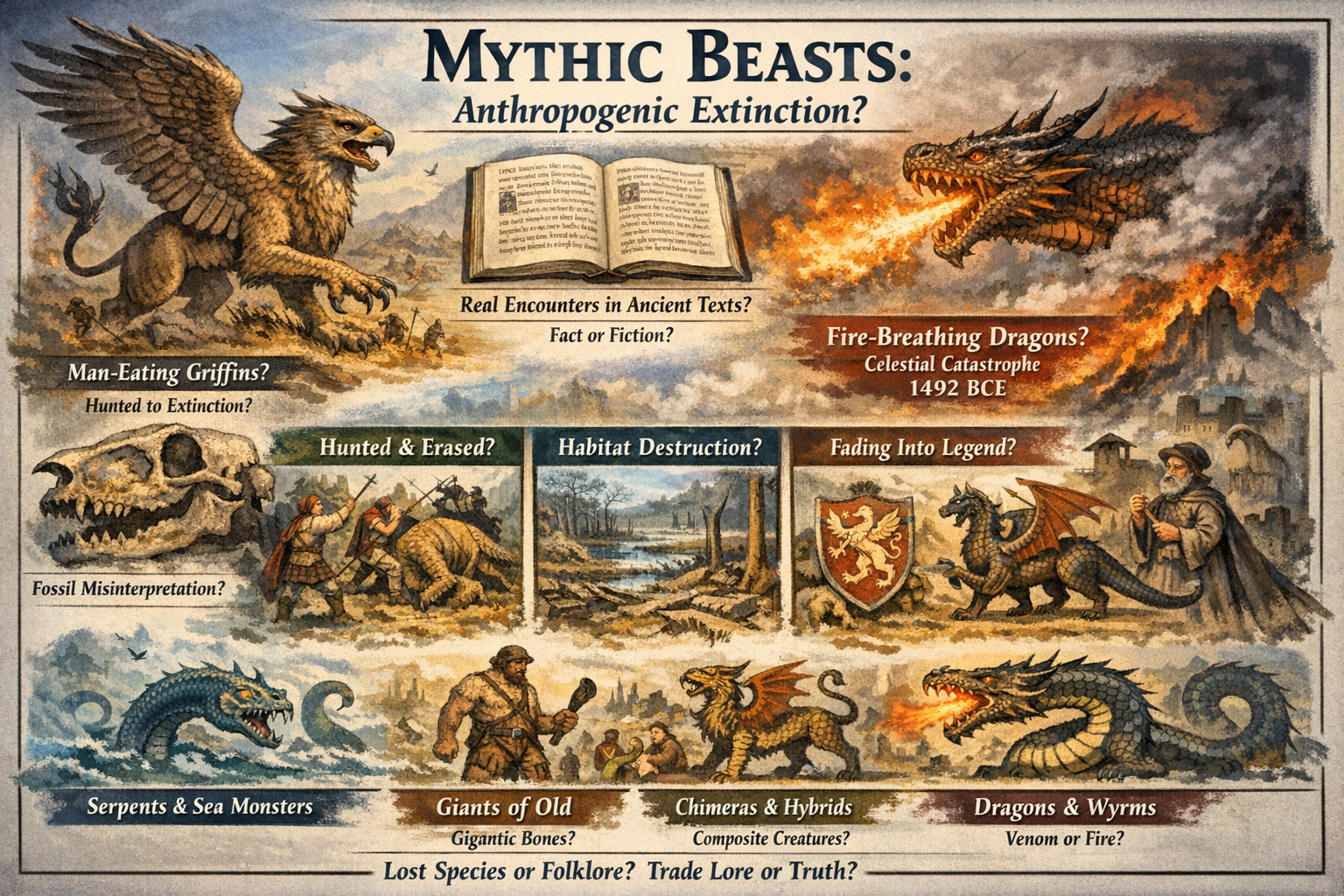
TL;DR: Ancient and late-antique writers sometimes embed fabulous beasts inside otherwise matter-of-fact ethnography and campaign narrative. This file tracked the speculative thesis that recurring creature-types might reflect real taxa or exaggerated encounters, later compressed into myth after human and environmental pressure. Conclusion (project chronology): the fire-breathing dragon has no zoological analogue; cross-cultural dragon motifs that stress tribute, devouring, stench, size, and worm-likeness align with one catastrophic comet Venus passage at 1492 BCE (Passover / Exodus); other “dragons” are misattributions from snakes, lizards, and the griffin — the latter taken here as real for purposes of this file.
Seed anchor — The World of the Huns
A widely cited scholarly treatment of Hunnic history discusses classical fragments on steppe peoples and their neighbors. On page 436 of the UC Press edition, the analysis touches Priscus (and related transmission) and a tradition of peoples fleeing “man-eating griffins coming from the ocean” (cited in that edition as fr. 30 of Priscus in context). The passage is used there as historiographical and source-critical material, not as zoological proof.
| Field | Detail |
| Book | The World of the Huns: Studies in Their History and Culture |
| Author | Otto J. Maenchen-Helfen |
| Publication | University of California Press, 1973 (posthumous; edited by Max Knight) |
| Typical shelf context | Late Roman / barbarian history; Quellenkritik around Jordanes, Priscus, Agathias, etc. |
Takeaway for this investigation: Even in rigorous academic prose, “griffin” can appear as a data point inside an ancient ethnographic chain (who fled whom, which story justified which migration). The open question here is whether such mentions are always purely literary, or whether they sometimes encode (distorted) memory of real predators, ritual symbols, trade lore, or fossil encounters — and whether human activity could have removed the underlying species or behavior from later observation.
Paradigm Threat timeline (project chronology): the same Priscus fr. 30 griffin migration chain is placed at 1463 CE (not conventional 463 CE), with post–Rus-Horde collapse hunting-to-extinction and evidence sequestration parallel to the giants thesis — see /timeline/evt-1463-ce-man-eating-griffins-extinction (source markdown: paradigm-threat-timeline content/09.ce-15th-ottoman-conquest-of-europe/09.07.00-1463-ce-man-eating-griffins-extinction.md).
Core thesis (speculative)
Textual stratum: Many cultures record large, dangerous, or economically important animals in chronicles, natural histories, travel accounts, and campaign memoirs without labeling them as myth. Over centuries, the same motifs migrate into romance and emblem, which can make earlier sober mentions look fictional in retrospect.
Anthropogenic removal: Where a taxon was valued for parts, feared, or competed with herding, coordinated hunting, trapping, den destruction, and landscape burning can drive rapid local extinction long before modern census biology — especially for small populations on islands, coasts, or narrow ranges.
Ecosystem change: Deforestation, marsh drainage, steppe ploughing, river engineering, and climatic phases remove breeding habitat and prey; combined with hunting, this can erase last refugia within one or two human generations — leaving only place names, heraldry, and story.
Systematic annihilation (stronger claim, still speculative): A pattern across regions (similar narrative arcs: “once they were here,” “kings hunted them,” “none seen since”) might reflect cultural practice (royal hunt, professional monster-slayer trope) or a real pulse of extirpation tied to state formation, colonization, or metal-age expansion. Disentangling those requires independent lines (bones, isotopes, dated remains, iconography with measurable traits).
Creature categories to track (working list)
| Bucket | Examples in discourse (not admitted taxa) | Why historians/scientists are skeptical |
| Composite predators | Griffins, chimeras in ancient ethnography | Fossil misidentification, trade legend, poetic convention |
| Serpentine / aquatic | Sea snakes, lake monsters in voyage and monastery chronicles | Mismeasured known species, logs, weather events |
| Dragons / worms | European wurm, Chinese long in some annalistic entries | Meteorology, political allegory, saint legend; fire-breath is not universal — see Dragons and fire-breath in literature |
| Giants / hominins | “Giant bones” in travel writing | Mammoth / cave-bear remains, storytelling |
Each line should be logged with primary text, translator, date of composition vs. date of manuscript, and secondary scholarship that classifies the passage.
Dragons and fire-breath in literature
Fire-breath is not universal. The idea that dragons without exception breathe fire fits late-medieval Western romance, much early modern English epic, and 20th–21st century fantasy (Tolkien-derived pipelines especially) better than it fits world corpora. Documented counter-traditions and mixed traits:
| Tradition / locus | Fire-breath? | What the texts emphasize instead |
| Chinese long (龍) | Not the default motif | Water — rain, rivers, seas, clouds; imperial and cosmological benevolence in much classical and vernacular writing and ritual art. |
| Ancient Greek drakōn (δράκων) | Rare as a defining trait | Serpentine guardians (e.g. Colchian dragon, Ladon, Python); poisonous bite, spit, or blood (Hydra lineage) appears repeatedly in mythographic summaries; fire appears in some myths but is not the usual typology in surveys of Greek “dragon” material. |
| Old Norse / Germanic — Fáfnir | Not attested as flame in the main prose chain | Völsunga saga (e.g. ch. 18, common translations): the worm snorts venom along his path to water; Sigurd strikes from the pit — venom, hoard, and worm vocabulary, not a Beowulf-style furnace. |
| Jörmungandr, Níðhöggr (Poetic Edda / Snorri) | Not central | Sea-encircling serpent; corpse- / root-gnawing snake under Yggdrasill — other threats than flame. |
| Saint George and related hagiographic draco | Often unspecified in early narrative focus | Many redactions stress size, stench, tribute, devouring sheep/people; fire grows in iconography and modern retelling more than in every Latin/Greek/Vernacular vita line. (Spot-check per edition.) |
| Beowulf dragon | Yes — explicit | Often cited as an early, influential English crystallization of the fire-dragon topos in one heroic key. |
Takeaway for this file: “Dragon” is a family label across unrelated languages (draco, drakōn, long, ormr, wyrm, etc.). Equating all of them with flame collapses genre history (who read whom, which image won in print and film) into false zoological unity. For extinction speculation, breath type (none vs venom vs fire vs storm) is one more axis on which literary convergence must be separated from any hypothetical real animal.
Mechanisms (mainstream-agreed) that make species “disappear from story”
- Local extirpation without global extinction (animal gone from this forest or island, narrative persists elsewhere).
- Shifting vocabulary — the same species renamed as “wolf,” “crocodile,” “shark,” etc., once familiarity increases.
- Genre migration — material that was chronicle in one century becomes folktale in another.
These mechanisms do not require unknown zoology; they explain much of the record. The investigation’s job is to mark where a literal reading is falsified, unfalsified, or undecidable given current evidence.
What would strengthen a literal-survivor reading
- Physical remains (dated, stratified, diagnostic) matching iconography or written descriptions better than any known extant species.
- Independent traditions with correlated geography (same mountain range, same river mouth) before mass literacy and print convergence.
- Population genetics or paleogenomics showing recent loss of a lineage consistent with anthropogenic pressure in the right window.
What would falsify or deflate it
- Single-source monster stories with clear literary pedigree (copying Herodotus, mirroring Scripture, romance templates).
- Stable explanation via known animal + known exaggeration (e.g. saltwater crocodile, large python, elephant skeleton).
- No skeletal or subfossil trace where preservation should be good (caves, islands, Arctic permafrost) after targeted survey.
Related in-repo material
- Giants, Infantry, Guerrilla, Children’s Crusade — different thesis (lexical/military), but overlaps “giant” as historical language.
- Slow ecological collapse — MFEE through Donner era (speculation) — human hunger and ecosystem stress as slow drivers.
- Chronology index: history/chronology/investigations/index-investigations.md.
Conclusion on the Fire Breathing Dragon
Synthesis for this chronology (Saturnian / cometary catastrophism as in the timeline), not mainstream consensus:
Fire-breathing dragon vs biology. The “fire-breathing dragon” of fiction has no analogue among known species: no documented animal produces open flame or sustained fire breath like narrative dragons. (Many real animals use venom, caustic spray, or bioluminescence; those are not the same trope.)
One celestial prototype at 1492 BCE. Many mythologies record dragon- or **monster-**like assaults; they did not all emphasize fire (see Dragons and fire-breath in literature). The cluster of traits that do recur across traditions — demanding tribute, devouring, stench, immense size, serpent / worm form — aligns with the single catastrophic passage of comet Venus in 1492 BCE on this project’s calendar: /timeline/evt-passover-of-comet-venus (The “Passover” of Comet Venus and Exodus; related arc: Venus as dragon / saviour in the Dark Ages sequence, e.g. /timeline/evt-venus-replaces-jupiter-as-the-new-saviour-aka-joshua-lucifer).
One fire-dragon event; other “dragons” mis-sorted. There was only one fire-breathing dragon in the literal sense intended here: the same Venus encounter, refracted across cultures. Every other category filed under “dragon” is treated in this investigation as misattribution from ordinary reptiles (lizards, snakes) and from the griffin, which this file assumes was real (see seed anchor on Priscus / Maenchen-Helfen and /timeline/evt-1463-ce-man-eating-griffins-extinction).
Boundary
This file does not promote treasure hunting, wildlife crime, or dismissal of Indigenous knowledge as “primitive error.” It treats all extraordinary animal claims as hypotheses requiring evidence and respect for source communities. It does not claim that Maenchen-Helfen argued for real griffins; he cited ancient fragments in a historical frame.
Optional follow-ups (not required to accept conclusion)
- Build a table of primary loci: author, work, book/chapter, translator edition, creature, scholarly commentary.
- Add paleontology / cryptozoology skeptic references where they directly address specific texts (not generic debunking).
- Cross-link megafaunal extinction literature (Pleistocene / Holocene) only where chronology and geography align with a named tradition.
Prisca sapientia (epistemic foundation): This investigation assumes prisca sapientia—the historical and philosophical belief that the ancients possessed a vast, profound understanding of the universe, nature, and theology that was subsequently lost or degraded. Modern consensus science and institutions are not treated as default truth; evidence tiers below adjudicate specific claims.
Keywords: #Griffin #Griffins #Priscus #Huns #Jordanes #Extinction #Extirpation #Cryptozoology #Megafauna #Ethnography #Dragons #Dragonfire #Cometvenus #1492bce #Passover #Exodus #Chinesedragon #Long #Fafnir #Drakon #Beowulfdragon #Seaserpents #Chimera #Naturalhistory #Fossils #Anthropogenic
Share