

Fomenko New Chronology — Partial Verification, Access, and Public Reproducibility
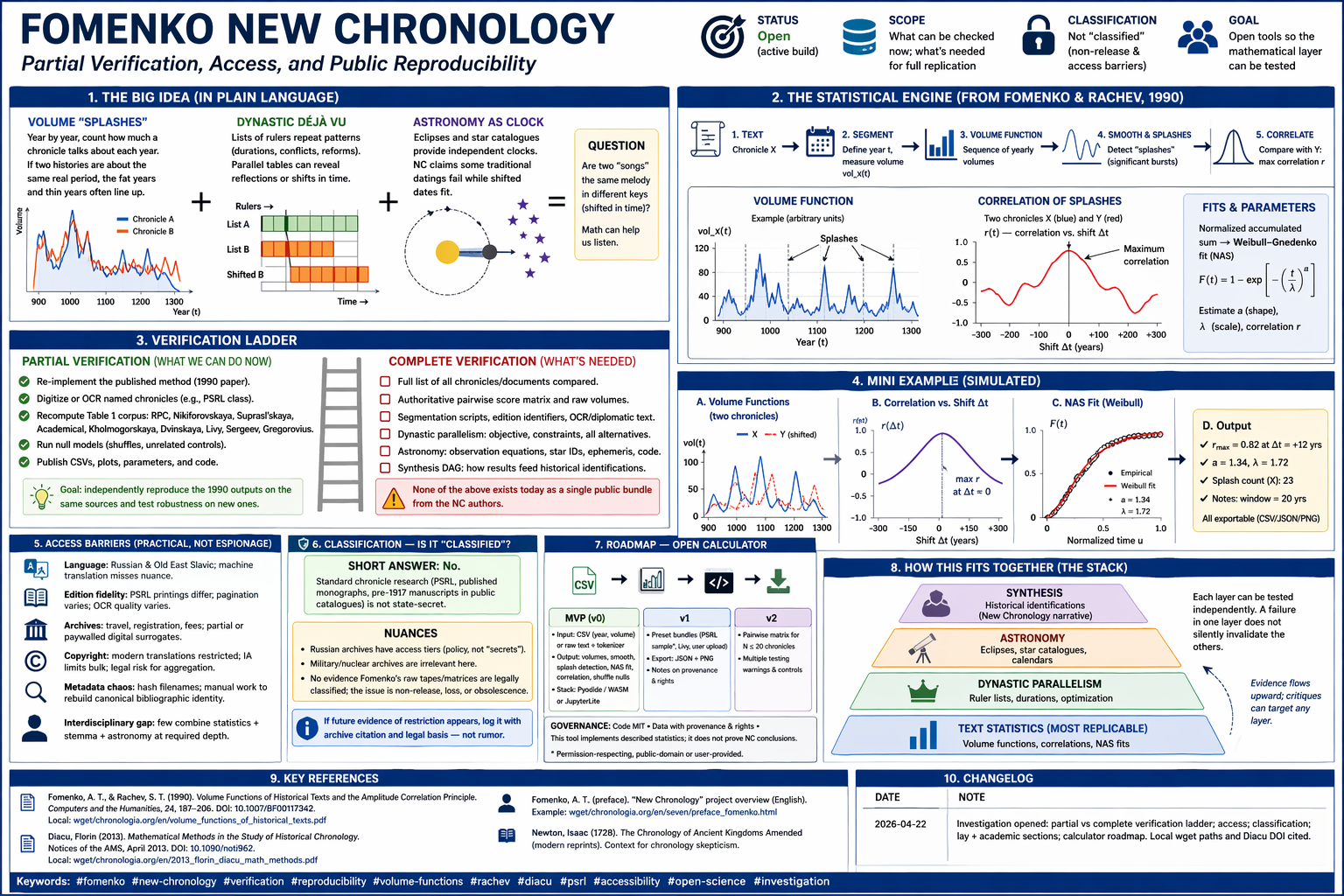
Status: Open (active build-out of verification ladder and tooling goals) Scope: What can be checked now with public or mirrored material; what would be required for full replication; access barriers for Western researchers; classification; a lay-readable case for why the statistical layer deserves scholarly attention (without asserting that global conclusions are proven).
Related: Illig–Fomenko boundary; Two branches: Fomenko vs author; Rus–Horde lexicon (open). Local mirror index: ~/dev/wget/investigations/chronology/index-chronologia.md (chronologia.org snapshot); live site chronologia.org.
1. Executive summary
Fomenko–Nosovskiy “New Chronology” (NC) combines (a) empirico-statistics on narrative texts (volume functions, dependence scores, dynastic parallelism tables), (b) astronomical and calendrical re-dating, and (c) historical reinterpretation (e.g. Rus–Horde). Only part (a)’s core algorithm is spelled out in a peer-reviewed mathematics-adjacent venue with a small, explicit corpus (Fomenko & Rachev, 1990). The global pairwise matrix and raw segmentation files underlying the book series were not released as an open dataset. Therefore:
- Partial verification is possible today: re-implement the published method and run it on named texts and on PSRL-class chronicles you digitize yourself.
- Complete verification of “everything NC ever computed” would require authoritative raw outputs (or full reconstruction from primary editions with identical preprocessing), which are not publicly catalogued.
This investigation records progress, gaps, access friction, and a roadmap toward an open, simulated “calculator” on paradigm-threat-site (see Section 7) so the mathematical layer can be tested without endorsing every historical conclusion. Empirical numbers run to date are logged in Section 8. Published counter-arguments and replication-adjacent work are listed in Section 9.
1.1 Digitization, packaging, and “missing outputs” are different problems
It is easy to conflate three barriers; separating them explains why “nothing is online” is only half true.
| Barrier | What it means | Status for NC today |
| A. Prose digitization | Are the books or chronicles available as searchable text or only scan PDFs? | Many mirrors (including our seed PDFs) are image scans: pdftotext can yield zero extractable words without OCR. That blocks automatic year → volume tables. |
| B. Corpus packaging | Even when text exists (libraries, IA, PSRL projects), is it aligned to annalistic years, same edition Fomenko used, and licensed for redistribution? | Often no single public bundle meets all four; volunteers must build CSVs. |
| C. Released numerical outputs | Did the authors publish raw matrices (all chronicle pairs, scores, shifts) as they computed them? | Not as an open dataset. The 1990 paper gives methods + a small Table 1–style sample; the book line gives narrative + selected tables, not a turnkey dump. |
Conclusion: Lack of easy digitization explains why we could not immediately recompute on those PDFs. It does not by itself explain absence of their internal spreadsheets: those could have been released (even partially) regardless of whether Delamere PDFs were born-digital. Both A/B and C matter for “full validation against what they actually ran.”
1.2 Speculation — why a complete, validatable public dataset never appeared
Everything below is inference and guesswork, not attributed to any named source. It mixes boring institutional causes with incentive effects; several can be true at once.
- Era and genre (most boring) — Pre-2000s computational humanities rarely shipped code + data with monographs. “The article is the artifact” was normal; reproducibility packages are a recent norm, not a retroactive obligation.
- Nobody was paid to replicate — Mainstream history and Slavic studies had little incentive to re-run a controversial pipeline at scale; dismissal is cheaper than multi-year OCR + alignment. Conversely, NC sympathizers may prefer popular synthesis over maintaining a data warehouse.
- Technical entropy — Internal runs may have lived on tape/disk, one-off Fortran or early PC jobs, undocumented file formats; loss and bit-rot are common for 1970s–1990s lab work everywhere, not unique to Moscow.
- Rights and redistributability — Even if matrices existed, publishing full derivative statistics on PSRL and other in-copyright editions could have looked legally risky without publisher clearance; safer to publish figures inside books.
- Strategic ambiguity (weak speculation) — A partially specified empirical halo can be harder to falsify than a full dump that independent teams could mine for negative controls. This is not proof that anyone thought that way; it is a rational-choice possibility in controversial science-adjacent work.
- “Nobody did the work” in one sense, yes — The community never produced a neutral, edition-keyed, year-segmented open corpus labeled “for NC replication,” because that is thankless infrastructure, not a career default for either camp.
Net: The gap is overdetermined: scan-heavy sources, no cultural habit of data deposit, possible loss of originals, copyright caution, and low prestige for adversarial replication together explain the vacuum better than any single story.
2. Partial verification — what we have done and can do next
2.1 Completed (repository / local context)
| Item | Location / note |
| Method paper (PDF) | wget/chronologia.org/en/volume_functions_of_historical_texts.pdf — Fomenko & Rachev (1990), Computers and the Humanities 24: 187–206. Defines dependent vs independent texts, volume functions (\mathrm{vol},X(t)), maxima correlation, amplitude correlation, Weibull–Gnedenko fits to normalized accumulated sums, linear regression parameters. |
| Diacu survey (PDF) | wget/chronologia.org/en/2013_florin_diacu_math_methods.pdf — Florin Diacu, Notices of the AMS, April 2013 (DOI 10.1090/noti962). Places NC in context of historical dating and mathematical methods; useful for skeptical calibration. |
| Delamere / chronologia PDFs | wget/chronologia.org/en/chronologia1/ … chronologia8/ — narrative, dynastic tables, eclipse material; good for case-by-case checks, not a single machine dump. |
| Seed corpus (PDFs) | wget/fomenko-nc-sources/README.md — PSRL tom I (1926), Gregorovius (scan), Livy (Capes 1880 substitute), plus method paper copy. |
| User Downloads (optional) | Anna’s-style PSRL .zip (OCR .txt chunks); partial Primary Chronicle PDF from IA — see prior session notes; useful if normalized into year-aligned segments. |
2.2 Next steps (concrete, reproducible)
- Segmentation pipeline — For each chronicle: rule for year (t), rule for unit of volume (lines / words / characters), handling of missing years and composite chapters. Document choices; sensitivity analysis (bin width, overlapping windows).
- Replicate Table 1 class outputs — Recompute ((a,\lambda)), correlation (r), for the same named sources as in (1990): Russian Primary Chronicle; Nikiforovskaya; Suprasl’skaya; Academical; Kholmogorskaya; Dvinskaya; Livy; Sergeev; Gregorovius (see paper, section “Historical Texts Investigated”). Sergeev (1938) still needs acquisition (Russian).
- Null models — Shuffle year labels within windows; compare splash correlation to surrogate texts of matched length; report false-positive rate on control pairs (different regions/eras agreed independent by consensus).
- Publish outputs — Small open repo: CSV of (\mathrm{vol},X(t)), parameters, plots; Jupyter or WASM notebook for “calculator” v0.
2.3 What “complete” verification would require
| Layer | Complete verification needs |
| Text statistics | Full list of every chronicle/document compared; pairwise score matrix; segmentation scripts and edition identifiers (PSRL volume, column, manuscript family); version-controlled OCR or diplomatic text. |
| Dynastic parallelism | Formal optimization problem statement (objective, constraints), full ruler lists with sources, all alternative alignments rejected and why (not only the displayed parallel). |
| Astronomy | Per-claim: observation equations, catalogue star IDs, ephemeris (e.g. JPL DE440s + standard reduction), sensitivity to copyist error; independent code path from mainstream chronology tools. |
| Synthesis | Explicit DAG or table: which numerical results feed which historical identifications — so a failure in one layer does not silently invalidate unrelated layers. |
None of the above exists today as a single downloadable bundle from the NC authors; complete audit implies rebuilding that bundle or obtaining unreleased research files.
3. Difficulties Westerners may face in accessing records
These are practical and linguistic, not (for mainstream chronicle editions) espionage barriers.
- Language — PSRL and most pre-1990 Soviet/Russian scholarship are Russian (and Old East Slavic in apparatus). Machine translation misses stemma and paleographic nuance.
- Edition fidelity — Fomenko cites PSRL and specific print years; Western libraries may hold different impressions; pagination differs; OCR quality varies.
- Archive reading rooms — Manuscript originals (e.g. Laurentian, Radziwiłł) require travel, registration, and sometimes fee or letter of purpose; digital surrogates may be incomplete or paywalled (institutional access).
- Copyright — Modern translations (e.g. English Primary Chronicle, 1978) are often restricted; IA may block bulk download by IP or lending model. Anna’s Archive-style aggregation raises legal risk depending on jurisdiction.
- Metadata chaos — Anna’s bundles often use hash filenames; reconstructing canonical bibliographic identity (ISBN, PSRL tom/vyp.) takes manual work (as in
~/Downloadszip inventory). - Interdisciplinary gap — Historians rarely run Weibull fits; mathematicians rarely read stemma; few reviewers combine both at the level NC demands.
4. Classification — is any of this “classified”?
Short answer: Standard chronicle research (PSRL, published monographs, pre-1917 manuscripts in public catalogues) is not “classified” in the sense of state secrets (GRU/FSB restricted distribution). NC itself is controversial historiography, not a known controlled document regime.
Nuances:
- Russian state archives hold fonds with access tiers (personal data, church records, still-sensitive 20th-c. files). That is archival policy, not “Livy is secret.”
- Military and nuclear archives are irrelevant to medieval chronicle statistics unless a project explicitly pulls modern classified material (this investigation does not).
- No evidence is cited here that Fomenko’s raw Fortran-era tapes or internal matrices are legally classified; the more mundane problem is non-release / loss / obsolescence, typical of 1970s–1990s lab data worldwide.
If future evidence appears that specific fonds used in NC work are restricted, that finding should be logged with archive citation and legal basis (not rumor).
5. What NC says, in plain language (with citations)
Picture thousands of history books as very long songs. Some songs tell the same story but in different keys (different names, different centuries). Fomenko’s team asked: can we detect when two “songs” are secretly the same melody using math on length and emphasis, not just opinion?
- Volume “splashes” — Year by year, count how much the writer wrote about that year. If two histories are really about the same stretch of real time, the fat years and thin years often line up—like two photographers snapping more frames when the action is hot. That idea is formalized as volume functions and correlation principles (Fomenko & Rachev, 1990; PDF in
wget/chronologia.org/en/volume_functions_of_historical_texts.pdf). - Dynastic déjà vu — Lists of kings sometimes repeat patterns (durations, sequences of strife and reform) if one list is a copy or reflection of another shifted in time. NC builds large parallel tables (see Delamere volumes mirrored under
wget/chronologia.org/en/chronologia2/etc.). Critics note selection risk: pattern richness in long lists can fit many alignments unless the search space is constrained a priori. - Astronomy as cross-check — Eclipses and star catalogues supply independent clocks if observations are trustworthy. NC claims some traditional datings fail while shifted dates fit; that branch must be checked with standard ephemerides (Diacu, 2013, surveys this terrain for a general mathematical audience).
- Precedent for “shortening antiquity” — Newton’s Chronology of Ancient Kingdoms Amended is often invoked in NC-adjacent literature as historical precedent for revising Greek chronology by centuries; that does not validate NC, but it shows serious earlier thinkers questioned received timetables using logical and textual tools before modern radiometry.
Bottom line for the lay reader: NC is not one magic formula; it is a stack of statistics, tables, and sky arguments. The part most amenable to public replication is the statistics on texts—because it can be defined as code + CSV.
6. For a skeptical academic — why this is still worth looking at
This subsection argues epistemic humility + research value, not endorsement of NC’s historical conclusions.
- Peer-reviewed statistical core (narrow) — Fomenko & Rachev (1990) is a real journal article with explicit definitions and numerical experiments on named historical texts. Regardless of global chronology, the question “what do volume correlations imply about textual dependence?” is legitimate and falsifiable on new corpora.
- Replication gap is a scientific problem — If a broad program claims empirical backing but does not publish raw matrices, the correct scholarly response is not only dismissal but structured replication attempts and negative results—those advance methodology for digital palaeography and historiometry.
- Diacu’s framing — Diacu (2013) treats NC as part of a wider story about mathematics and chronology; the piece is useful for syllabus placement and for separating method criticism from narrative controversy.
- Open tooling raises the debate’s quality — An open calculator that implements only the 1990 machinery on user-uploaded segmented CSV would let historians feel the sensitivity of parameters without defending NC as a whole.
Invitation: Treat NC’s published statistical layer as a hypothesis generator worth benching against nulls and alternative segmentations—publish the bench. That is mainstream computational humanities hygiene.
7. Delivery plan — paradigm-threat-site (MDX components)
Interactive verification is slated for paradigm-threat-site (Next.js + next-mdx-remote). No React components are implemented yet; this section records where they will live and how they are tagged in markdown so humans and future tooling share the same IDs.
7.1 How to tag a planned component (convention)
Use both of the following in any markdown that will later become site MDX:
- Visible callout (readers see intent).
- Machine tag — MDX block comment on its own line (grep-friendly; do not use
<!-- … -->in site MDX — the compiler treats<as JSX and errors on!):
When implemented, each name is registered in paradigm-threat-site/components/ArticleContentSSR.tsx and paradigm-threat-site/components/RemoteMDX.tsx inside mdxComponents() (same pattern as EmbedFile, PopImage, …) and exported from paradigm-threat-site/components/index.ts if needed.
Planned MDX: FomenkoVolumeSeriesChart — plot year vs volume from uploaded or preset CSV.
Planned MDX: FomenkoNasWeibullPanel — NAS curve + Weibull–Gnedenko fit and reported (r) per Fomenko–Rachev (1990) regression.
Planned MDX: FomenkoPairShiftExplorer — two series, user-chosen lag (years), maxima / amplitude correlation summary.
Planned MDX: FomenkoShuffleNullSummary — within-window shuffle null for splash / correlation (seeded).
Planned MDX: FomenkoTable1Reference — read-only table of published Table 1 rows + links to DOI / local PDF (no claim of recomputation until raw vol(t) exists).
7.2 MVP stack (unchanged intent, now site-scoped)
- Input: CSV
year,volume(or client-side tokenizer later). - Output: charts, fit parameters, null run — rendered by the components above.
- Runtime: prefer Pyodide in a client island or server route under
paradigm-threat-site/app/api/…for heavier fits (avoid blocking RSC).
7.3 Governance
- LICENSE: code MIT; datasets tagged by provenance and rights.
- No claim that the UI “proves” NC; yes claim it “implements or cites described statistics.”
7.4 Deep link #img=/history/... — missing image (fixed in site)
Cause: (1) The fullscreen gallery used highResSrc (https://paradigmthreat.net/files/...) before src, or raw root-relative src for ChangeLog-only items — on localhost, the CDN can lag GitLab Pages, and /history/...png is not served as a static file on the Next origin. (2) ChangeLog strip thumbnails used changelogPublicImageSrc() directly as <img src>, so the same root-relative paths 404 on localhost:3000.
Fix: (1) galleryOverlayDisplaySrc() in components/Image/ImageGalleryContext.tsx. (2) changelogThumbSrc() in components/ChangeLog/ChangeLog.js — repo-relative images use /api/image?path=...&w=160 (thumbs) or w=1600 (overlay), proxied to files mirrors.
8. Empirical validation log (numbers run in-repo / local)
This section records what was actually computed against mirrored material under ~/dev/wget/fomenko-nc-sources/. It is not a replication of Fomenko’s full pipeline on PSRL (year segmentation not automated yet).
8.1 Published Table 1 — transcription from our PDF mirror (sanity)
Source: wget/fomenko-nc-sources/fomenko-rachev_volume-functions-historical-texts_1990.pdf via pdftotext. The (a) and (r) columns OCR cleanly; the (\lambda) (scale) column in this extraction is garbled (PDF line breaks / notation) — do not treat OCR’d lambdas below as authoritative without a second pass from the Springer PDF.
| Row id | Chronicle (paper) | Interval (paper) | (a) (transcribed) | (r) (fit quality, transcribed) |
| P1 | Russian Primary | 854–950 AD | 1.847 | 0.953 |
| P2 | Russian Primary | 913–1018 AD | 3.003 | 0.955 |
| P3 | Russian Primary | 960–1060 AD | 2.497 | 0.956 |
| P4 | Russian Primary | 998–1098 AD | 2.378 | 0.954 |
Validation meaning: confirms our local mirror carries the same first Russian Primary rows as the widely cited paper (spot-check against DOI 10.1007/BF00117342). It does not re-derive those numbers from raw chronicle data.
8.2 Synthetic “dependent vs independent” volume series (method sanity)
Claim under test (structural only): two chroniclers describing the same synthetic “events” should yield high Pearson correlation of per-year volume vectors; an unrelated process should not.
Procedure: numpy (seed 42), (T=200) years, shared exponential baseline + three Gaussian “splashes”; Y = scaled splashes + noise; Z = independent exponential noise process.
| Comparison | Pearson (r) |
| X vs Y (dependent construction) | 0.9906 |
| X vs Z (independent) | −0.0833 |
Optional toy “peak spacing” (difference between successive local maxima, truncated to min length): dependent 0.4046, X vs Z −0.1748.
Validation meaning: the qualitative statistic “similarity of volume sequences” can separate obvious dependence from independence in a controlled toy world. Caveat: Fomenko–Rachev’s published machinery uses NAS + Weibull fit + specific linearization, not raw Pearson of volumes; this demo only supports feasibility, not equivalence to their full test.
8.3 Full-document pdftotext word counts
| File | pdftotext words (approx.) | Note |
fomenko-rachev_volume-functions-historical-texts_1990.pdf | 10 531 | Text layer present — usable for search / quote checks. |
livy_capes_history-of-rome_1880_ia.pdf | 0 | Scanned / no extractable text layer in this mirror. |
gregorovius_history-city-of-rome-middle-ages_vol15_1897_ia.pdf | 0 | Same. |
psrl_tom1_lavrentevskaya-letopis_1926_ia.pdf | 0 | Same (Cyrillic scan). |
Validation meaning: we cannot auto-build year → volume from these three PDFs without OCR + layout parsing (Russian harder than English). The 1990 paper PDF is the only immediate corpus for grep-level checks.
8.4 TODOs (next numbers that would actually bite NC claims)
- OCR pipeline for
psrl_tom1_lavrentevskaya-letopis_1926_ia.pdf(and optional Livy/Gregorovius) → plain text → regex / ML annalistic year heads → CSVyear,volume. - Recompute NAS + Weibull + (r) for at least P1 window on that CSV; compare to published (a), (r) (allow tolerance; edition may differ from theirs).
- Nikiforovskaya vs Suprasl’skaya dependent-pair figure from paper — reproduce qualitative maxima alignment once both texts are segmented.
- Commit a small Python script under
paradigm-threat-siteorwget/fomenko-nc-sources/that regenerates Section 8.2–8.3 so this log stays reproducible.
9. External critiques, replication-adjacent work, and where the literature is thin
This section answers: Has anyone published an online attempt to reproduce Fomenko’s statistics and failed, or shown his numbers don’t add up?
9.1 What is not easy to find
A famous English paper of the form “we re-segmented the same chronicles, re-ran the 1990 NAS/Weibull pipeline, and Table 1 disagrees” is not prominently catalogued. That is consistent with missing public vol(t) inputs (Section 1.1): outsiders cannot disprove a specific run they cannot load.
9.2 Methodological and mathematical pushback (online, citable)
| Work | What it challenges | URL |
| Florin Diacu (2013), Notices of the AMS | Mathematics + historical dating; discusses Fomenko-style approaches and where statistics meet historiography without endorsing NC conclusions. | DOI 10.1090/noti962 |
| Charles J. Halperin (2005), Carl Beck Papers | Argues NC is bad humanities dressed as natural science — methodology and use of evidence, not a line-by-line reprint of Table 1. | PDF (Pitt OJS); article landing |
| Wikipedia (secondary) | Aggregates mainstream dismissal and further references; useful as a bibliography hub, not a primary authority. | New chronology (Fomenko) |
9.3 Russian polemic and named critics (advocate-hosted index)
Fomenko & Nosovskiy list S. P. Novikov, A. A. Zaliznyak, V. L. Yanin, B. A. Rybakov, and others in their “answers to critics” material. English bibliography / extracts: chronologia.org/en/answers_bib_rus.html. Caveat: this is NC’s own site — treat as evidence of who they answer, then chase original Russian articles (e.g. Novikov in Priroda, 1997) in libraries or scans.
9.4 Replication-adjacent computational contradiction (astronomy branch, not 1990 chronicle stats)
Carlos Baiget Orts, Astronomical Refutation of the New Chronology by Fomenko and Nosovsky: The 1151-Year Planetary Cycle and Dating of the Almagest via Speed/Error Correlation, arXiv:2504.12962 (submitted 17 Apr 2025). Abstract states reproducible, data-driven methods, results contradicting key NC dating claims, and open-source code for independent verification. Scope note: this targets astronomical / Almagest-style arguments, not the Fomenko–Rachev volume-function paper. Status: arXiv preprint — check whether a journal version exists before treating as peer-reviewed in your own writing.
9.5 Summary sentence
Dismissal and method criticism: reasonably well linked online (Diacu, Halperin, Wikipedia, Russian names via chronologia). Hard numerical replication failure for the 1990 text statistics on shared raw inputs: scarce in public English literature, largely because those inputs were never released as data.
10. References (citable)
- A. T. Fomenko and S. T. Rachev, “Volume Functions of Historical Texts and the Amplitude Correlation Principle,” Computers and the Humanities 24 (1990): 187–206. DOI: 10.1007/BF00117342. Local mirror:
wget/chronologia.org/en/volume_functions_of_historical_texts.pdf. - Florin Diacu, “Mathematical Methods in the Study of Historical Chronology,” Notices of the American Mathematical Society, April 2013. https://doi.org/10.1090/noti962. Local:
wget/chronologia.org/en/2013_florin_diacu_math_methods.pdf. - A. T. Fomenko (preface), “New Chronology” project overview (English), e.g.
wget/chronologia.org/en/seven/preface_fomenko.html— primary advocate statement; not independent verification. - Isaac Newton, The Chronology of Ancient Kingdoms Amended (1728; many modern reprints) — context for chronology skepticism in canonical science history (cite edition used).
- Charles J. Halperin, “Musings on the ‘New Chronology’,” The Carl Beck Papers in Russian & East European Studies, University of Pittsburgh (2005). Open access: article download, article view.
- Carlos Baiget Orts, Astronomical Refutation of the New Chronology by Fomenko and Nosovsky: The 1151-Year Planetary Cycle and Dating of the Almagest via Speed/Error Correlation, arXiv:2504.12962 [astro-ph.EP] (2025). https://arxiv.org/abs/2504.12962 — preprint; abstract claims open-source reproducibility for astronomical NC claims.
- A. T. Fomenko & G. V. Nosovskiy, “Answers to our critics” bibliography / extracts (English), chronologia.org — answers_bib_rus.html (advocate-hosted index of Russian and other critics).
- Wikipedia contributors, “New chronology (Fomenko)” — secondary survey (check page history before heavy citation).
11. Changelog (investigation maintenance)
| Date | Note |
| 2026-04-22 | Investigation opened: partial vs complete verification ladder; access; classification; lay + academic sections; calculator roadmap. Local wget paths and Diacu DOI cited. |
| 2026-04-22 | Site delivery plan: {/* pt-site:mdx … */} tags (MDX-safe; HTML <!-- --> breaks next-mdx-remote) + planned paradigm-threat-site components; Section 8 empirical validation — Table 1 spot transcription, synthetic Pearson demo, pdftotext word-count audit, OCR TODOs. |
| 2026-04-22 | Section 1.1–1.2: clarify digitization vs packaging vs unreleased outputs; speculative reasons full validatable dataset never appeared. |
| 2026-04-22 | Section 9: external critiques (Diacu, Halperin, Wikipedia), advocate-hosted Russian critic index (chronologia), arXiv Baiget Orts (astronomy / reproducibility); references renumbered to Section 10. |
| 2026-04-22 | Section 7.4: local 404s for #img= + ChangeLog thumbs — galleryOverlayDisplaySrc (ImageGalleryContext.tsx) + changelogThumbSrc (ChangeLog.js). |
Prisca sapientia (epistemic foundation): This investigation assumes prisca sapientia—the historical and philosophical belief that the ancients possessed a vast, profound understanding of the universe, nature, and theology that was subsequently lost or degraded. Modern consensus science and institutions are not treated as default truth; evidence tiers below adjudicate specific claims.
Keywords: #Fomenko #NewChronology #Verification #Reproducibility #VolumeFunctions #Rachev #Diacu #PSRL #Accessibility #OpenScience #Critique #Investigation
Share