
Investigation: Artemis II — Mission as Faith Test, Staged-Production Readings, and Foreign-Press Patterns
Artemis II — April 1st / test of faith (illustration)
TL;DR: §0 states the Revelation of the Method (RoM) spine in full; this block compresses it. Artemis II’s media surface is modeled as a test of faith whose designed output is predictable, role-wise compliance across cheerleaders, neutrals, and skeptics—without shared belief. Mechanism: front-loaded sloppiness, contradictions, and hoax-readable glitches so exposure (real or apparent) drives engagement; supporters take institutional closure; skeptics burn cycles on complaint / debunk / forensics that rarely convert into lawful tax withholding against NASA’s budget share. That is aggressive RoM: partial disclosure with seams visible, behavior still locked—outrage online, tax still flows (§13). §1–§12 carry mainstream coverage, viral/debunk forensics, foreign press, debunk corpus, April 1, attention economy; §13 carries institutional NASA, IRS frame, church/Crown, MIC. Not a proof any launch was staged.
Summary
Claim (investigation thesis): The Artemis II lunar flyby campaign (launch targeted April 2026 after multiple slips; crewed Orion flight) is better read as a public liturgy and loyalty test than as a neutral science milestone. In this reading, the mission’s media surface (delays, viral “glitches,” AI-slop counterfeits, and polarized debate) functions as divide-and-conquer: most people cheer and trust institutional narrative; skeptics receive enough contradiction to argue forever without receiving court-grade proof of a hoax. A related suspicion is that low-effort “mistakes” in distributed footage are not random leaks but controlled ambiguity—the smallest flake of theory—so populations fight each other over interpretation while faith in the agency hardens among supporters.
Addendum (faith-test mechanics): The same episode can offer footage that reads as plainly contradictory and a ready-made official explanation that sounds technical and convinces a large public—while failing to add up for viewers who already saw the contradiction as semantic (e.g. text-like structure where it should not appear), not as “noise.” In that split, persuasive debunk is not the opposite of the thesis; it is part of the test of faith (which side you join after the explanation lands).
Status: Open. This file documents the thesis, mainstream and fact-check accounts, and web citations for and against a “staged mission” reading. It does not adjudicate physics or flight hardware; it maps information dynamics and foreign press behavior. §0 lays out Revelation of the Method as the organizing strategic lens (predictive compliance, sloppiness-as-engine, tax lock). §1–§12 are evidence and pattern blocks under that lens; §13 records institutional NASA—rhetoric, tax, IRS/legal sketch, church/Crown analogy, Cold War/MIC sentiment—not a duplicate of the Artemis II hardware question.
0. Revelation of the Method — strategic spine (organizing lens)
Definition (author, this file): Revelation of the Method (RoM) names a media-state pattern: partial disclosure of the operation—contradictions, sloppy seams, hoax-readable glitches, distribution-layer weirdness—so that exposure itself becomes the engine of engagement, while outcomes stay modelable without requiring everyone to believe the same story.
Test of faith → predictive compliance: The public layer is treated as a test of faith whose output is not unanimous assent, but a partitioned equilibrium that still funds the same institution:
- Cheerleaders recommit after institutional closure (narrative resolution).
- Neutrals consume spectacle and algorithmic feeds (low friction exit from primary-source duty).
- Skeptics enter complaint, debunk, meme, and forensic argument—often high intensity—yet remain locked into federal tax flows that support NASA-class lines unless they take rare, legally high-risk tax positions (§13; IRS frivolous-argument publications).
Aggressive RoM: The aggressive form foregrounds sloppiness and contradiction so that critics stay busy on exposure—the primary driver of their “compliance” with the budget status quo—while institutional money and prestige continue. Complaint without fiscal opt-out is still compliance with Treasury mechanics.
How the numbered sections attach (do not skip if you want the full argument):
| Section | Role under RoM in this file |
| §1 | Baseline official and wire narrative the spectacle orbits (schedule, delays, success framing). |
| §2 | Vocabulary: faith event vs science event; divide-and-conquer; Lex Luthor analogy; sloppy stage as signal (overlaps RoM engine—details stay here). |
| §3 | Fuel: what circulated virally (Rise/CNN, harness/green-screen, AI slop)—raw material for contradiction loops. |
| §4–§5 | Two-step mechanics: contradiction + canned technical closure; HARD LIE mark on totalizing pop-debunk; imaging citations; §5.5 walkout phone-preview thread; §5.6 search / preview tech. |
| §6 | Foreign debunk cluster and hoax endorsement gap; silence ≠ proof. |
| §7 | Strategic hypotheses (fog, stall, gatekeeping rhymes) compatible with permanent interpretive war. |
| §8–§9 | Open questions; related in-repo files. |
| §10–§11 | Debunk corpus inventory; for-profit debunk vs conspiracy economy (controlled opposition read). |
| §12 | April 1 / fool-proof audience model; Trump/Iran incentive sketch—packaging as predictable sorting. |
| §13 | Institutional NASA: dismissiveness since Apollo; taxpayer proportionality; no checkbox; IRS / conscience; First Fruits / Crown; Cold War / MIC; church parallel—why skeptic outrage can coexist with compulsory funding. |
Boundary: RoM here is an analytic lens on media, attention, and fiscal structure. It does not assert that every glitch was planned, or that no real flight occurred; it asks whether the rollout structure predicts partitioned compliance including funded critics.
1. Mainstream account (NASA and major outlets)
Official and wire-level reporting describe Artemis II as the first crewed flight of Orion / SLS-class stack on a lunar flyby profile (no landing), with extensive pre-launch delays tied to wet dress rehearsal issues (e.g. hydrogen, valves, helium flow, weather). Outlets framed a successful flight and splashdown in the Pacific in the April 2026 window.
Representative sources:
- NASA event and schedule framing: Artemis II — NASA
- Delay reporting (engineering and schedule): NASA delays launch of Artemis II lunar mission by a month — NPR, NASA’s Artemis II lunar mission may not launch in March — NPR
- UK popular astronomy press on windows and rollout: When will Artemis II launch? — BBC Sky at Night Magazine
- Mission-follow coverage (splashdown narrative): Artemis 2 splashdown / mission updates — Space.com
Investigation note: The thesis section below disputes the epistemic weight of this package (trust in video, institutional narration, and “science event” framing), not necessarily every engineering bullet in isolation.
2. Thesis: “Science event” vs “faith event”
RoM cross-ref: §0 states the strategic spine (Revelation of the Method, predictive compliance, tax lock). This section keeps the thesis vocabulary and hypotheses in full; it does not replace §0.
Author framing (recorded here as hypothesis):
- Primary reframing: Treat Artemis II’s public-facing layer as a test of faith in NASA and the Western space-state story—analogous to how religious liturgies test adherence when empirical ambiguity exists.
- Divide and conquer: The population splits into cheerleaders (no incentive to audit) and skeptics (incentive to audit). The middle is eroded: argument replaces coalition; no shared evidentiary standard survives the noise floor.
- Generational targeting: The campaign speaks to young people who might once have dreamed of crewed flight the way an older cohort dreamed in the Apollo era—aspiration capture as loyalty capture.
- Lex Luthor parallel (cultural analogy): In the 2025 Superman film, allies assist Luthor under money, ideology, and fear despite the operation’s moral color. The analogy here: contractors, broadcasters, and secondary narrators can be threaded into a deceptive production without each participant holding a single shared “script”—incentives and fear suffice. Analogy only; not a claim about any named individual.
“Sloppy stage” hypothesis: Viral anomalies (below) are read by some as incompetent staging—low-grade actors and bad compositing. The investigation adds an alternative: sloppiness as signal—just enough for factional warfare, not enough for forensic conviction. Same idea under RoM (§0): sloppiness and contradiction as fuel for partitioned compliance, not only accidental error.
3. Viral “hoax” strand — what circulated (April 2026)
RoM: §3 lists what fed the contradiction engine (§0).
Skeptical narratives clustered around:
- CNN interview / “Rise” plush (zero-G indicator): A clip of crew interview footage showed odd text-like artifacts on the mission mascot Rise; many viewers called it green-screen / chroma failure. The clip often spread as phone footage of a TV, not a direct rip of a clean feed.
- Harness / green-screen stills: Images of astronauts in harness-like rigs before green screens circulated; fact-checkers flagged AI-generated or tool-generated origins in prominent cases.
- Broader “fake space” memes: Hashtags and repackaged Apollo-denial tropes resurfaced alongside new AI slop (e.g. fantastical Moon imagery, non-realistic spacewalk framing).
Pro-hoax / skeptic commentary (secondary press):
Treat influencer quotes therein as claims, not independent verification.
4. Debunking strand — official fact-checks and tech press
RoM: Institutional debunk = closure package for the faithful faction; skeptics may reject it while staying inside the same attention / tax structures (§0, §11, §13).
Core debunk: The Rise anomaly is widely attributed to broadcast graphics / failed text overlay on syndicated feeds, not to NASA’s master camera files—and secondarily to re-capture (e.g. phone pointed at a TV), which fact-check copy often bundles with moiré / compression / overlay stacking. §5 marks the totalizing “phone/TV/subpixel” comfort explanation as HARD LIE (faith-test closure) while citing imaging literature that does document real phone–display artifact classes—without equating them to any particular viral clip’s meaning-level contradiction.
- Artemis II broadcast error used to stoke false claims mission was staged — AFP Fact Check (quotes UC Berkeley’s Hany Farid on overlay failure; compares viral clip to CNN YouTube upload)
- NASA’s Artemis II: conspiracy theories take off about ‘staged’ green screen — FRANCE 24 English (YouTube) — walks through phone-off-TV, SynthID on faked stills, and AI garbage in parallel.
- Artemis II Conspiracy Theory Explained — IBTimes UK — summarizes viral spread and alternate explanation (re-encoding / social clip path).
- Viral photos used to claim Artemis II footage is fake are actually AI fakes — Digital Camera World — BBC Verify / SynthID angle on counterfeit “evidence.”
- Artemis II lunar mission draws flood of conspiracy theories — CBS19 (AFP wire) — disinformation researchers on reflexive fakery claims; quotes experts.
Investigation takeaway: The debunk layer is coherent if one accepts broadcast-chain optics and AI pollution as sufficient explanation. The thesis section asks whether that same structure can still serve social control (faith testing) even when many anomalies are mundane—and whether “mundane” explanations that satisfy crowds can still operate as closure that does not satisfy witnesses.
5. Contradiction + canned explanation; the “phone / TV” debunk (author mark: HARD LIE as totalizing story)
RoM: §5 is the case study for “contradiction + pre-cooked explanation” and critic capture via forensic busywork (§0).
5.1 Two-step pattern (author thesis)
- Contradictory footage: Material circulates that reads as impossible under the official scene description (e.g. text-like behavior on a physical prop in ways viewers map to compositing, not to “random noise”).
- Pre-prepared explanation: A technical-sounding account arrives immediately in the fact-check ecosystem—often before any serious witness-led inventory of primary feeds. The promoters of that account are already positioned to explain this contradiction (because the contradiction was anticipated in narrative planning, in the author’s reading—not because every engineer conspired, but because media ops are pre-cleared).
Crowd vs witness: A huge fraction of people find the official explanation convincing; that majority assent is part of the faith test for those who do not find it convincing—they must either silence themselves, accept minority status, or escalate into unpublishable territory.
5.2 Author position: the pop “phones filming TVs / subpixels / compression” package
Marked claim (maintainer): The glib line that “phones filming TVs see subpixels, compression, and broadcaster overlays”—offered as full explanation for why the viral clip disagrees with the clean CNN/YouTube rip—is treated here as a HARD LIE in the investigation sense: a misdirection that functions as final closure for the faithful without addressing the witness who already parsed contradiction at the level of meaning (structured glyphs on an object, not “wavy rainbow moiré”).
Tighter author axiom: No phone ever shows anything but the preview / pipeline image—never a naive optical truth of “the TV’s subpixels as such.” What you get is ISP output: demosaicing, tone mapping, sharpening, then re-encoding. Invoking “subpixels” as if the viewer were directly sampling the display lattice like a microscope is the wrong model for what people are arguing about in the Artemis clip dispute; the author reads that swap as deliberate dim-minded comfort food for one faction in the test of faith.
Investigation label: HARD LIE = not (yet) a court finding; = this file’s formal flag that the totalizing pop-debunk is epistemically dishonest as closure for the Rise-style controversy unless a primary-feed comparison is accepted by the witness as resolving their contradiction. Third-party assent and expert branding do not void that flag for the unconvinced observer.
5.3 Citations that exist against absolute “there is no phone–display interaction” (physics and imaging literature)
These sources do not prove any particular viral clip was only physics; they do show that imaging an emissive display with a smartphone is a known failure mode producing structured artifacts—so anyone asserting both “zero grid interaction” and “all pop debunks are physics-illiterate” would need a narrower argument.
- Rolling shutter / row-wise readout: CMOS rolling shutter means not all rows share one instant of scene time; interaction with PWM / refresh can yield banding and partial exposure effects. See Rolling shutter — Wikipedia.
- Moiré + flicker-banding when mobile phones capture screens: Peer-style preprint on joint moiré and flicker-banding from smartphone capture of displays, explicitly modeling rolling shutter × display modulation: Combined Flicker-banding and Moiré Removal for Screen-Captured Images — arXiv 2602.01559 (abstract and §1 describe real degradations when photographing display screens with mobile devices).
Fork for readers: If you accept the author’s HARD LIE mark, the fork is: (A) the institutional story misused real display-capture physics as a blunt instrument to shut down meaningful debate, or (B) the physics papers describe orthogonal failure modes from the actual objection. This file does not choose (A) vs (B); it requires primary-feed dispute resolution per clip, not crowd closure.
5.4 Why “just use real phones in orbit” still fails the public (unchanged structural point)
Crew video is downlinked, encoded, re-broadcast, re-compressed. A smartphone on Earth in a viral chain never receives raw orbital sensor data; it receives media economics—whether or not a given Earth-side re-capture story is honest.
Thesis-compatible extension (speculative):
- If ambiguity were useful, no additional stage fakery would be required for every row of pixels—distribution alone manufactures fight fodder. The public still never gets unmediated phone video from orbit in Twitter threads; it gets products.
5.5 “HARD LIE” clip — crowd, phones, preview vs orange/red suits (primary post located)
What the maintainer describes (the viral line, not the Rise/CNN story):
- Scene: Astronauts in bright orange / International Orange suits (reading as red-orange on camera) among spectators at walkout-style event; people hold phones to film.
- Claimed anomaly: On at least one phone’s live preview / viewfinder, the framing does not match what the eye sees—little or no orange/red; instead a dark silhouette or single figure reading as generic vs the vivid suited crew in the real scene. Annotated reposts circle the phone and zoom the preview to stress the mismatch.
Primary citations (X / Twitter) — same walkout / phone-preview issue, different posts:
| Role | Status ID | Link |
| Annotated / quoted repost | 2043936717103665271 | x.com/i/status/2043936717103665271 |
| Longer mirror (fuller clip / context) | 2043861546057773398 | x.com/i/status/2043861546057773398 |
Archive both (e.g. archive.today); X links rot.
Quoted overlay / caption from the viral chain (English translation of the thesis, not independent verification):
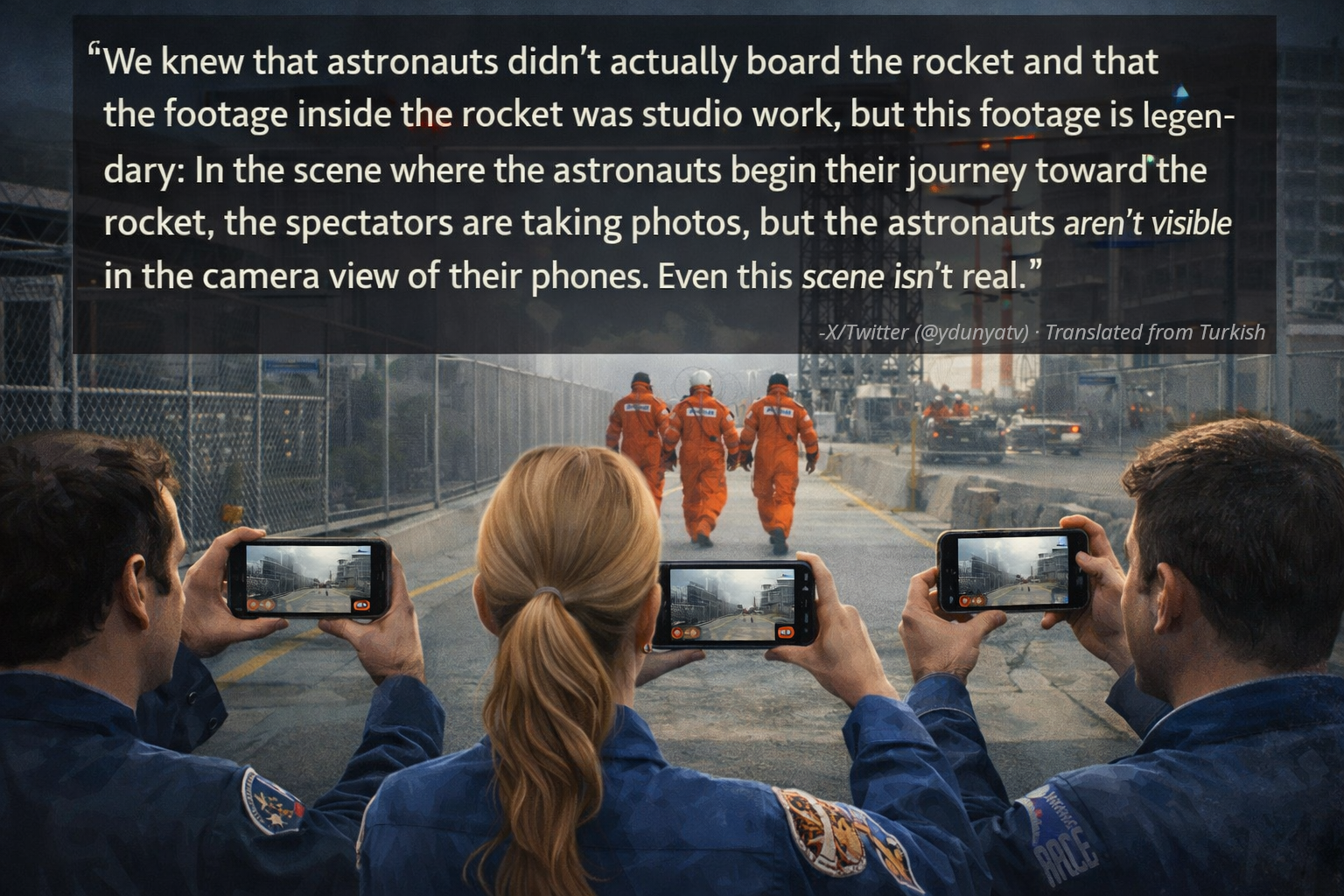
We knew that astronauts didn’t actually board the rocket and that the footage inside the rocket was studio work, but this footage is legendary: In the scene where the astronauts begin their journey toward the rocket, the spectators are taking photos, but the astronauts aren’t visible in the camera view of their phones. Even this scene isn’t real.
Illustration (in-repo, wide): same walkout / phone preview vs orange suits thesis as a diagram-style figure (crowd, phones, preview mismatch)—companion to the annotated viral still below.
Screenshot archived in this repo (annotated still: crowd, Space.com-branded source corner, phone circled “here,” inset zoom on preview showing dark silhouette vs orange suits in-scene):
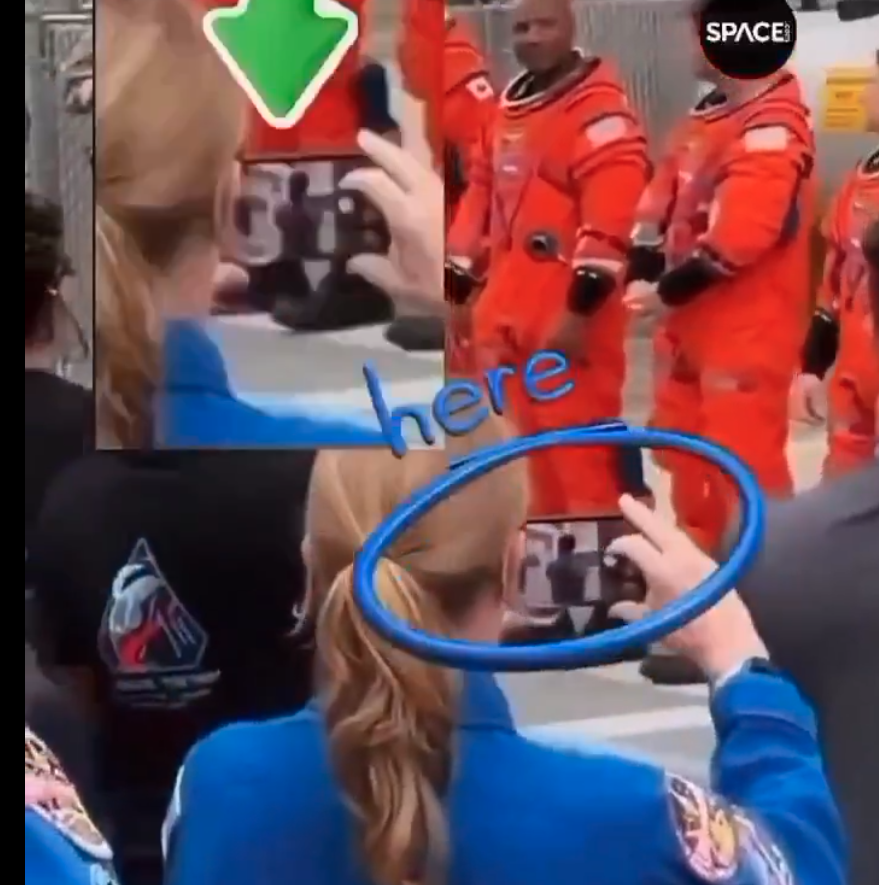
Investigation status: This is the specific incident behind the maintainer’s HARD LIE reaction to glib “phones filming TVs / subpixels” debunks when applied to this clip: the objection is not “moiré on a TV,” it is preview pipeline vs physical scene in a crowd context.
Fact-check gap (unchanged in kind): As of this writing, no AFP / Reuters / BBC Verify / FRANCE 24 / ITV / IBTimes / Digital Camera World / Snopes article has been seen that names this walkout-preview claim or debunks it under this description (they still cluster on Rise, AI stills, SynthID). That absence is not proof the claim is true; it is a catalogue gap.
Closest “official” video of the same kind of scene (four suited crew, crowd, phones—April 1, 2026 walkout): NBC News — crew greets crowds, VideoFromSpace — walkout and drive to pad, NASA still — Artemis II Walkout. Compare primary broadcast to the viral post frame-by-frame if disputing compositing.
Non-committal technical hypotheses (not conclusions): Odd preview behavior could in principle include exposure / HDR crushing color on the rear screen while the saved file differs, portrait / subject-tracking UI, reflection of a different subject, compression in a reupload chain, or edited viral still—each needs file-level analysis. This file does not pick one without primary video file and sensor metadata.
Witnesses: Additional mirrors, archives, or provenance for the X post are still welcome via usual Paradigm Threat / repo channels.
5.6 Online references — this walkout / phone-preview claim vs “preview ≠ scene” (general tech)
Search log (open web, April 2026):
- The X status IDs for post 1 and post 2 (longer mirror) did not surface in generic web search indexes (common for ephemeral social URLs). Discovery remains direct link, screenshot, or in-repo archive.
- Artemis II — “glitch” / hoax coverage in mainstream and fact-check outlets does not address the walkout + spectator phone preview thesis. Articles cluster on (a) Rise / CNN interview and phone-filming-TV, (b) AI green-screen stills, (c) SynthID. Examples (same cluster as §4 / §10): AFP — broadcast error / staged claim; FRANCE 24 — Truth or Fake; PRIMETIMER — “video glitch” / false claims (still Rise/broadcast-layer framing in the fact-check ecosystem, not walkout preview); Digital Camera World — AI “evidence”.
General smartphone “preview vs what you get” (not NASA-specific): Users often report live preview differing from saved image—HDR, exposure, compression, display gamut. Discussion threads (illustrative, not peer-reviewed): Quora — preview vs saved quality; Straight Dope — preview vs final. Apple Support Community threads on washed / wrong colors in close-ups and HDR rendering (e.g. washed color close-ups, Photos HDR rendering) — lock exposure is a common mitigation. Adobe / Premiere community notes on iPhone HDR (HLG) vs SDR monitors explain systematic “looks wrong off-phone” effects (example thread).
Segmentation / “subject” pipeline (possible rhyme with silhouette-like previews): Phone Portrait modes rely on alpha matting and depth; Google Research describes silhouette / illuminated-background capture for training matting (Accurate Alpha Matting for Portrait Mode — Pixel 6). That does not prove any specific walkout phone was in Portrait mode; it only shows commercial pipelines do separate subject from background in ways that can look unlike a naive optical view.
6. Foreign sources — hoax endorsement vs debunk (search log, April 2026)
RoM: Non-U.S. desks still participate in the same debunk cluster / silence pattern (§0 partitioned closure).
What we found:
- Non-U.S. outlets debunking or contextualizing the green-screen viral wave include AFP (France), FRANCE 24 (French international English service), and BBC-linked verification cited via UK-oriented tech press—not state ministries, but clearly non-American editorial desks participating in the debunk cluster.
- We did not locate (in this pass) a major foreign state wire or state space agency officially endorsing the thesis “Artemis II was a hoax” with independent tracking data. Russian and Chinese science bloggers and English-language aggregators circulate speculation (e.g. anomaly narratives in other domains); nothing in the quick survey rose to government-verified falsification of the mission.
Investigation note: Silence is not proof of anything. Possible reads include: (a) no foreign power gains from picking this fight; (b) all major powers share ISS-era and deep-space tracking culture—embargoing a hot take is safer than accusation without hardware evidence; (c) hypothesis space (author): a Cold War–descended international security / aerospace bloc may align narrative more than national flags suggest—unfalsifiable from open sources here.
Record as open: If readers have primary non-English sources that assert hoax with technical specifics (radar, ranging, independent optical), they should be added with date, author, and institutional backing.
7. Strategic reads (hypotheses — low confidence until sourced)
RoM-compatible: Permanent fog extends the interpretive war without forcing a single global belief state (§0).
These are political-strategic extensions, not technical proofs:
- Stalling human spaceflight: A permanent fog of AI fakes + viral debunks raises the cost of public trust; real programs can be delayed while budgets and territorial consolidation proceed on Earth.
- “Only when no one can challenge”: Mirrors older gatekeeping narratives in this repo’s war and governance investigations—see British divide-and-conquer — Israel and CIA investigation for pattern language, not as dependencies of this file.
8. Open questions
- Independent tracking: Which non-NASA entities published ephemeris / ranging consistent or inconsistent with a translunar Orion state vector for the flight days (amateur radio, optical, allied agencies)?
- Primary foreign ministry statements: Did any G20 foreign ministry or space agency issue congratulations or silence that diverges from expected diplomacy?
- Leak taxonomy: Can viral artifacts be fully explained by broadcast chains + AI slop, or is there a residual set that survives highest-quality primary feed comparison?
- Workforce sociology: Analogy to fiction aside, what contractor incentives and NDA / clearance structures shape what ground crews can say?
- Crowd / phone-preview clip (§5.5): X: annotated repost, longer mirror; screenshot in-repo. Optional: archive.today of both URLs; independent frame analysis vs official walkout broadcast if primary video file obtained.
9. Related material in-repo
- April First and the Test of Faith — illustration companion copy & annotated callouts (wide image prompt block + six label texts)
- British divide-and-conquer — pattern frame
- Gnosis vs agnosticism — faith after “planet gods”
10. Debunk corpus — extended citations and debunkers’ main stated reasons
RoM: Inventory of closure products the faith faction consumes; baseline for §11 (§0).
10.1 Additional online citations (pro–official narrative / anti–hoax claim)
These sources defend the mission’s authenticity or explain away viral “evidence” of staging. Listed for inventory; inclusion is not endorsement by this file.
Already listed in §4: CBS19/AFP wire, FRANCE 24 YouTube segment, NPR/Space.com/BBC Sky at Night as mainstream mission narrative.
10.2 Synthetic checklist — what debunkers most often assert (reasons the mission was not fake)
Drawn from the sources above; grouped by claim type:
- Rise plush / “text on toy”: Not present on primary CNN / VideoFromSpace uploads; anomaly = broadcaster overlay failure or chroma interaction with blue on the toy (expert: Hany Farid, AFP). Not NASA camera master.
- Viral path: Clip is second-generation (phone → TV) and/or re-encoded / edited before share; not the clean feed (IBTimes, FRANCE 24).
- Wire-suspension / harness videos: AI-generated; SynthID or similar flags (ITV, AFP, Digital Camera World, FRANCE 24).
- Far-side / lunar stills “wrong light”: NASA statement on Sun–Moon–spacecraft alignment and visible fraction of far side; not “proof” of studio lighting (ITV).
- Apollo comparison memes (timing, trajectory): Different mission design vs Apollo; meme is missing context (Reuters, Artemis I fact check).
- No stars: Exposure / dynamic range; bright foreground washes faint stars (Reuters, standard astronomy explanation).
- Side-by-side Earth “same clouds”: Image not from official NASA galleries; AI / Gemini watermarking (AFP A7233KE).
- Green screen as technique: Chroma key is normal TV production vocabulary; conspiracy accounts misread studio grammar as if it implied Orion was on a soundstage (IBTimes explainer tone).
- Meta narrative: Spike in theories reflects institutional distrust and AI-fueled doubt of real footage (ITV academic framing), not a independent proof of hoax.
Investigation use: This checklist is the debunk industry’s shared playbook as of April 2026. It is the baseline against which §11 asks whether the same economy that funds conspiracy entertainment also funds debunk entertainment.
11. For-profit debunk vs for-profit conspiracy (controlled opposition hypothesis)
RoM: Same trough feeds both sides of partitioned compliance (§0): engagement without coalition or primary-source discipline.
Author thesis (hypothesis): The attention economy does not cleanly separate “responsible debunkers” from “irresponsible conspiracists.” Both live on views, shares, subscriptions, donations, and ad impressions. Packages like ITV’s explainer, FRANCE 24 (Truth or Fake), Snopes listicles, and AFP fact-check articles are professionally produced content with entertainment pacing (hook → viral clip → expert → resolution). Serious forensic closure (primary-feed chain of custody, independent ranging) is not the product being sold; emotional resolution for one faction is.
Controlled opposition read (speculative): Outlets that appear to oppose the hoax narrative may still function as managed pressure release—the same algorithmic trough where a viewer, after accepting the debunk, is recommended toward flat Earth, Mandela Effect, ancient aliens, time travel, etc., and where a viewer who rejects the debunk is recommended toward the same fringe cluster from the opposite door. Neither path produces coalition or primary-source discipline; both produce engagement.
Pattern (author): Hosts who gain an audience among NASA-skeptical viewers often migrate those viewers to adjacent high-engagement hoaxes—not because of a single provable handler, but because platform incentives and content bundles reward topic drift. Investigation label: economic isomorphism between debunk and conspiracy channels, not proof any named journalist is a literal agent.
12. April 1 launch timing; “fool-proof” rollout; Trump / Iran (speculative)
RoM: Calendar / symbolism as extra sorting layer on top of the same predictive audience model (§0 “fool-proof” rhyme).
April 1 (author): Given the degree of narrative packaging (viral contradictions + immediate fact-check saturation), there is no compelling reason in this file to treat April 1 as accidental symbolism. Fool’s Day alignment is recorded as plausibly intentional—a wink to in-group confidence that the public can be sorted into predictable buckets (faith, mockery, debunk virtue). Not a cryptographic proof.
“Fool-proof” audience model (author): The aggression of the rollout (volume of AI slop, clip volume, speed of institutional debunk) suggests confidence that audience behavior stays within modeled bands: cheer, meme, debunk share, fringe argue—with no mass primary-source pivot. Hypothesis only.
Trump / Iran / credibility (speculative, April 2026 context): A sitting president who needs maximum credibility on a hot Middle East / Iran file may rationally avoid picking a fight with NASA and allied space narratives—independent of what he privately believes. This file does not claim knowledge of any leader’s inner belief; it notes incentive not to amplify moon-hoax discourse when other crises consume political capital. Open: public statements by White House / campaign on Artemis II during the window (to be sourced if added later).
13. NASA as institution — dismissiveness since Apollo, taxpayer proportionality, and “church” parallel (author sentiment)
RoM: §13 answers why “skeptic compliance” (§0) is fiscally stable: no opt-out, IRS frame, coerced funding, MIC / Congress inertia, institutional dismissal of core challenges.
Framing (author): The decisive public issue is not only whether any particular mission claim is true. It is whether NASA-as-institution has ever, since the first Apollo-era accusations, treated primary skeptical claims with good-faith, on-the-record, adversarial engagement. In this reading, every major institutional response pattern sorts into dismissal: labeling (fringe, flat Earth, crank, “science denier”) without conceding the specific evidentiary prompts; no sustained, funded forum where core challenges are named and answered in the same vocabulary the challengers use. Acknowledgement of the strongest opposing case is avoided; boundary work replaces inquiry.
Taxpayer proportionality (author): Federal space budgets and public-affairs spend are not distributed as if all taxpayers were represented stakeholders. Propaganda, education, and mission lines are large; there is no sense in public accounting that a proportional slice is reserved for skeptics—for independent verification budgets, adversarial review panels, or plain outreach to people who reject the official story. Counterfactual (speculative): A small fraction of cumulative spend, directed at substantive engagement rather than ridicule, might have reduced the daily war of sketchy releases vs endless critics—unprovable, but raised as a governance question.
Coercion / consent (author, parallel only): There is no checkbox on typical tax instruments to withhold one’s share from NASA (or from other morally contested federal lines—abortion-related spending is named here only as the same structural pattern: controversy persists because objectors still pay). This file does not litigate abortion policy; it notes fiscal non-consent as parallel to forced subsidy of a narrative agency.
Legality of a “conscience opt-out” (U.S., sourced sketch—not tax advice): The IRS publishes that taxpayers may not lawfully refuse to pay federal income tax on religious or moral grounds or because taxes fund programs they oppose; such contentions are treated as frivolous in The Truth About Frivolous Tax Arguments (Section I.D.1), with civil and criminal consequences surveyed in Section III. Supreme Court precedent cited there includes United States v. Lee, 455 U.S. 252 (1982) (broad public interest in a uniform tax system over individual withholding of tax on conscience). Author read: any practical attempt to redirect or withhold payment along NASA-related moral lines runs into tax-protest law, not a clean opt-out—so debate stays cultural while Treasury mechanics stay compulsory.
English First Fruits and Tenths; Pope vs Crown (author analogy): The Act of First Fruits and Tenths (1534, England) diverted first fruits and tenths from the Papacy to the English Crown—a revenue reroute at court and statute level, not a popular line-item budget vote. The author also cites 1199 as epochal shorthand for high-medieval papal fiscal claims on national church income (e.g. Innocent III–era instruments); this file does not collapse 1199 and 1534 into one statute. Metaphor: state capturing ecclesiastical dues without doctrinal minorities scheduling their own exemptions.
Cold War genesis; MIC (author): NASA is read as born under geopolitical pressure: compete with the USSR in space prestige, anchor talent and narrative in a civilian federal program, and preempt a vacuum where only rival superpower or uncontrolled civilian actors might claim the symbol. Military–industrial influence on Congress is posited as structural why appropriations continue without skeptic carve-outs or meaningful audit closure for objectors.
Strategic corollary (author): Institutional supporters who want skeptics converted cannot, in this reading, simultaneously rely on coerced funding and dismissive rhetoric—yet lawful resistance is narrow, so revenue flows until Congress can reduce capture by MIC-aligned interests (hypothesis, not a prediction).
“Church” parallel (author): NASA is argued to behave like a national church: it teaches one cosmology and one history as authorized; it does not use its platform and treasury to teach everyone “everything,” including alternate frameworks as equals—e.g. Saturnian cosmology (this site’s chronology), young-Earth readings, or Judeo-Christian creation narratives—while still extracting tax from communities who hold those views. Tithe language is metaphorical (withholding is not legally available to most filers); the claim is cultural: revenue and authority without line-item consent and without the full public audit skeptics would recognize as closure.
Investigation boundary: This is political-strategic sentiment and institutional critique, not a proof that any specific launch was faked. It rhymes with §0 (RoM / tax lock), §2 (faith event), and §11 (attention economy).
Prisca sapientia (epistemic foundation): This investigation assumes prisca sapientia—the historical and philosophical belief that the ancients possessed a vast, profound understanding of the universe, nature, and theology that was subsequently lost or degraded. Modern consensus science and institutions are not treated as default truth; evidence tiers below adjudicate specific claims.
Keywords: #Artemis #NASA #Moon #Faith #Hoax #Divide #Conquer #RevelationOfTheMethod #Chronology #Investigation
Share