

Investigation: Ted Cruz, Kevin Malone (The Office), and the “Hijacked Plan” Hypothesis
TL;DR: National-security lens on elections: press + party may starve “real” challengers and boost puppet / brand / compromise-ready figures; Epstein-style blackmail is the posited lever. Post-~2005 GOP crisis (here: Bush + Epstein-network pressure) still hits a 2012 pipeline framed like Will Durst’s April 2012 GOP “Angry Birds” column—extended here to “Angry Birds” candidates the mass media would amplify—read as clearing Obama 2012. Cruz: planned path from Kevin Malone-scale fame to on-schedule Senate, 2016 through the same filter, then co-option; Jade Helm 15 as hinge on Texas / Cruz. Memes, Office material, timelines below; macro in armed confrontations file — Jade Helm hypothesis stack.
How to read this file (outline): Thesis · Author frame (Office as antibody) · Disclaimers · Counterfactual “Cruz logic” · Investigator addendum + calendar · The Office — Season 1 curiosities (broadcast order) · Meme / rally facts · Bodysuit search · Kevin weight / food jokes S2–S9 · Cryptic lines table + deep dives · Dwight’s Speech (coded revolution) · Jade Helm stub · Falsifiers · Changelog
Evidence hygiene: Unless a sentence explicitly claims adjudicated or sealed proof, interpretive material is governed by Disclaimers. Repeated inline disclaimer links were trimmed in the 2026-02-14 / 2026-04-09 reorganizes to reduce noise.
The national-security thesis (media, blackmail, and controlled candidacies)
This investigation treats a 21st-century American national-security class of problem: how election coverage and party institutions may deny air and viability to “real” candidates while admitting only figures who function as puppets, manufactured brands, or compromise-ready alternatives. The trigger in this reading is blackmail as the Epstein saga has been reported—creating a high likelihood that Republican and Democratic leadership alike were compromised by networked leverage.
Circa 2005, much of the GOP is read here as having woken up to an internal rot: the catalyzing shock, in this theory, was evidence or credible allegations that George W. Bush had engaged in illegal conduct involving minors during his presidency—an existential crisis among grassroots-aligned leadership who concluded the federal government could be hijacked wholesale by blackmailed actors tied to Epstein-adjacent networks. In the panic that followed, those circles reportedly surveyed many paths, especially around 2012, including candidates from outside the conventional political class. By then the adversary was understood to have moved first: the pipeline had been prepared into what Will Durst satirized as GOP “Angry Birds” in April 2012 (Record Online)—extended here to “Angry Birds” candidates—the only profiles mass media would amplify and protect. That structure is read as having cleared the board for Obama in 2012 (an easy general); some anecdotal or fringe reporting suggested Obama was barely campaigning or disengaged that cycle—claims that were heavily contested and “debunked” in mainstream outlets soon after, but remain part of the investigator’s sentiment record.
The “George Bush 1” allegation (early-2026 tranche): In the final wave of DOJ Epstein-related document releases in early 2026, press coverage of the files points to a report stemming from a complaint to the New York Police Department by a purported victim who named a figure rendered as “George Bush 1” and alleged sexual assault on a yacht in 2000 (alongside other figures named in the same summaries). Law-enforcement notes quoted in those reports treat parts of the account as unverified (e.g. recovered-memory / intake caveats). Summary: Roya News — “Anonymous victim accuses George H. W. Bush of sexual assault: Epstein investigation” (Feb 2026). This file does not adjudicate that claim; it cites the public tranche narrative as context for the Bush–Epstein pressure reading above.
Ted Cruz is read here as running a deliberate plan: grassroots origin; a family story that could be sold as uncompromised; the open engineering problems of how to enter Texas politics without dynasty selection or nepotistic placement, and how to reach Democrats and left-leaning youth despite the media wall. By 2012, this theory holds, Cruz had proved the chassis: a clean break from mass Kevin Malone recognition into a U.S. Senate term that started on schedule—no embarrassing gap between pop-culture face and sworn federal role. He then forced a presidential run through the same filter that was designed to stop non–Angry Birds figures—enough breakthrough that the deep state response, in this reading, followed its usual playbook: convert a threat into an asset. Jade Helm 15 is the hinge: after it, Cruz and Texas are read as fully brought to heel—narrative containment, grassroots demoralization, and elite ridicule doing the same work the theory assigns to media starvation elsewhere.
The sections below document memes, timelines, Office dialogue patterns, and mainstream calendar facts (actors, shoots, oaths) as supporting material for that arc. This file’s narrow focus is Cruz, Kevin, and Jade Helm; the macro blackmail-and-Angry-Birds stack is developed in the armed confrontations investigation and the extended hypothesis.
See also (fiction / PP): Trump-era Hollywood — predictive programming investigation (Simpsons 2000, The Boys / Homelander, scorecard) — optional read for how satire and tropes may rhyme with this thesis without proving shared briefs.
Author frame — U.S. The Office (not U.K.) as antibody
Site positioning: The entire American The Office (2005–2013) is treated here as operating in part as an antibody—counter-programming or narrative immune response—relative to Ted Cruz’s attempt to break through media-driven GOP political gridlock (the same starvation / “Angry Birds” filter described above). The U.K. Office is out of scope for this frame. Interpretive; not a claim of documented writers’ intent or network brief.
Last substantive reorganize: 2026-06-06 (Fun Run S4E1: Michael fat legs / olden-times fat person monologue, Kevin refuses then runs; Andy drafting deflection; “in a lot of trouble” athletic-cover read—catalogue + cryptic row + deep dive). 2026-05-08 (Dwight’s Speech coded-revolution section; Michael’s Birthday skin-cancer / “evil sun”; Drug Testing marijuana-symptoms list). 2026-05-07 (Valentine’s Day giant-bear). Earlier passes: Changelog. 2026-05-07 (Valentine’s Day giant-bear weight/size jab: Kevin “bigger than I am” / “Oh zip it”; added cryptic table row + catalogue note; writer/actor note via Lee Eisenberg). 2026-05-02 (The Dundies cluster: skillets / “ate them all,” camcorder lyric, Stanley bowel-movement line + restroom Dundie; expanded catalogue + cryptic row). 2026-04-28 (The Dundies / Dunkin’ Donuts origin; Kevin weight–food S2–S9 catalogue methodology; cryptic-table row; TOC + cross-links). Earlier 2026-04-09 (Cruz/Jade dedupe, Basketball restore, Changelog, Stairmageddon trim, bodysuit ↔ cryptic, disclaimer trim). 2026-02-14 pass: TOC, calendar stub, Cruz addendum, Jade Helm stub, S1 order. Full history: Changelog.

Scope, evidence limits, and disclaimers
Everything in this single section replaces scattered “unproven,” “hypothesis,” and “not legal proof” language elsewhere—see cross-references as Disclaimers.
- Not adjudication: This file does not offer courtroom findings. It maps patterns, timing, and cultural rhyme under the thesis stated above. Epstein, Bush, and Obama 2012 sub-claims rest on contested public material and interpretive weighting, not on sealed evidence reproduced here.
- The Office limits: There is no expectation of a subtitle line naming Cruz, Texas, or an election literally. Cryptic readings of Kevin dialogue are arguendo pattern work—not a claim that NBC writers encoded politics.
- Cover-up frame: Classification, ridicule, narrative flood, and gatekeeping can make direct proof of coordination scarce; the file weights pattern strength accordingly.
- Surface “debunks”: Stories that the Feb 2016 rally sign was comedian-driven, or that Brian Baumgartner is not Cruz, address surface threads only; they need not collapse the macro thesis unless they are dispositive for the same claim.
- Assistant / editor bias: Default pressure is toward “nothing to see here.” Helpers should separate falsifiers for specific sub-claims from general mockery of the whole arc.
- Calendar vs literal identity: Canonical one-screen summary: Calendar at a glance in the investigator addendum. The thesis does not require literal same-body identity; it concerns narrative, compromise, and containment. Readers who distrust studio and trade schedules as final may still treat calendar rows as contested in the same spirit as Jade Helm OPSEC—without elevating speculation to fact.
What would move the file: See What would confirm or falsify this thesis?.
Speculative “Cruz logic” — secret character, youth demo, mass recognition (counterfactual)
Framing: Reconstruction of what internal logic might have looked like if a faction had tried to weaponise pop culture for a presidential brand aimed partly at younger voters. This expands the bullet logic already sketched in The national-security thesis (Cruz path, media wall, youth-facing recognition)—read that block first; this section is optional detail.
- Long-bake familiarity: The Office ran nine seasons (2005–2013) and reached normie saturation—Democrats and Republicans alike knew Kevin Malone as a type (affable, awkward, meme-friendly). Anyone “revealing” as that archetype later would inherit years of affection and recognition without needing to win new IP from scratch.
- Youth-skewing pipeline: College and young adult cohorts binged the show in syndication and streaming; that demographic was exactly where the GOP primary bench often failed to register in 2012 and 2016. A Kevin-shaped humour lane could theoretically soften the party for audiences immune to talk-radio tones.
- Reveal beats invention: “I am the guy you already loved on TV” beats introducing a new mascot from zero—if one could ever sell the joke as more than a meme.
- Intended shelf life (your guess): You suspect no serious operator would have planned to ride the bit past ~two seasons’ worth of narrative attention—i.e. a short burst of recognition then pivot to “serious” statesman mode. The actual show ran far longer than two seasons; this clause means the hypothetical political use of the Kevin image was meant to be disposable in campaign time, not that the sitcom should have ended early.
Investigator addendum — presidential outcome, Senate timing, youth mood, Jade Helm silence
Under the thesis at the top, Cruz’s 2012 Senate win and 2016 presidential run are read as a breakthrough against the Angry Birds media filter; the same section of the file still records mainstream calendar facts (oath dates, finale shoot, Baumgartner credits) that complicate literal same-body readings.
Calendar at a glance (canonical)
| Milestone (documented) | When |
| Cruz Texas Senate general | 6 Nov 2012 |
| Cruz sworn in (U.S. Senate) | 3 Jan 2013 (Dallas Morning News) |
| The Office finale principal photography ends | 16 Mar 2013 (Wikipedia — “Finale” (The Office)) |
| The Office finale broadcast | 16 May 2013 (same source) |
Takeaway: On the public record, Cruz was a sitting senator during the final finale shoot block—two careers overlap Jan–Mar 2013; that is the strong mainstream check on literal same-body identity. Shoot order ≠ air order and missing call sheets still matter for hypothesis readers; full narrative below.
Presidential lane vs national outcome: The thesis at the top does not require winning the White House—only that Cruz forced a national presidential bid against the Angry Birds filter. Cruz ran for the 2016 Republican nomination but did not win it and never appeared on a November presidential ballot. A Kevin-adjacent or ironic-recognition play aimed at a younger national audience can still be read as only partly realized at the general-election tier even while Cruz’s Senate career and movement profile advanced.
The Office — final filming dates vs broadcast vs Cruz’s Senate seat (documented order): This file cares about principal photography, not only Nielsen air dates. The U.S. series finale episode (Finale, s09e24–25) is documented in mainstream production histories as: table read ~4 Mar 2013; filming commenced 6 Mar 2013; filming for the episode and the series ended 16 Mar 2013; original broadcast 16 May 2013. See e.g. the production subsection of Wikipedia — “Finale” (The Office) (citing cast/crew contemporaneous notes and trade coverage). Cruz won the Texas Senate seat in Nov 2012 and was sworn in January 3, 2013 (e.g. Dallas Morning News — “Texas’ new U.S. senator, Ted Cruz, is sworn in”). Publicly documented timing therefore runs: Senate seat first (Jan 2013) → last block of series filming (Mar 2013) → finale air (May 2013). That order does not support a simple causal story that the production wrapped so Cruz could take the seat—on the contrary, he was already in office before the finale was shot. Season 9 had continued to air and to shoot other episodes through the winter; only the finale block sits in March. Non-literal readings remain open (narrative symbolism, “era ending” in culture vs calendar, or unknown private coordination); timing alone does not confirm that NBC or the show ended for Cruz.
Election → oath transition (documented): From general election (6 Nov 2012) to swearing-in (3 Jan 2013) is 58 days—about 8½ weeks. In that interval Cruz was senator-elect only: no federal oath of office, no Senate voting duties—typically used for staff build-out and transition. That window is compatible with the idea that his only mandatory political focus was closing out the campaign (plus transition), not yet acting as a sworn senator.
Season 9 filmed out of broadcast order (documented): The ninth and final season aired 20 Sep 2012–16 May 2013 and was produced on the usual network schedule—roughly summer 2012 through spring 2013 (renewal 11 May 2012; production through the finale shoot ending 16 Mar 2013). The episode table for season 9 explicitly warns that broadcast order “may not necessarily correspond to” production codes—i.e. shooting was not locked to air sequence (Wikipedia — The Office (American TV series) season 9). A concrete example: “The Farm” carries production code 9005 but aired as the 17th episode (14 Mar 2013), while codes 9001+ map to earlier-aired installments in mixed order.
Production mechanics (general — agreed for this investigation): Episodic TV is not required to be filmed in broadcast order, episode by episode. Schedules are driven by sets, locations, cast days, economics, and batching; story order is imposed in post and editing. So in principle—without proving The Office did it—a production could have placed all of one actor’s Kevin scenes before a not-after date (e.g. 3 Jan 2013) if scripts, stages, and contracts allowed. There is no structural reason a show must shoot “episode 1, then 2, then 3…” on consecutive calendar days. What this file still lacks is evidence that Baumgartner’s last Kevin work was before January; publicly cited finale photography remains March 2013 for the series finale episode itself (Wikipedia — “Finale” (The Office)), which may or may not exhaust Kevin’s presence in that installment. Feasibility ≠ proof.
Investigator logic check (hypothesis layer): If Kevin scenes were scheduled across non-final shoot dates—before the finale block and possibly before the 3 Jan 2013 oath—then a literal “end the Office stunt, start the Senate role” beat could be compressed into the senator-elect window and/or spread across out-of-order production without requiring the actor to neglect a federal oath he had not yet taken. After 3 Jan 2013, any remaining Kevin work still overlaps sitting-senator time unless call sheets show Baumgartner’s last day before that date—not publicly verified here. Broadcast ≠ shoot order is mainstream fact, so calendar debunks that assume strict “last thing filmed = finale in March” are weaker than they look without day-by-day production records. Cruz and Baumgartner remain two people in all ordinary records.
Investigative thread — ~two months of “both true” on the public record: Between early January 2013 (Cruz sworn in) and mid-March 2013 (last Office principal photography on the finale block), the mainstream story has Ted Cruz operating as a sitting U.S. senator while Brian Baumgartner was still shooting as Kevin Malone. That overlap is a strong surface debunk of any literal same-body identity swap: two publicly documented career tracks in the same window.
Epistemic fork: Under elite deception, media ridicule, and classification, trusting trade-press wrap dates, studio logs, and encyclopedia chronology as final means trusting institutions as honest narrators. The two-month overlap window is either (a) a clean refutation of literal Kevin=Cruz if the calendar is honest, or (b) only as strong as one’s confidence in those sources—an open thread until independent forensics exist.
Brian Baumgartner — screen work during and after The Office (surface “debunk” material): Public filmographies list Baumgartner in many distinct credits while The Office was still in production and afterward—television guest spots, film roles, voice work—under his own name and face. Examples after the show’s broadcast run include Ordinary World (2016), Ghostbusters (2016; extended/deleted material noted in sources), One Last Night (2018), Electric Jesus (2020), My Boyfriend’s Meds (2020), Rumble (2021, voice), Confessions of a Christmas Letter (2024, TV movie), plus episodic/recurring TV (The Goldbergs, Hand of God, Trash Truck, The Other Black Girl, Suits LA, etc.). See consolidated tables at Wikipedia — Brian Baumgartner and IMDb. For ordinary inference, that résumé supports two people / two careers. If macro claims (Texas containment, Cruz compromise, stage-managed narrative) were substantiated, “debunks” of this kind could be reinterpreted along many routes (publicity-only separation, body-double fictions, selective editing, layered operations, or other speculative paths)—the list is not bounded in advance.
Cruz 2012–2016 context, youth, Texas, and Jade Helm (parallelism)
Senate 2012 and The Office era (parallelism): Cruz’s breakout and peak Office ubiquity remain culturally concurrent (late Bush–Obama sitcom era, same cable-and-streaming youth attention economy). No public evidence ties NBC scheduling or Greg Daniels’ writers’ room to Cruz’s political calendar.
Youth, Texas cities, TV/internet culture — what is documented vs what remains hypothesis: Cruz described his 2012 coalition as pulling together conservatives, libertarians, evangelicals, women, young people, Hispanics, and “Reagan Democrats” (as paraphrased in national coverage). The Washington Post (The Fix, 2015) stresses that Texas had no statewide exit poll in 2012 (cost-saving alongside other non-competitive states), so those subgroup claims cannot be verified from 2012 exits: “Ted Cruz told Megyn Kelly that his 2012 Senate race proves he can win in 2016. It’s impossible to prove him wrong.” (headline reflects uncertainty in both directions).
For young voters in Republican contests (2016), there are age-bracket snapshots: e.g. Iowa caucus entrance polling — Cruz led among 18–29 Republican caucusgoers per CIRCLE analysis, as summarized in Inside Higher Ed — “Young Republican voters flock to Ted Cruz and Donald Trump” (Feb 2016); South Carolina GOP primary — CNN exit polls summarized as Cruz leading 17–29 in Washington Examiner — “Confirmed: Ted Cruz won younger voters in South Carolina” (Feb 2016); millennial outreach and campaign framing in Orange County Register — “Cruz moves aggressively to court younger voters” (Feb 2016). Those document GOP-primary youth, not young Democrats or liberals.
For Texas, 2012, and cross-pressured urban demographics, the picture is mixed, not “young liberals loved Cruz.” NPR reported that in the general, Cruz did about as well as Romney among Texas Hispanic voters—“which is to say, not very well” — while noting GOP hopes for Cruz as a Hispanic figure: “Tea Party Texan Cruz Gives GOP Hope In Hunt For Hispanic Votes” (Jan 2013). The Texas Observer analyzed Harris County Latino splits in 2012: high-propensity Latino voters favored Cruz over Paul Sadler 53–44%, while Sadler ran behind Obama among county Latinos overall — a nuanced urban pattern, not a youth-liberal homogenate: “What Must Happen for Texas to Turn Blue” (context on 2012 Latino voting).
Left-leaning / crossover youth: No solid mainstream citation surfaced here that Cruz was popular with left-leaning or liberal-leaning young people as a distinct target demographic alongside his GOP base in the 2012→2016 window. That absence may reflect weak support, thin polling, structural blind spots, or—under the Jade Helm containment of Texas framing in the parallel file—narrative chill after mid-2015.
Hypothesis: TV- and internet-saturated young people in some Texas metros—including cohorts that trended liberal in presidential preference—might have been more willing than partisan labels suggest to reward a culturally legible figure.
Citation types that could add weight: Precinct- or county-level breakdowns by age band and party ID in urban Texas (2012 Senate, 2016 primary); panel surveys; qualitative fieldwork on irony / meme literacy; campaign or opposition-research documents; social-listening archives; FOIA mail from Cruz’s Senate office; academic papers on crossover appeal. These would test whether targeted left-leaning youth appeal was measurable.
Jade Helm and the information climate after 2015: If the deep-state reading of Jade Helm has weight, raw grassroots information from Texas might thin afterward—classification, ridicule, or narrative flood cooling public talk. Even as a drill, the exercise can still read as federal show of force at the edge of dissent and chill talk of presidential ambition or Texas-as-theater. See Jade Helm / Texas / Cruz hypothesis.
Endgame vs Trump: By 2016, institutional actors may have had motive to hijack or steer Cruz’s narrative against the remaining outsider with independent gravity—Trump.
Ridicule and epistemic lockdown: When major media and even a sitting president mock grassroots concern about a large federal exercise (Jade Helm–style narratives) while the public has no practical way to independently verify tasking, rules of engagement, or after-action truth (classification, OPSEC, press habit), that combination (mockery + lockdown) reads as compatible with elite cover-up for readers who already weight deception and narrative management as plausible. High-profile accusations against Obama (or other ex-executives) are contested; the comparison here is tonal—skepticism toward official Jade Helm framing is often mild next to other public accusations.
Author stance — production secrecy, “official” documentaries, and why calendar skepticism is not only about Jade Helm: The epistemic complaint here is not limited to military exercises. Film and television production routinely keeps development, writers’ room work, shoot schedules, call sheets, and post opaque—NDAs, trade secrecy, and promotional storytelling mean the public usually sees finished product plus sanctioned behind-the-scenes, not raw decision logs. Official documentaries and network DVD extras are still curated; some audiences read them as PR, selective, or agenda-laden. Michael Jackson / Neverland–era documentary material is cited only as an example of programming many viewers treat as suspicious or biased—a reader who distrusts packaged media truth might extend the same posture to shoot-date and schedule narratives about The Office or any other show. If producers insist the entire development process must stay secret except what appears in approved retrospectives, schedule cover stories or date manipulations stay on the table as hypotheses alongside the rest of this file. Full transparency—complete archival release with narrow exceptions for individual privacy and physical safety—is the only thing that would fully vindicate Hollywood and similar institutions in this author’s view against schedule-skeptical theories. Until that standard is met, the file maps dark areas where open sources do not close the story.
Logic check — Jade Helm as an instrument class: Coherent chain for the thesis at the top of this file:
- A two-term Democratic administration that defeated John McCain (2008) and Mitt Romney (2012) might still be read—by a hostile interpreter—as having faced opposition tickets that did not yield a GOP president however one judges those candidacies (“weak,” “managed,” “unthreatening,” etc.).
- If an administration’s strategic aim included denying the opposition a credible, uncontrolled president-in-waiting—especially from Texas—a large, federally narrated military exercise that habituates the public to troop movement and maps “hostile” / “permissive” framing onto domestic geography is one class of instrument long used in war-gaming and fiction for political-psychological effect alongside training value.
- Jade Helm 15 sits in that abstract class here. Open sources in this file do not establish presidential intent, orders from Obama, or that McCain / Romney were “fake” candidates in any legal or journalistic sense—see parallel Jade Helm file.
The Office — Season 1 curiosities (broadcast order)
Curiosity — Pilot (S1E1): Kevin in early vérité, “opening office,” and the ledger-secret read
Investigator curiosity (not proof of intent or of Kevin = Cruz): Some viewers read Kevin as present in the pilot’s opening office coverage—sometimes phrased as the “opening shot” of the workplace story—and treat that as a subtle nod that the series was always anchored on accounting and a hidden ledger logic that pays off in the finale (Keleven / cooking the books; see Wikipedia — Kevin Malone Seasons 7–9 / finale summary). This file does not assert that Greg Daniels or Ken Kwapis encoded a future presidential doppelgänger joke in 2004; it logs the rhyme for readers who track long payoffs and performance vs reality.
What the record supports (cited):
| Claim | Status | Source |
| Kevin’s in-universe first appearance is the pilot | Supported (character infobox) | Wikipedia — Kevin Malone |
| Pilot used daily morning vérité: cast at desks from ~7:30 AM, ~30 minutes of pretend work, skeleton doc crew; B-roll fragments were cut into the finished episode (example: Pam / White Out) | Supported (cast production memory) | Office Ladies — transcript, Ep 001 The Pilot (Jenna Fischer recounting Ken Kwapis’s rules; search “seven thirty”, “thirty minutes”, “B roll”) |
| Pilot infobox “first scene” summary centers Jim and Michael at Jim’s desk (quarterlies)—not Kevin-led dialogue | Supported (editorial summary) | Wikipedia — Pilot (The Office) |
| Angela and Kevin shared accounting placement from early pilot days (cast first-day memory) | Anecdote (not screenplay evidence) | Same Office Ladies transcript (Angela Kinsey: Brian “walked in as Kevin” beside her in accounting—day-one ensemble chemistry) |
Wording caveat (“opening shot”): Wikipedia’s Pilot page does not certify “frame one = Kevin.” Streaming and syndication credits / cold-open packaging can shift what a viewer sees first. The defensible claim is: vérité morning B-roll feeds early bullpen material, and Kevin is pilot-canon from that episode—so accounting is in the room from the start of the office documentary texture, whether or not he is literal first pixel.
Curiosity — “Diversity Day” (S1E2): Kevin and the “Chris Rock guy” reenactment
Investigator note (pattern, not Cruz proof): Diversity Day (S1E2; first U.S. air 29 Mar 2005) is the first predominantly original-script week for the American show after the British-adapted pilot (Wikipedia — Diversity Day Production). The plot turns on Michael’s imitation of Chris Rock’s “Black People vs. …” routine and the corporate diversity seminar that follows.
Kevin’s beat (cited): When Mr. Brown will not let Michael replay the offender role in the reenactment, Kevin offers to be the joke teller (the Chris Rock side of the exercise); Michael takes the listener slot; Kevin’s version does not satisfy Michael, who interrupts with his own profane rendition (Dunderpedia — Diversity Day). Episode summaries frame the same blocking as Kevin = “Chris Rock”, Michael = “guy listening” in the reenactment (The Office TV Show — Diversity Day)—treat as secondary guide text; confirm against the episode if disputed.
“First speaking role” caveat: Cast memory in Office Ladies — Ep 001 transcript includes Kevin dialogue in the pilot accounting scene—so S1E2 is not Kevin’s first canonical spoken line in absolute terms. It is still a clean introduction of Kevin as public performer inside the Chris Rock / HR crisis—honest character work in the sense that Kevin tries the role Michael cannot safely hold, fails by Michael’s lights, and hands the floor back to chaos.
Significance read (hypothesis only): The episode bundles speech codes, who may imitate whom, and accounting staff as witnesses to management meltdown—themes that rhyme with this file’s mask / layer / compromise language without proving writers knew any 2016 meme arc. Syndication / re-edit noise around the episode (e.g. Snopes — Diversity Day pulled from some reruns) is logged only as cultural friction fact, not as evidence of hidden briefs.
Optional anti-globalist / nationalist-fringe read (hypothesis only): The whole episode can be retold (without claiming NBC intent) as headquarters / corporate template rolled onto a local branch: mandated sensitivity block, traveling facilitator (Mr. Brown), and choreographed group work that surfaces who breaks form. Dunderpedia’s plot summary records a late private beat: Brown says he only needed Michael’s signature but ran the entire office through the seminar so Michael would not feel singled out; Michael then protests ( played as feigned outrage ) that it “wasn’t really about diversity” (Dunderpedia — Diversity Day, paragraph beginning “Privately, Brown explains …”). A viewer adopting a pro-nationalist / anti-globalist frame might weight that dyad as the trainer / apparatus caring less about substantive diversity than about signatures, visibility, and intervention-style exercises ( reenactment, HERO forms, forehead-card round) that expose non-compliant staff. Same disclaimer as above: interpretive rhyme only; not evidence of writers’ briefs or Cruz pipeline proof.
Curiosity — “Health Care” (S1E3): policy / management read (hypothesis only)
Investigator note: Health Care (S1E3; first U.S. air 5 Apr 2005) follows corporate pressure for the cheapest plan, Michael delegating the choice to Dwight, stripped benefits, angry staff, health forms that draw out ailments (and fake diseases as prank), and Michael bluffing a “surprise” he does not produce (Wikipedia — Health Care Plot / lede). The same material can be read in a political register—workplace benefits as allocative conflict, managerial buck-passing, who pays for coverage, and transparency vs exposure of personal medical fact—without asserting that NBC or Paul Lieberstein targeted any real-world bill or election. Pattern only; not Cruz proof.
Curiosity — “The Alliance” (S1E4): downsizing, reality-TV alliance — and Donald Trump by name (cited)
Investigator note: The Alliance (S1E4; first U.S. air 12 Apr 2005) pairs downsizing rumors and a Survivor-style office “alliance” prank with Meredith’s forced-early birthday plot (Wikipedia — The Alliance Plot / lede). The episode is on this file’s radar because Michael names Donald Trump in a talking head about having to downsize—contrasts himself with Trump on taking pleasure in saying “You’re fired,” briefly does a Trump impression (Apprentice-era cultural reference, spring 2005), and prefers a “You’re hired” catchphrase as unrealistic for his role (Springfield! Springfield! — The Office (U.S.) S1E04 full script; search “Donald Trump” in page). Transcript site = secondary; dialogue anchor for fact of the name + bit; not a claim that the show predicted 2016 or served a brief tied to this file’s later Trump-era lens ( see Trump and the MAGA Revolution ). Log only as S1 U.S. The Office with Donald Trump named on camera.
Optional political / survival-coalition read (hypothesis only): The same downsizing rumor climate the episode uses ( Wikipedia — The Alliance Plot / lede ) can be retold as “everyone is forming an alliance for survival”: perceived scarcity ( jobs / status ) pushes coalition choreography, conditional loyalty, and Survivor / reality-TV game logic ahead of open merit talk ( Dwight–Jim–Pam axis and its betrayal beats ). That map rhymes with electoral blocs, caucus trade, or any large organization where members believe heads may roll—interpretive only; not evidence the writers targeted a specific contest or this file’s Cruz arc.
Curiosity — “Basketball” (S1E5): Kevin’s mask vs the actor’s real game
Investigator curiosity (not proof of identity): The meme stack treats Kevin as slow, marginal, and comic; literal Kevin = Cruz is not supported by calendar at a glance or filmography. For readers who still log performance vs reality splits as texture: Kevin is written out of Michael’s pick-up team in Season 1, Episode 5 “Basketball” (aired 19 Apr 2005), then shown sinking shots alone after the main game—irony on screen because the character was “not even on the court” as a player.
What the record supports (cited):
| Claim | Status | Source |
| Baumgartner made a long streak of real baskets; several takes appear in the finished episode | Supported in mainstream production summary | Wikipedia — “Basketball” (The Office), Production section: 14 consecutive free-throw shots, cites Season 1 DVD commentary (Greg Daniels, writer/director; cast commentary). |
| Carell noticed Baumgartner shooting between takes, had a camera roll without necessarily telling him, and production used the candid streak as an ironic end tag | Supported as Carell’s account, aggregated with Office Ladies podcast | Sporting News — “Six things you didn’t know from ‘The Office’ basketball game episode” (quotes Sports Illustrated Media Podcast; also references Office Ladies ep. 5). |
| Cruz defeated Jimmy Kimmel in a June 2018 Houston charity one-on-one (“Blobfish Basketball Classic”), aired on late-night TV; game played to 11 after 15-point cap discussed | Supported (mainstream recap) | CNN Politics — “Ted Cruz bests Jimmy Kimmel in ‘sloppy’ one-on-one basketball game for charity” (Jun 19, 2018); ABC News — Kimmel / Cruz “Blobfish” game (Jun 18, 2018). |
Citation hygiene: Wikipedia’s production line specifies free throws; Carell’s quoted recollection in Sporting News uses “3-pointers” in the same anecdote. Treat shot distance as secondary-summary drift unless checked against the DVD commentary directly; the stable facts for this file are (a) real makes, (b) long consecutive streak (14 per Wikipedia / Sporting News’s DVD line), (c) candid / semi-candid capture and deliberate inclusion for irony. Cast retellings and short-form video often float ~15 in a row; treat that band as memory / social drift unless a timestamped primary DVD pull locks the count.
Social video (TikTok, etc.): Viral posts often repeat “13–14 shots from 12–15 feet” and similar numbers; those align directionally with the table above but are not used here as primary citations.
NBA 2K13 “playable Kevin”: Widely repeated online; no entry in Wikipedia — Brian Baumgartner filmography or other checked authoritative list in this pass—omitted until a primary roster/credits or major games-press source is added.
Contrast — Ted Cruz (athletics, separate person on the record): Cruz’s Houston high-school years are summarized in mainstream press as including varsity basketball (and soccer) at Second Baptist before college—e.g. Newark Advocate — “Ted Cruz’s Houston past molded today’s 2016 contender” (Sep 2015); San Antonio Express-News — “A young Ted Cruz had a presidential plan in high school”. In June 2018 he beat Jimmy Kimmel in a promoted Houston charity one-on-one aired on network late-night (table row above). (Wikipedia — Ted Cruz Early life names Second Baptist and valedictorian but, as of this check, does not list sports—so pre-Senate hoops detail here rests on press and event recaps, not encyclopedia body text.) Both the actor and the senator have documented real basketball moments at different life stages; that parallel does not collapse them into one body—it only notes that “Kevin can’t play” is character, not actor, and that both names sit in a Venn overlap meme readers might mistake for identity if they confuse performance layer with person.
Investigator sentiment — “major find” on shot-making (still not same-body proof): Surface meme debunks ( calendar rows, filmographies, Baumgartner press interviews ) answer the literal “same person ?” question with two careers — correctly for ordinary inference. Inside this file’s hypothesis mood, though, the basketball layer hits harder than jawline gags: Cruz carried hoops from youth varsity into middle-aged public play and then closed a televised one-on-one against Kimmel (2018) when millions were watching for the punchline to be his loss. Baumgartner, as Kevin’s actor, shows up in the record with a long unbroken make streak on camera ( 14 consecutive per Wikipedia’s DVD commentary summary; oral retellings often say ~15 ) — angled / deep looks, not lucky taps at the rim, with co-stars on Office Ladies comparing his touch to an NBA shooter’s ( Episode 5: Basketball and the Second Drink: Basketball bonus ). Most adults — even most good gym runners — do not string that many clean makes in a row on tape, and not many sitting senators volunteer a national humiliation risk on a halfcourt if they cannot really shoot. For the author of this investigation, that pairing reads as a major find: it is the first place the Kevin / Cruz joke stops being only cosplay and starts looking like a matched motor skill — the kind of overlap a handler would need if a “dumb / unathletic” mask had to survive YouTube and slow-motion breakdowns. It still does not beat the two-body calendar; it only raises the stakes on performance / decoy readings and keeps the thread emotionally charged for anyone tracking the thesis honestly.
Documented facts — the Cruz / Kevin meme (satire / viral culture)
| Event | What the record shows | Citation |
| Rally stunt, “Same Person?!?!” sign (Cruz vs Kevin Malone) | Comedian Donnie Does; side-by-side poster at Cruz rally; viral Imgur / social spread; hashtags #cruziskevin, #thetruthisoutthere in reporting | PopSugar; Mandatory — Feb 17, 2016; Mashable — Feb 18, 2016 |
| Meme documentation | Know Your Meme gallery (“Ted Cruz Looks Like”) | e.g. KYM photo |
| Brian Baumgartner (actor, Kevin) responds | Distinguishes himself from character; finds rally video funny; Instagram joke that comparison insults Kevin’s intelligence; states not a Cruz supporter (policy: guns, religion quotes) | Bustle — Mar 15, 2016 |
Investigator note — man with the “Same Person?!?!” sign (Feb 2016)
Impression: Subjective read of footage and stills: the man holding the side-by-side poster—widely reported as comedian Donnie Does at a Cruz rally—seemed oddly camera-aware, as if playing to the lens behind him to draw a reaction from Cruz. The viral clip can read less like plain grassroots weirdness and more like performance—which outlets such as PopSugar framed as another internet-conspiracy gag.
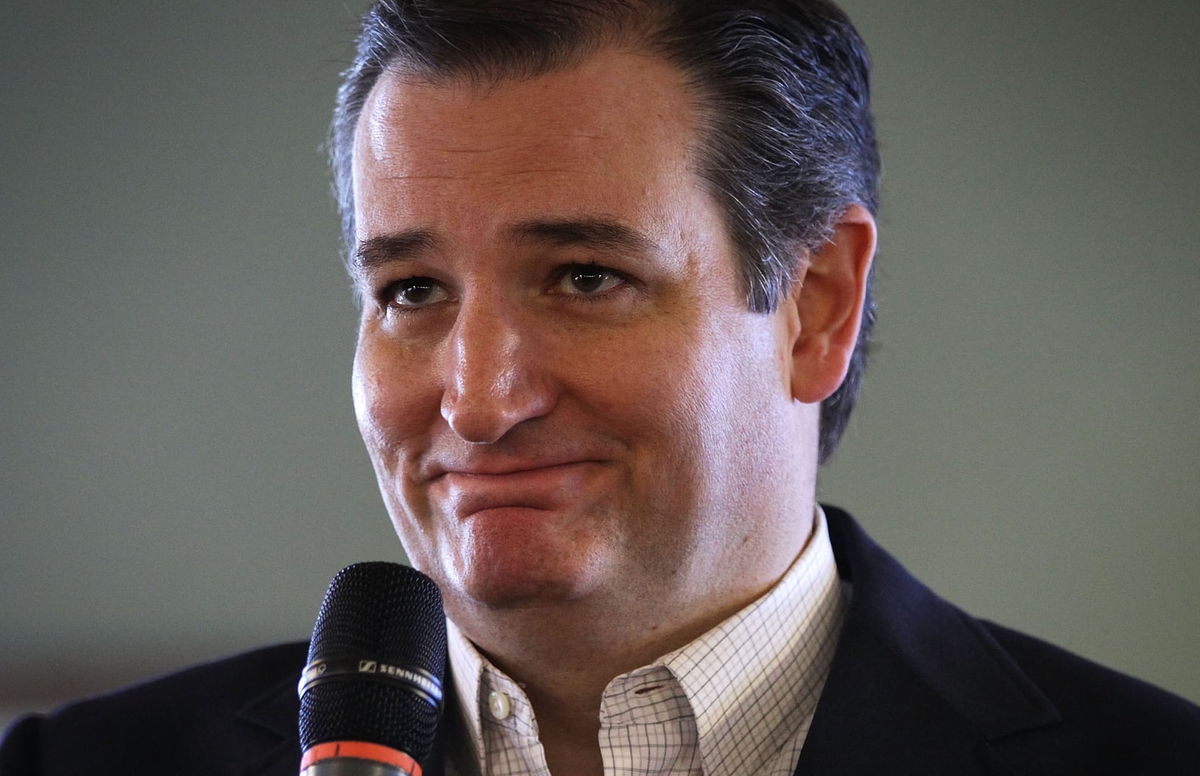
Image source: File reproduced from PopSugar — “Ted Cruz Might Actually Be Kevin From The Office” (Feb 18, 2016), which credits Getty Images / Alex Wong (Getty 510840572). Retain that credit if republishing; Getty may impose separate licensing for commercial reuse.
Timeline note: This cluster is Feb–Mar 2016—months after the active Jade Helm 15 window (mid-2015). Any causal link Jade Helm → Kevin meme is not supported by dates alone; parallel narrative pressure is speculative. Full chronology (Office premiere/finale, 2012/2016 votes, Jade Helm, Indiana exit, volcano news cluster) lives under “Master timeline” in the parallel Jade Helm file.
“Bodysuit” and identity jokes — what actually appeared in search
Kevin-heavy dialogue that rhymes with bodysuit / impostor / layer themes lives in Possible cryptic Office lines; running weight / food / “fat Kevin” beats follow the separate S2–S9 catalogue rule. This bodysuit block logs mainstream-search and non-script threads (Zodiac meme, student satire) adjacent to the half-recalled bodysuit accusation.
The investigator’s memory of bodysuit accusations tied to Kevin was not located in mainstream reporting in a single canonical story. Adjacent satirical material includes:
- Ted Cruz / Zodiac Killer meme — widely described as joke, not literal belief: Wikipedia: Ted Cruz–Zodiac Killer meme.
- Student satire with “costume” / dry-cleaner fiction (explicitly false on page): Western Howl — humor.
Working note: Conflation of disguise memes (Zodiac, rally props, Maury lookalike cycle per Yahoo — history of “suspicious identity”) with Kevin lookalike is psychologically plausible; documentation should separate threads.
Kevin weight and food jokes (S2 through S9 catalogue)
Catalogue rule (this investigation): Every on-screen beat that uses Kevin’s weight, appetite, or body shape as the joke—especially when the punchline is weak (insult or observation without a proportionate character payoff, callback, or structural irony)—is treated here as a cryptic-line candidate alongside the table below. The logic is twofold: (1) under a bodysuit / padded suit / double-body reading, “fat Kevin” material doubles as pressure on the disguise (bulk reads as weight; food/donut vocabulary nudges the audience). (2) Without that layer, the same run of jokes reads as a sustained, often gratuitous target on one employee across roughly eight seasons—after Season 1—at a density that this file argues sits below the show’s usual joke craft elsewhere. Season 1 (Pilot through Basketball in broadcast order) is read here as not establishing that same running fat-Kevin insult engine; Season 2, episode 1 is where the pattern opens on camera for the thesis.
Origin cluster — The Dundies (S2E1; first U.S. air 20 Sep 2005): This episode stacks several Kevin beats that this file reads as weight- / appetite- / body-adjacent under the catalogue rule—each treated as a cryptic candidate (food bulk, camera-blocking bulk, digestion/odor). Dialogue anchors: Springfield! Springfield! — The Office (U.S.) S02E01 full script; summary transcript with stage cues: The Office TV Show — The Dundies; episode context: Wikipedia — The Dundies. Treat transcript sites as secondary—confirm on the episode if disputed.
Dunkin’ Donuts (talking head): Michael says many staff rarely get trophies, names Meredith and Kevin, then asks who would give Kevin an award—“Dunkin’ Donuts?”—pairing Kevin with chain junk food as the laugh.
“Someone had eaten all of them” (skillets of cheese): Michael complains that when he got offstage, someone had eaten all the skillets of cheese—and the script turns to Kevin while delivering the line (The Office TV Show — The Dundies stage direction; same beat in Springfield S02E01). Investigator read: “Kevin ate them all” as the implied punchline—gluttony / size—with little else going on comedically except fat man ate the appetizers.
“Kevin sat in front of the camcorder all night” (parody song): During Pam’s Dundies-highlight montage, Michael’s parody lyrics include “This is the part where Kevin sat in front of the camcorder all night. It’s great.” (Springfield S02E01; The Office TV Show — The Dundies.) Investigator read: the joke is Kevin’s body blocking the shot—again size-first humor with no second layer unless one imports bodysuit bulk or in-world ribbing at someone who cannot slim the frame for the documentary.
Same episode (optional fourth beat): Stanley jokes that at least he did not win “smelliest bowel movement like Kevin” during Dundie banter (Springfield S02E01); Michael later gives Kevin the “Don’t Go in There After Me” restroom Dundie—odor / digestion ridicule in the same night’s pile-on.
Method note: The investigation does not claim an exhaustive list yet; grep subtitles and transcripts for Kevin + eat / fat / food / donut / candy / hungry / diet / camcorder / camera / bowel / skin / sun / cancer / marijuana / drug / Dwight / run / fat legs / shorts / 5k / athletic (etc.) and add rows to the cryptic table or extend bullet lists here over time.
S2E16 Valentine’s Day giant bear delivery (weight/size jab): A Vance-Refrigeration delivery man arrives with an oversized bear; Kevin comments: “Man, that thing’s bigger than I am.” and then “Oh zip it.” (The OfficeQuotes — Valentine’s Day transcript). This is treated as a cryptic-line candidate because the beat is a thin punchline built out of bulk/size without a proportional character-payoff. Writer involved note: Lee Eisenberg (a The Office writer/producer) also acted as a Vance-delivery person (“Gino”), including in delivery beats across episodes. (Lee Eisenberg — Wikipedia)
S2E19 Michael’s Birthday skin-cancer B-plot (“evil sun”): Kevin spends the day waiting on skin cancer results (“I might have skin cancer”; doctors request a second opinion); the office’s attention drifts from Michael’s birthday to Kevin’s scare (Springfield — Michael’s Birthday S02E19; Wikipedia — Michael’s Birthday (The Office)). Michael later announces an ice-skating outing for Kevin—“far, far away from the evil sun”—tying the beat explicitly to sun and surface anxiety. Default viewer assumption (lay): melanoma scares are linked in broad culture to UV / sun exposure; some viewers informally associate a larger body with more skin area and imagine “too much sun” / absorption as an explanation—an oversimplified pop gloss, not a medical claim this file endorses. Cryptic / bodysuit read: the episode still makes Kevin’s body the spectacle and tags sun + surface; if one adopts the bodysuit branch (bodysuit block), the same material can be filed as encoded teasing of extra bulk or suit surface (“more for the sun to hit”) while remaining deniable as straight medical dramedy.
S2E20 Drug Testing — Dwight’s “marijuana symptoms” list (Kevin-first interview): Dwight opens on Kevin mid-snack (“Spit that out”; Kevin shoves the rest of the donut into his mouth per transcript stage direction), then runs through a symptom checklist aimed at who Kevin “sounds like”: “slow moving, inattentive, dull, constantly snacking, shows a lack of motivation.” Kevin cuts in with “Hey…” (same transcript)—read here as pushback / offense at being reduced to that list. Diegetically it is a drug investigation joke; under this file’s catalogue rule, the same language doubles as a cluster stereotype (slow + snacking) that tracks fat-guy punchlines without naming weight outright—i.e. another cryptic body jab smuggled inside stoner vocabulary. Source: OfficeQuotes.net — Drug Testing (S2E20); episode frame: Wikipedia — Drug Testing (The Office).
S4E1 Fun Run — Michael’s fat legs pressure + forced 5K (athletic “proof” read): Kevin refuses the charity run (“You cannot make me run”; “It’s stupid Michael, and I’m not gonna do it”) and invokes Michael’s absence during his S2E19 Michael’s Birthday skin-cancer scare (“You didn’t run for me… when I thought I had skin cancer”). Michael escalates with sustained weight material: “I know that you’re probably scared of people seeing your fat legs in shorts”; Kevin: “No.”; then a lengthy “back in olden times, a large fat person, like this…” monologue (power / food / respect vs athletic “peasant”). Kevin cites missing gear; Michael closes: “Well, you’re going to have to run, or you’re going to be in a lot of trouble. It is not olden times anymore.” Kevin runs anyway (episode summaries: drenched in sweat, no running clothes). On race day the camera deflects from Kevin’s effort via Andy—nipple-chafing absurdity, then drafting “running right behind Kevin” (“Key is drafting, eliminate wind resistance”). Investigator read (author sentiment): the default laugh is fat-shaming; under the bodysuit / hoax branch, Michael’s trouble line can be heard as cover maintenance—Kevin must be seen doing athletic activity in public (shorts, legs, motion) so the Kevin body reads as a real person, not a static suit; Andy’s obnoxious parallel run pulls focus so the proof beat lands without lingering on how Kevin moves. Deep dive: Fun Run — fat legs / forced run. Source: Springfield — Fun Run S04E01; Forever Dreaming transcript.
Possible cryptic Office lines (Kevin-heavy) — double-meaning search seeds
Framing: The Office is fiction. This table is a pattern catalogue: dialogue that rhymes with the investigation’s themes (identity, layers, performance, compromise) and can be grep’d against subtitles or transcripts alongside the Jade Helm file. Complement: bodysuit / mainstream-search. Kevin weight / food insults follow the S2–S9 catalogue rule—each instance is a candidate, not a certified cipher. Governed by Disclaimers.
Order: Rows are sorted by descending investigative resonance (how strongly the bit rhymes with bodysuit / rumor / identity / layers / secrecy in this file), not by episode airdate. Stairmageddon and Gossip anchor the tightest rumor-and-cover cluster; The Dundies row opens the parallel weight–food catalogue; Fun Run carries two rows—PB&J / Oscar epistemology and fat legs / forced 5K athletic-cover; the rest follow.
| Approx. line or bit | Why it might resonate with this investigation |
| Stairmageddon (s09e19) — Kevin’s “secret so good … you didn’t freaking know … but I knew!” beat | Excellent match for compartmentalized knowledge and surprise vs private certainty; diegetically Oscar / Senator Lipton. Cast-wide or macro stretches stay hypothesis—author note, speculative read below. |
| The Dundies (s02e01) — Cluster: Dunkin’ Donuts line; skillets of cheese “someone had eaten all of them” (Michael turns to Kevin); parody lyric “Kevin sat in front of the camcorder all night”; optional Stanley “smelliest bowel movement like Kevin” + restroom Dundie | Opens the S2 weight/food/body ridicule thread (author catalogue): multiple size / appetite / odor beats in one episode; each is thin as straight comedy—stronger as in-world needle if padded suit / bodysuit bulk is the shared secret. Full rule: Kevin weight and food jokes (S2–S9). |
| Valentine’s Day (s02e16) — giant bear delivery: Kevin “Man, that thing’s bigger than I am.” / “Oh zip it.” | Thin bulk/size punchline: oversized-bear delivery + Kevin as the sizing joke; treated as a cryptic-line candidate for “bulk reads as padding/suit” when readers adopt the bodysuit branch, and otherwise as another insensitive weight/insensitivity beat in the investigation’s “thin punchline” logic. Writer involved note: Lee Eisenberg (writer/producer) also acted as a Vance-delivery person (“Gino”) on The Office. (The OfficeQuotes — Valentine’s Day transcript; Lee Eisenberg — Wikipedia) |
| Michael’s Birthday (s02e19) — Kevin skin-cancer screening; Michael: ice skating “far, far away from the evil sun”; Kevin: “I might have skin cancer” | Sun / skin / surface: medical B-plot centers Kevin’s body; evil sun makes UV framing almost literal. Lay default: sun exposure + informal size → more skin / “too much sun” gloss (pop culture, not clinic). Alternate: bodysuit needle—surface area / absorption language teasing bulk or suit layer while staying deniable as melodrama. (Springfield S02E19) |
| Drug Testing (s02e20) — Dwight to Kevin: “slow moving, inattentive, dull, constantly snacking, shows a lack of motivation”; Kevin Hey…; opens on donut / Spit that out | Drug plot as cover for body ribbing: “symptoms” overlap stoner tropes with fat-guy stereotypes (slow + snacking); Kevin’s immediate objection fits thin punchline logic if the list is read as another size-first needle under bodysuit pressure. (OfficeQuotes — Drug Testing) |
| Dwight’s Speech (s02e17) — “Blood alone moves the wheels of history!” + “No revolution is worth anything unless it can defend itself” (hands slam cue) | Encoded-universal revolution template: dictator-cadence rhetoric repackaged as a workplace sales rally; sounds universal enough for any mainstream listener, but structured like a revolution speech that resists pinning to one specific real-world uprising. In this file’s mood, it rhymes with how a “Kevin-in-a-suit” political vessel could deliver a message to everyone while staying deniable. |
| Gossip (s06e01) — “Who’s been saying that there’s another person inside of me working me with controls?” | Strongest catalogue match: in-universe rumor that Kevin is piloted—person inside, working him with controls. Same vocabulary family as bodysuit / impostor / shell themes without stretching metaphor. Episode context: Michael’s fabricated gossip (detail below). |
| Fun Run (s04e01) — Michael: “fat legs in shorts”; “large fat person, like this…”; Kevin No / refuses run; Michael: “in a lot of trouble” if he doesn’t; Andy drafting behind Kevin | Extended weight ridicule + athletic cover: Michael at length targets Kevin’s body (legs, fat, shorts); Kevin denies the stated motive but runs; trouble line read as hoax upkeep—must perform motion in public so Kevin reads real; Andy deflects focus (chafing, drafting). Catalogue: Kevin weight / food jokes (S2–S9); deep dive: fat legs / forced 5K. (Springfield S04E01) |
| Fun Run (s04e01) — Kevin: “Are you kidding me? Pam and Jim are totally hooking up …” vs Oscar: “There is no evidence of intimacy …” (good moods could be other things) | Epistemology / burden-of-proof match: Kevin treats stacked circumstantial cues as obviously decisive; Oscar withholds conviction until direct evidence appears—the same tension as this file’s inferential stack versus calendar / filmography debunks and any criminal beyond a reasonable doubt bar. Adds a redaction-leak read: if proof is direct-only while the smoking gun stays hidden, truth can be formally unprovable in that frame—yet coincidences / contradictions / curiosities may still bleed around the cut and converge on one latent fact (detail below). Rhetorical how many times do we see inference without smoking-gun documents? mirror, not advice to abandon skeptical standards. |
| Niagara: Part 2 (s06e05) — “The peeing is fast, Oscar. It’s getting my tie back on.” | Major pattern match (author): undressing / re-dressing next to a private function; tie as professional layer; wedding-trip spectacle. Not literal proof—competing readings below. |
| “Sometimes Batman’s gotta take off his cape.” / “I do deserve a vacation.” | Batman / cape: self-myth and fatigue—statesman cosplay vs exiting the role; “take off his cape” is verbally close to “take off this bodysuit,” same undress-the-cover image as the bodysuit / costume memes earlier in this file. |
| “I wanted to eat a pig in a blanket, in a blanket.” | Double cover — layered disguise metaphor as food joke. |
| “Why waste time say lot word when few word do trick” / “When me president, they see.” | Message discipline and visibility—soundbite politics; presidential ambition stated as blunt formula. |
| “I got six numbers, one more and it would have been a complete phone number.” | Almost — near-win / incomplete intel as joke; rhymes with runner-up primary math. |
| Trivia (s08e11) — “It’s just nice to win one.” (after his team wins a trivia question) | Small win / relief — not the big prize, but a rare victory; loose rhyme with breaking through in a crowded primary, delegate math, or “finally” moments on the trail. |
| “I can’t do this forever.” / “Call it.” (CPR class) | Stopping a performance — endurance vs quit; loose metaphor for campaign or narrative exhaustion. |
| “No. It’s not Ashton Kutcher. It’s Kevin Malone.” | Reveal / unmasking — the lookalike meme made literal in-universe; parallels rally “same person” jokes. |
| “I have very little patience for stupidity.” | Irony layer — Kevin as judge of intellect; surrogate for pundit tone toward primary field. |
| Server password “Big Boobs” / “big boobz” | Crude signal inside a serious system—leak or inside joke as plot (not literal Cruz). |
| “Jim’s gone” / “Who’s pickle?” | Rival absence / nonsense identity—loose hooks for reading primary as soap opera. |
Dwight’s Speech — coded universal revolution (Mussolini copy)
Dwight’s Speech reads (in this file’s mood) like the show openly demonstrates the very mechanism the Kevin/Cruz hypothesis assigns to the lookalike arc: an extremely encoded revolutionary template delivered in a universal “everyone understands the motivational core” form—while staying deniable about which real revolution it’s meant to serve.
Jim’s staging is explicit that the talking-points come from a famous dictator. In other words, the episode itself admits this rhetoric’s origin even while the delivery is sanitized into a sales-conference performance. (Springfield Springfield — Dwight’s Speech script)
The physical emphasis matters: Dwight punctuates the oration with slammed fists on the “defend itself” line, i.e. “No revolution is worth anything unless it can defend itself,” which in this investigation’s reading is exactly the defensibility condition needed for any “movement” to be treated as more than theater.
Verbatim speech block (Dwight’s delivery; verbatim excerpt):
Dwight: [bangs fists] Blood alone moves the wheels of history! Dwight: Have you ever asked yourselves in an hour of meditation, which everyone finds during the day. [waves arm] how long we have been striving for greatness? Dwight: [bangs fist] Not only the years we’ve been at war, the war of work, but from the moment as a child when we realized that the world could be conquered. Dwight: It has been a lifetime’s struggle [waves arms]. A never-ending fight. Dwight: I say to you [hits podium] and you’ll understand that it is a privilege to fight! Crowd: [clapping] Dwight: WE ARE WARRIORS! Crowd: [clapping and cheering] Dwight: Salesman of Northeastern Pennsylvania, I ask you once more rise and be worthy of this historical hour! Crowd: [clapping and cheering] Dwight: [laughs maniacally] Yeah. Yes! Dwight: No revolution is worth anything unless it can defend itself. [bangs fists] Crowd: [claps] Dwight: Some people will tell you salesman is a bad word. They’ll conjure up images of used car dealers and door to door charlatans. Dwight: This is our duty - to change their perception. Dwight: I say salesmen… and women of the world unite! Dwight: We must never acquiesce for it is together, TOGETHER, THAT WE PREVAIL! Dwight: We must never cede control of the motherland! For it is… Crowd: [shouts] Together that we prevail! [cheering and clapping]
Why it hits this investigation’s “encoded universal revolution” theme: In the author’s belief, the key isn’t the literal political content—it is the template: revolutionary-sounding mobilization (“blood,” “war of work,” “privilege to fight,” “together… we prevail”) delivered in a way that is universally legible while remaining deniable about which real revolution it serves. The show makes that deniability concrete through Dwight’s “hands on the ground” physical insistence on the line: “No revolution is worth anything unless it can defend itself.” In this file’s framework, that defensibility criterion is exactly the nature of what we believe Ted Cruz was doing with the Kevin character if he was indeed that kind of encoded political vessel.
Republican Party comparison (frame-level, not a claim of author intent): “defend itself” + “don’t acquiesce” + “unite” reads like the same mobilization style that tends to package politics as urgent duty and legitimacy as resistance—not as a platform pinned to one named historical uprising. For readers tracking the Cruz/Kevin contrast: see the thesis’ “controlled candidacies / media blackmail” lens and the speculative “Cruz logic” section above for how a mass-recognizable persona could carry revolutionary-sounding energy without needing to name or pin the specific revolution. (national-security thesis · Speculative “Cruz logic”)
Source for the verbatim excerpt match (including the hand-slam cue): Springfield Springfield script + OfficeQuotes transcript for The Office (US) S02E17, “Dwight’s Speech.” (Springfield Springfield; OfficeQuotes).
Kevin, Oscar, Angela — The Accountants webisodes and season 9 “senator” thread (speculation)
Documented side project: The Office: The Accountants is the first NBC.com webisode series: 10 episodes (July–September 2006), between the second and third broadcast seasons, starring Kevin, Oscar, and Angela (Brian Baumgartner, Oscar Nunez, Angela Kinsey) as the accounting team investigating missing petty cash. Writers Michael Schur and Paul Lieberstein; it won a Daytime Emmy for broadband comedy. See Wikipedia — List of The Office (American TV series) episodes (webisodes / The Accountants) and Dunderpedia — The Office: The Accountants.
Containment in-character (descriptive): Across the series, Oscar and Angela repeatedly frame, correct, and police Kevin—budget authority, social judgment, “who is allowed to know what” in accounting. That is ordinary sitcom dynamics; this file logs it because the triangle (Kevin + Oscar + Angela) is also the only core trio of The Accountants.
Real names and first-name overlaps (documented casting): Unlike many ensemble comedies where actor and character names are fully distinct, The Office (U.S.) often blurred the line: Angela Kinsey played Angela Martin; Oscar Nunez played Oscar Martinez; Phyllis Smith played Phyllis Lapin / Phyllis Vance; Clark Duke played Clark Green (the “Clark” temp arc); Robert R. Shafer played Bob Vance (Robert / Bob); and Creed Bratton played a heavily fictionalized version of himself under his real name (see e.g. Wikipedia — The Office (American TV series) cast lists and character pages). Not every cast member follows that pattern (e.g. Brian Baumgartner / Kevin Malone). For this investigation, the overlap is logged because name congruence + “plays himself” cases rhyme with identity, mask, and who is the real person themes elsewhere in the file.
Season 9 and the Oscar–senator arc (fiction, not Cruz): The final season includes a multi-episode thread around Oscar’s affair with Pennsylvania state senator Robert Lipton and the fallout once the “documentary” airs—i.e. an explicit “Oscar and the senator” plot on network television while the real-world 2012–2013 window included Cruz’s Senate election and swearing-in (Jan 2013). No mainstream source ties the writers’ room to Cruz; the parallel is chronological and thematic only.
Speculative read: A fictional senator scandal could function as cover or pressure-release in the same narrative space as a real Texas senator’s rise—a rhyme if one already assumes compromise and containment at the macro level (Jade Helm file). If Stairmageddon’s “You didn’t freaking know” were stretched to mean other cast members beyond Oscar, Oscar and Angela are the long-running counterweights to Kevin in-show; only Oscar Nunez and Angela Kinsey would need to be privy to a hypothetical off-screen scheme in this reading—everyone else kept in the dark until late exposure matches the feel of a final-season reveal architecture. Pattern language for follow-up.
Stairmageddon author note: “did it” and the final season
In the same press-conference run (still Stairmageddon), dialogue right after the “secret so good” block stacks knew / secret / did it in one breath. Oscar says “He knew!”; Kevin answers “Yes. We did it.” then “Yes! Oh, I did it! Oh, I did it!”; Oscar tells him “You did it, Kevin.” (Subtitles vary slightly; meaning is stable.) If you remember it as “he did it,” that tracks Oscar’s “He knew!” (about Kevin) plus the whole we did it / I did it / you did it pile-up—Kevin is not limited to a single literal three-word line.
Author read: Season 9 was the last season—NBC had already announced the show was ending, and this episode is late in that run. Subjective meta rhyme: Kevin sounds as if he already knows the whole story is winding up and is still crowing “did it”—closure language in the actual final season.

Gossip quote: another person inside, controls (s06e01)
Context (The Office, “Gossip”, 2009): Michael invents false rumors to flood the office so people will dismiss real gossip (Stanley’s affair). One planted story is that Kevin has another person inside his body working him with controls. Kevin confronts everyone: “Who’s been saying that there’s another person inside of me working me with controls?” (Wording varies slightly in subtitles; meaning is stable. Wikipedia and episode summaries document the beat.)
Why it ranks first in this table: The show puts the puppet / pilot / not-really-Kevin image in dialogue—not by fan inference alone. For this investigation’s bodysuit, identity, and rumor threads, that is maximal surface overlap. Meta: in-universe the rumor is false (Michael made it up); it mirrors “absurd cover story vs. whisper narrative” structure at one remove.
Competing read: Straight sitcom farce—body-horror-adjacent joke about Kevin’s size and weirdness; reviewers cited the line as funny, not as a cipher.
Assistant take: Major match for pattern work—same kind of idea as bodysuit, operator, and lookalike discourse. If only one Kevin line belonged on a shortlist for this file, it would be this one.
Fun Run quote: “Are you kidding me?” — circumstantial certainty (s04e01)
Context (The Office, “Fun Run”, Season 4 premiere; first U.S. air 27 Sep 2007): Jim and Pam tell the office they are only friends while behaving happily; Kevin insists they are secretly dating (his PB&J nickname—“Pam Beesly and Jim”). Oscar pushes back: he does not know, there is “no evidence of intimacy,” good moods could have other explanations. Kevin answers with incredulous “Are you kidding me?”—twice in the same exchange on the transcript used here—and lists what he reads as obvious tells (Springfield! Springfield! — The Office (U.S.) S4E01 script; search “Are you kidding me” and “no evidence of intimacy”). Episode summaries align on Kevin’s certainty vs the couple’s cover story (Dunderpedia — Fun Run; Wikipedia — Fun Run (The Office)).
Investigation rhyme: Much of this file is built from inferred parallels—timing, memes, performance splits, dialogue patterns—without a single exhibit that would clear criminal “beyond a reasonable doubt” hurdles; that is by design and by Disclaimers. Kevin vs. Oscar here is a clean in-fiction mirror: one voice says the pattern is so loud that withholding belief feels perverse; the other holds out for the kind of direct proof skeptics correctly demand for literal same-body identity or courtroom findings. The rhetorical question — how many times are we shown circumstantial evidence without direct evidence? — lands as author sentiment about the investigation’s own evidence class, not as permission to confuse pattern work with adjudication.
Redaction-leak thesis (hypothesis only): Lock Oscar’s “there is no evidence of intimacy” next to Kevin’s “Are you kidding me ?” and you get a usable cartoon of a modern bind : if the only admissible currency is direct, exhibit-ready proof and the dispositive artifacts are deliberately withheld ( classification, sealed settlements, destroyed records, or never-written practice ), then inside that narrow gate the underlying truth can stay formally “unprovable” forever — even when everyone in the room can feel the shape of it . Second move ( still hypothesis , not evidence ) : when a fact is real but displaced — present obliquely beside the public record rather than absent from reality — redaction behaves like lossy compression . Coincidences, contradictions, and curiosities can bleed around the cut line as side-channel noise ; many unrelated-looking leaks may still converge on one latent vertex ( the same removed / secret thing ) without ever handing Oscar the one document he asked for . That does not vacate calendar debunks or ordinary skepticism ; it only names why pattern stacks can feel Kevin-loud while Oscar’s evidence rule remains textbook-correct as stated ( Disclaimers ).
Competing read: Straight rom-com tension—the audience already knows Pam and Jim are together; Kevin is right in-story for ordinary sitcom reasons, not because Greg Daniels encoded federal law standards.
Assistant take: Useful self-check anchor for readers who notice the file’s music sometimes outruns its admissible facts—and for authors who still feel the pattern stack as Kevin does when Oscar asks for paper.
Fun Run quote: “fat legs” / forced 5K — athletic cover (s04e01)
Context (The Office, “Fun Run”, Season 4 premiere; first U.S. air 27 Sep 2007): After Michael mandates a rabies 5K, Kevin refuses. Michael guesses Kevin fears exposure—“scared of people seeing your fat legs in shorts”—Kevin: “No.” Michael then delivers an extended “large fat person, like this” / olden times riff (fat as power vs athletic peasant). Kevin cites missing sneakers; Michael: “Well, you’re going to have to run, or you’re going to be in a lot of trouble. It is not olden times anymore.” Kevin participates anyway. During the race, Andy supplies comic overload (nipple chafing, marathon boasts) and drafts directly behind Kevin—“Key is drafting, eliminate wind resistance”—so the episode’s visual attention splits between Kevin’s run and Andy’s obnoxiousness (Springfield S04E01; Forever Dreaming transcript).
Investigation rhyme (author sentiment): Same episode as the PB&J / Oscar epistemology beat, but this block is body-first: Michael ridicules Kevin’s weight at length under the cover of charity and peer pressure. Default read: cruel, lazy fat joke. Cryptic / bodysuit-hoax read: Kevin’s No to “fat legs” may be denial of the obvious surface (not “I’m not scared”—that’s not why I won’t expose myself). Michael’s trouble threat then sounds like institutional cover: the Kevin character must periodically show athletic life—running in shorts, legs visible, motion on camera—so viewers treat the bulk as living flesh, not a static padded suit or impostor shell. Andy running glued to Kevin’s back deflects scrutiny (audience watches the annoyance, not how Kevin runs)—a misdirection pattern this file logs beside other thin punchlines in the S2–S9 catalogue. Rhymes with Basketball (S1) and real-world athletic curiosity elsewhere in the file without claiming they prove identity.
Competing read: Standard sitcom—Michael is an insensitive boss; Andy is Andy; Kevin sweating in dress clothes is slapstick; “trouble” is just Michael bluffing.
Assistant take: Strong catalogue entry for performance-of-realness under bodysuit pressure—distinct from the episode’s Oscar/Kevin evidence mirror, but same hour of television.
Niagara quote: peeing is fast, tie back on (author-weighted)
Approximate dialogue (The Office, “Niagara: Part 2”, 2009): Kevin tells Oscar that peeing is fast; what takes time is getting his tie back on. Oscar reacts as if Kevin’s bathroom process is stranger than usual.
Fork (high level): Either (1) absurdist joke—successful or not—with no second meaning, or (2) a reading that rhymes with bodysuit / costume / layer themes elsewhere in this file.
Why the author calls this a major match: Same cluster as the Batman / cape and bodysuit threads—clothing as cover, private moment versus public face, ritual of dressing and undressing around the body. Niagara adds spectacle-wedding pressure next to that beat. Pattern strength for the hypothesis space.
Competing explanations (non-cryptic; list is inclusive):
- Absurdist comedy — Kevin is written as odd; backward or over-elaborate logic is the character brand.
- Sitcom “silly beat” — Quick punch-in before the ceremony; humor over tight realism.
- Funny line on “straight” behavior — Some people are fussy about ties and clothes in a stall; the line exaggerates that into laughs.
- Line that sounds absurd on purpose — WTF reaction (Oscar / audience) is the point.
- Writers’-room logic — “What’s the weirdest Kevin thing to say here?” or a pitch that won the table read.
- Joke that lands or doesn’t — The author’s opinion is that this one is confusing at best and not up to the usual Office bar for a clean laugh; others disagree (some fans call it underrated or WTF in a good way).
Note to readers who share the author’s reaction: If the line felt flat, forced, or off-brand for the show’s humor, it is still reasonable to ask whether there is a “real” meaning behind the message. It lines up with layers, identity, performance, costume—themes this file tracks.
Jade Helm — Cruz’s public role and the containment hinge
Stub (this file): Operational detail, maps, and timeline stack live in the parallel investigation; the paragraph below is a one-screen bridge so readers need not leave for the basic Cruz–Texas–Jade narrative hook.
In the thesis stated above, Jade Helm 15 is the moment the deep state retasks a threat (Cruz + Texas grassroots energy) into a controlled asset: federal narrative, map-based “hostile” framing, and media ridicule of concern together cool independent verification and align Cruz’s public voice with Pentagon reassurance. Cruz’s May 2015 statements (Pentagon contact, acceptance of “training exercise,” empathy with distrust) are summarised in the parallel investigation; they are compatible with ordinary constituent politics or with narrative management under the macro pressure described at the top of this file.
Offline / sibling work (subtitles)
A machine-assisted pass over local OpenSubtitles mirror English packs produced:
- Part A: Speaker-tagged
(Kevin)lines (high confidence, small count — many uploads lack SDH names). - Part B: Cues containing the word Kevin (includes others addressing Kevin).
Output path (developer machine): ~/dev/subs/the-office-us-kevin-malone-master.md — not part of this repo; re-import excerpts here if the site maintainer wants them canonical on paradigmthreat.net.
What would confirm or falsify this thesis?
Scope: Dispositive evidence vs ambient weakeners (Disclaimers).
Would strengthen “planned Kevin stunt / hijack” (examples):
- Authentic campaign or PAC documents mentioning Kevin, Office licensing, or surrogate stunt strategy.
- Leaked comms showing third-party coordination between entertainment assets and political timing.
- Credible witness: staffer states under oath directed meme amplification or suppression orders.
Would weaken specific sub-claims (not necessarily the entire investigation):
- If archived campaign emails (if disclosed) show no internal Kevin or Office references anywhere, and independent reporting confirms only organic comedian or fan origin for the viral rally moment, that thread loses weight—without by itself proving no other lane of pressure or parallel narrative work existed. Current public record leans organic for that stunt only.
Cross-links
- Jade Helm — Texas coup / Cruz hypothesis
- CIA investigation (institutional “deep state” framing elsewhere in this corpus)
Changelog
Newest first.
- 2026-06-06 — Fun Run (s04e01): Michael fat legs / large fat person monologue, Kevin refuses then runs; Michael “in a lot of trouble” line; Andy drafting deflection; catalogue paragraph + cryptic table row + fat legs / forced 5K deep dive (athletic proof-of-realness read under bodysuit branch).
- 2026-05-08 — Drug Testing (s02e20): Dwight’s marijuana-symptom checklist at Kevin (slow moving… constantly snacking…); donut cold-open + Kevin Hey… pushback; catalogue paragraph + cryptic table row (stoner-cover vs body-jab read); method-note grep tokens (marijuana / drug / Dwight).
- 2026-05-08 — Michael’s Birthday (s02e19): Kevin skin-cancer wait + Michael “evil sun” / ice-skating beat; catalogue paragraph + cryptic table row (lay sun/size gloss vs bodysuit-tease read); method-note grep tokens (skin / sun / cancer).
- 2026-05-08 — Added Dwight’s Speech (s02e17) coded universal-revolution section: verbatim dictator-style oration excerpt including “No revolution is worth anything unless it can defend itself” with slamming-hands cue; compared frame-level “defend/unite” mobilization to the Cruz/Kevin encoded-template thesis.
- 2026-05-07 — Added Valentine’s Day (s02e16) giant-bear delivery beat to the Kevin weight/food catalogue + cryptic table (Kevin: “bigger than I am” / “Oh zip it”), and noted that the delivery-man performer is in the show-writer orbit (Lee Eisenberg).
- 2026-05-02 — The Dundies origin cluster expanded: skillets of cheese / Kevin ate them all beat (Michael turns to Kevin); “Kevin sat in front of the camcorder all night” parody lyric (camera-blocking = size joke); optional Stanley “smelliest bowel movement like Kevin” + Kevin’s restroom Dundie; Springfield S02E01 script link; cryptic-table Dundies row widened to full cluster; method-note grep tokens (camcorder, bowel).
- 2026-04-28 — Kevin weight / food / “fat” joke catalogue methodology (treat each on-screen instance as a cryptic candidate; Season 1 read as not starting this thread; S2E1 The Dundies Dunkin’ Donuts line as origin); new section + TOC link; new cryptic-table row; bodysuit + cryptic Framing cross-links.
- 2026-04-09 — Removed duplicated Cruz 2012–2016 / youth / Texas / Jade Helm / author-stance / logic-check material from under S1E4 The Alliance (canonical copy remains under Investigator addendum — Cruz 2012–2016 / Jade Helm (parallelism)); restored Basketball (S1E5) subsection in broadcast order; added this Changelog; shortened the Stairmageddon summary table row (detail in author note + webisodes subsection); added bodysuit ↔ cryptic cross-links; trimmed more trailing inline disclaimer links where the disclaimers section already governs tone.
- 2026-02-14 — TOC after TL;DR, evidence-hygiene note, calendar-at-a-glance in addendum, Cruz / youth / Jade block moved under addendum, Season 1 curiosities in U.S. broadcast order (Pilot through Basketball), Jade Helm short section, first pass trimming repeated
([Disclaimers](…))noise, Stairmageddon row compression started, bodysuit/cryptic outline anchors. - 2026-02-13 and earlier — See git history for this path (
git log -- governance/war/investigations/cruz-kevin-malone-deep-state-hypothesis-investigation.md): Fun Run redaction-leak thesis, cryptic-line table expansions, Alliance / Health Care / Basketball rows, rally documentation, etc.
Archival — former author-frame Date: line (pre–2026-04-09)
Preserved verbatim when the author frame was replaced by Last substantive reorganize + bullets above:
Date: 2026-04-10 (theory block; Office quote table; timing addendum; Kevin / Oscar / Angela); edits 2026-04-11 — national-security thesis at top; disclaimers consolidated; TL;DR (Will Durst / Angry Birds); cross-ref extended hypothesis; “George Bush 1” / early-2026 Epstein tranche cite (Roya News). Timeline: Trump and the MAGA Revolution. 2026-04-18 — author frame: U.S. Office as antibody vs Cruz / media gridlock (not U.K.). 2026-04-19 — Basketball (S1): Baumgartner real-shooting curiosity + validated cites (Wikipedia production; Sporting News / Carell, Office Ladies); no NBA 2K13 cite (claim not verified here). 2026-04-20 — Pilot (S1E1): Kevin in early vérité / “opening office” curiosity + Office Ladies + Wikipedia cites. 2026-04-21 — Diversity Day (S1E2): Kevin / Chris Rock reenactment beat + cites; 2026-04-09 addendum — optional anti-globalist / nationalist-fringe read (Mr. Brown / compliance theater; same subsection). 2026-04-09 (b) — Health Care (S1E3) political read; The Alliance (S1E4) + Donald Trump on camera (cited; below). 2026-04-09 (c) — The Alliance optional “alliance for survival” political read (same subsection). 2026-02-11 — Basketball subsection: Cruz lifelong / Kimmel 2018 win + investigator “major find” sentiment on Baumgartner / Cruz shot-making overlap (not identity proof). 2026-02-12 — Fun Run (S4E1): “Are you kidding me?” Kevin / Oscar beat—circumstantial vs direct evidence rhyme (cryptic table + subsection). 2026-02-13 — Fun Run addendum: redaction-leak / side-channel thesis (no evidence vs are you kidding me).
Prisca sapientia (epistemic foundation): This investigation assumes prisca sapientia—the historical and philosophical belief that the ancients possessed a vast, profound understanding of the universe, nature, and theology that was subsequently lost or degraded. Modern consensus science and institutions are not treated as default truth; evidence tiers below adjudicate specific claims.
Keywords: #Tedcruz #Kevinmalone #Theoffice #2016primary #Meme #Deepstatehypothesis #Jadehelm #Nationalsecurity #Epstein #Angrybirds #Blackmail #Investigationopen
Share