
Investigation: Call of Duty: Modern Warfare — Original Trilogy vs. Soft Reboot, Militainment, Iran–Russia Framing, and Cross-Media Operator Archetypes
TL;DR: Infinity Ward’s original Modern Warfare trilogy (2007–2011) vs the 2019–2023 soft reboot: Russia as peer/WWIII driver in the old arc vs arms supplier, PMC, and terror vectors in the new; Iran foregrounded in MW 2019–MWII (Quds, HVT). MWIII (2023) swings back to Makarov, No Russian–style spectacles, and Russia–U.S. WW–toned plot (Iran not the spine)—see §2.3 for controversy cites. The Chance Glasco–era Activision pitch (Iran→Israel game) is reported, not adjudicated. Alex = Chad Michael Collins (wiki). Audience demand to cast John Krasinski as an operator (GameByte Nov 2019; Reddit ~17k upvotes) sits on a primed timeline: Jack Ryan S1 (from Aug 2018) and 13 Hours (2016) before MW 2019 launch — not proof of intent, but documented mass “Jim / operator” overlap. Cross-reads: Benghazi / 13 Hours, CIA / Iran, Reverse Crusades. § Paradigm Threat synthesis maps media “two camps” to antibody vs deep-state “virus” (see CIA, 9/11 good-actor antibody): the pro-Israel / anti-Iran operational lane is read here as antibody-aligned—not mere ideology. All hedges in § Limits and disclaimers.
Status
Open. Mixes citable developer interviews and games press with site hypothesis lanes; does not close the case on who steers popular war imagination.
Guide (read order)
- Limits and disclaimers — how this file uses evidence vs fiction; cross-links are thematic.
- Paradigm Threat synthesis — site “two camps” / antibody vs deep-state frame (Israel–Iran script).
- §§1–2 — why the 2019 SKU is a reboot; original trilogy (Russia / WWIII tone) vs reboot (Iran, proxies, PMCs); §2.3 — MWIII (2023) Makarov / No Russian echoes, press controversy, timing vs Ukraine (author note).
- §3 — Glasco / Activision “Iran attacks Israel” pitch (games press only).
- §4 — Alex actor, Krasinski, audience, war-film pattern, Office clues (§4.6 includes a table of extra espionage rhymes — Golden Ticket, The Lover, beside Booze Cruise / Benihana), closing thesis on archetypes.
- §5 — 2025–26 arms headlines (real-world context for game premises).
- §6 — militainment; who paid (taxpayer/sim vs Activision); sentiment on overlap.
- §7 — gaps and research TODOs.
- Related investigations — table of other site files (same links as a former duplicate list; merged here).
- Investigator notes (file end) — maintainer/LLM only; skip for normal reading.
Limits and disclaimers
Prisca sapientia (epistemic foundation): This investigation assumes prisca sapientia—the historical and philosophical belief that the ancients possessed a vast, profound understanding of the universe, nature, and theology that was subsequently lost or degraded. Modern consensus science and institutions are not treated as default truth; evidence tiers below adjudicate specific claims.
Read this section once; later sections do not repeat these points except where new nuance is required.
Fiction. Campaigns use composite states (Urzikstan, Al Mazrah / U.R.A.), renamed factions, and “ripped from the headlines” tone. Nothing here is court-admissible as depiction of IRGC, CIA, or Russian OOB.
Evidence tiers. Developer quotes (Verge, Charlie INTEL) are secondary press. Chance Glasco’s Activision Iran→Israel pitch story reaches us via games journalism and social posts — not a sworn filing; seek Activision / Microsoft primary response before treating as settled.
No prediction / foreknowledge. Similarity between MWII 2022 beats (e.g. missile on Quds general; Russia–Iran arms deal frame) and real events (Jan 2020 strike; 2025–2026 Gulf press) is pattern resonance — not evidence the studio knew future policy.
“Two camps” / audience split (games and film). Used as a lens on competing Cold War vs proxy-war imaginaries — not that two literal propaganda shops own old vs new SKU. § Paradigm Threat synthesis extends this pair into the site’s antibody / deep-state frame (hypothesis, not mainstream consensus).
Cross-investigation links (Benghazi, CIA, Reverse Crusades, Paperclip) are thematic rhymes — Konni/Makarov ≠ documented history; Krasinski ≠ Alex actor.
Marketing vs mandate. 2019 reboot naming and Minkoff/Kurosaki interviews explain SKU reset and “realism” — they do not prove or disprove a hidden pro-Israel / anti-Iran brief; that line stays separate from Glasco allegations (different year band).
Militainment. Label depends on academic/press usage; FPS blockbusters sit in spectacle economies. “Trained millions” / recruitment-adjacent culture are sociological shorthands — not claims of Pentagon storyboard control or measured enlistment effect.
Real-world arms (§5). Reuters/CNN 2025–2026 sourcing is contested by quoted denials and intel opacity; use as context for plausibility of game premise, not as verified order of battle.
Paradigm Threat synthesis (§ below). Antibody/deep-state read of Israel/Iran is speculative site thesis tied to CIA investigation §IV Iran pipeline; it does not rest on Activision fiction or FPS sales data.
Paradigm Threat synthesis — “two camps,” antibody vs deep-state virus, and the Israel–Iran–nuclear script
Elsewhere on this site, antibodies are theorized as counter-forces to a deep-state institutional “virus”: e.g. NSA and good-actor vectors beside CIA covert parasitism — see CIA investigation §§III–IV — and historic antibody operations in tension with slow-burn plans — see 9/11 investigation (good-actor historic antibody thesis). The two camps this file uses for game/film audiences (original-trilogy Russian peer-war fantasy vs reboot Iran / proxy / headline realism) also map onto that antibody vs virus vocabulary as metaphor only: mass culture channels competing fears and loyalties; Call of Duty is not forensic evidence for or against covert state theses.
Author sentiment (site hypothesis, not journalistic fact): On the reading developed in CIA §IV — Iran pipeline, Washington and London (with partners) set up both Israel and Iran across decades so that later extremes could collide in holy-war and nuclear crisis — the endgame the parasite needs. In this frame, the camp that looks pro-Israel and operationally anti-Iran (pressure to defuse the bomb, strike Quds, absorb coalition costs and bad press) is not reduced to Zionist ideology alone; it is read here as antibody-aligned because those moves target the Iranian nuclear / regional trigger the deep-state script would weaponize for maximum civilizational damage.
Trade-offs the antibody read accepts as unavoidable in any scenario: erosion of international standing, surge in antisemitism, ugly headlines — not celebrated, but weighed as the price of playing on a rigged board instead of letting the worst timeline run unopposed. Antibodies in this sentiment do not claim to cancel deep-state plans wholesale; they aim to see the script through where it cannot be avoided, clip tail risk, preserve sovereignty where possible, and steer away from maximum-kill outcomes (nuclear exchange, unbounded regional holy war).
Interface with Modern Warfare fiction: The reboot’s Iran / Russia / cartel plot rhymes with real headline war (HVT, missile, proxy) and is useful for asking what audiences are trained to fear and cheer — not proof that antibody actors wrote the game or that Infinity Ward holds classified knowledge. IW developers who rejected an Iran-invades-Israel pitch (§3) can be read as refusing one provocation template while the reboot still delivers another MENA pressure cooker (see Limits, item 1). Modern Warfare III (2023) partially reverts that headline-MENA emphasis toward original-trilogy Makarov / false-flag / great-power spectacle (§2.3); this file treats that as a narrative fork in the annual SKU, not as proof of a single author.
Related investigations
| Thread in this file | Paradigm Threat investigation | Why link |
| Antibody vs deep-state virus; Iran/Israel pipeline; TF141 fiction | CIA investigation | §§III–IV (antibody/NSA, Iran setup) — substrate for § Paradigm Threat synthesis; Laswell/TF141 vs pipeline thesis |
| Historic antibody vs slow-burn plan | 9/11 — good-actor historic antibody | Parallel antibody vocabulary |
| Benghazi, contractors, operator cinema, Krasinski | Dubious stand-down orders — Libya / Benghazi | Shared PMC/CIA/SOF narrative ecology; 13 Hours cluster |
| Russia 2022 media adversary vs game PMC | The Four Reverse Crusades | NATO–Russia frame beside fictional arc |
| Homeland security culture | U.S. citizens vs federal armed confrontations | Militainment / exercise mood (loose) |
| Trump / Iran news vs credibility | Artemis II as faith test | §12 incentive sketch |
| Ukraine / asset threads | Operation Paperclip | Site index themes only |
| U.S. Office, media GOP gridlock, Cruz breakthrough | Ted Cruz, Kevin Malone — hijacked plan | Site treats American The Office (not U.K.) as antibody vs media-driven primary gridlock; full author frame in that file — rhymes with § Paradigm Threat synthesis |
1. Naming fork — why not “Modern Warfare 4” (2019)?
On-record developer rationale (press):
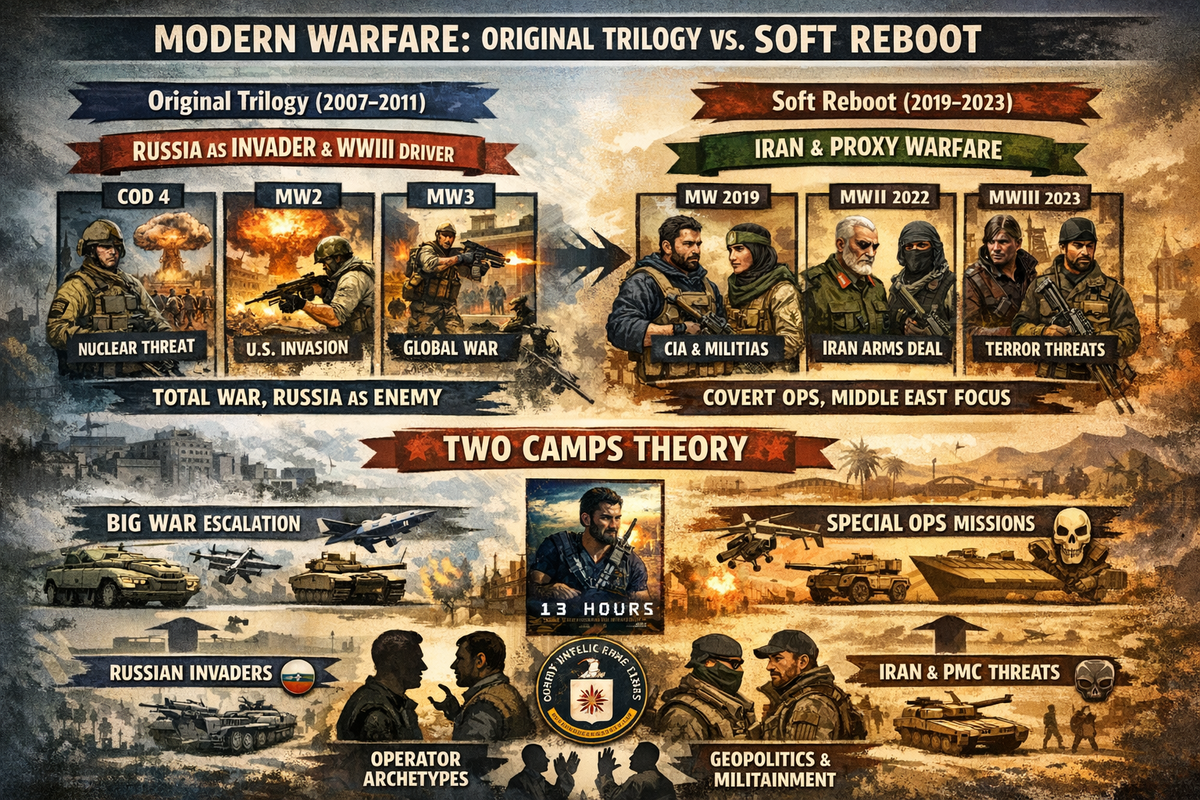
- Soft reboot, not sequel number: after MW3, the old arc (nuclear stakes, Russian invasion of US) was judged too far from contemporary plausibility for a straight MW4. The Verge — May 30, 2019 quotes Jacob Minkoff: old story “bear no resemblance to the world we see today”; new game is same brand, new continuity (likened to Daniel Craig Bond reset).
- Charlie INTEL interview with Taylor Kurosaki: new MW is not tied to CoD4/MW2/MW3 story; “ripped from the headlines” authenticity goal. Charlie INTEL
2. Original trilogy vs reboot — premise contrast (Russia, mass war, Iran)
2.1 Original trilogy (2007–2011) — “nationalist / total war” spine
| Work | Russia / USSR legacy | Iran / MENA |
| CoD4 | Zakhaev, civil war, nuke threat | Middle Eastern coup / nuclear MacGuffin (not a sustained Iran campaign) |
| MW2 | Makarov, No Russian, US–Russia escalation | Peripheral to core Russia plot |
| MW3 | WWIII, European war, Ultranationalists | Not the driver |
Illustrative missions (original trilogy): No Russian — Moscow airport mass-casualty attack, escalation to “all of Russia will cry for war”; Wolverines! — CONUS invasion beat. Tone: great-power catastrophe, not proxy sanctions discourse.
2.2 Reboot (2019+) — proxy war, composite states, Iran–Russia nexus
2019 — Modern Warfare: Russian general Barkov occupies Urzikstan; player threads CIA Alex, Farah ULF, Al-Qatala-type terror. Religion rarely doctrinal; families and local resistance humanized. Mission Proxy War: Russian airbase, drone strike on Russian helicopters.
2022 — Modern Warfare II: Opening Strike — Iranian Quds General Ghorbrani killed during arms deal with Russian forces; Hassan revenge arc; cartel / missile plot. Radio beat (paraphrase): Laswell — “Supplying Iran. It’s an arms deal.” Shepherd — “What the hell are the Russians doin’ with Ghorbrani?”
Interpretive synthesis: Reboot does not need Red Dawn–style Russia invades CONUS for sales; it imports Soleimani-strike echo, Russia as supplier, and later Konni / Makarov terror (MWIII) — closer to post-2014 real headlines than to 2007 Russian peer fantasy.
2.3 Modern Warfare III (2023) — Makarov, No Russian echoes, controversy (Iran no longer the spine)
SKU facts: Sledgehammer Games released Call of Duty: Modern Warfare III in November 2023 as the third campaign in the reboot sub-series. Vladimir Makarov returns as the lead antagonist — a Russian-affiliated ultranationalist terrorist (Konni Group), i.e. the reboot re-centers the original trilogy’s star villain and mass-casualty / false-flag story grammar (provoke Russia–West escalation) rather than the Iran–proxy / headline-deal spine that MWII 2022 opened with (§2.2). Iran is not the campaign’s main geopolitical through-line in the same way.
No Russian thematic return — trailers, mission beats, ESRB: Pre-launch marketing tied Makarov to airplane hijacking and the phrase “No Russian” (continuing MWII 2022’s post-credits tease), explicitly evoking the 2009 airport-massacre backlash. GameSpot — Aug 17, 2023 reports trailer material (gun assembly, text from “M,” “No Russian”). GameSpot — Nov 2, 2023 describes the campaign mission: Sochi-bound flight, on-board bomb, renewed debate (including vs 2009 skip warnings). PCGamesN — Oct 31, 2023 argues Sledgehammer “circles back to the red threat” and “a world war with Russia and America at its center.” COGconnected — Nov 3, 2023 summarizes the same arc. The ESRB content summary (quoted in games press and summarized on Wikipedia — No Russian) listed airplane takeover, stadium mass violence (attackers in police / paramedic disguise), passengers shot, etc.
Critics — timing vs real wars, “propaganda,” false flags: The Guardian — Nov 8, 2023 contrasts Nintendo delaying Advance Wars after Russia’s 2022 invasion of Ukraine with Activision shipping MWIII on schedule with Russian troops still in Ukraine and less than a month after the Oct 2023 Israel–Hamas war began; it names stadium carnage and a hijacked jet bound for Sochi among “cinematically framed atrocit[ies].” Eurogamer — campaign review calls the linear campaign, at its worst, “very, very close to propaganda” — Western heroes vs “international bad eggs” with little systemic politics (reviewer’s frame, not a legal accusation). Rock Paper Shotgun — Nov 9, 2023 describes Makarov leading “Russian ultranationalists.” Polygon — Nov 2023 discusses the plane sequence (player as Samara), false-flag logic, and anti-Arab racism as narrative device. Counter-read: Kyiv Independent — Mar 4, 2024 opinion argues MWIII “whitewashes the Kremlin’s crimes” by separating Makarov/Konni from Russian state war conduct — i.e. Western critics disagree whether the fiction over- or **under-**demonizes Russia; neither stance proves Activision’s intent.
Why false-flag / WW again vs “headlines” reboot pitch (§1)? On-record 2019 interviews emphasized contemporary plausibility and “ripped from the headlines” texture (Verge, Charlie INTEL — §1). MWIII instead re-deploys the legacy IP spine (Makarov, No Russian iconography, WW-scale stakes). Documented secondary explanations include nostalgia economics, annual release pressure, Sledgehammer as lead (vs Infinity Ward on prior reboot entries), and a compressed production timeline — Bloomberg — Nov 9, 2023 (Jason Schreier; ~16-month campaign work, expansion-to-sequel shift per sources); Wikipedia — Modern Warfare III (2023) (development section; Bloomberg/Wiki cross-cites); tone in Eurogamer. This file cites no 2023 Activision white paper that reconciles headline-realism marketing with Makarov’s return.
Author note — Paradigm Threat (opinion): Against § Paradigm Threat synthesis (“two camps”), MWIII looks like first-camp capture: peer-Russia / ultranationalist evil and escalation fantasy, after 2019–MWII had leaned into proxy, PMC, Iran–Russia, and MENA “headline” texture. That reversal is consistent with globalist / deep-state–aligned militainment — not as proven Pentagon storyboards, but as fitting a 2022–2024 news environment where Eurogamer-style reviews already name propaganda-shaped structure and The Guardian names tactless timing beside active wars. This author’s view: 2023 sat inside Russia’s expanded mobilization and wartime-economy transition after 2022; Western coverage often flattened Russia into cartoon villainy and unrestrained war-booster cadence while casualties mounted — a pattern this file reads as forgetting WWII-era warnings about dehumanization and total-war rhetoric, without equating today’s press to 1940s ministries.
3. Publisher vs Infinity Ward — alleged “Iran attacks Israel” pitch (separate timeline)
Claim: Chance Glasco (ex–Infinity Ward) stated Activision pressed IW (after 2010 leadership split / Respawn formation) to make a Call of Duty about Iran attacking Israel; most devs were “disgusted” and it was dropped.
Secondary sources (games press):
2026 press cycle (White House video / Iran strikes context): Glasco’s posts were widely quoted again after a White House social clip used Call of Duty–style UI over strike footage (Mar 2026). Example: VGC — 2026-03-05. Eurogamer states it contacted Activision for comment; no quoted Activision response appears in that article as consolidated here — still treat publisher silence vs allegation as an open evidence gap (§7).
If accurate, the story indicates publisher interest in a hot Middle East scenario in the early 2010s — orthogonal to whether MW 2019 was written to that brief (see Limits, items 2 and 6).
4. Casting — Alex Keller, Krasinski, 13 Hours, audience “Jim” overlap, and the war-film star pattern
4.1 Documented facts (still)
| Question | Documented answer |
| Who plays Alex in MW 2019? | Chad Michael Collins — Call of Duty Wiki — Alex Keller |
| Did Activision / IW say Alex was modeled on Krasinski? | No on-record claim found here; Limits item 5 stands (Krasinski ≠ voice/performance actor). |
| 13 Hours | Krasinski as Jack Silva — Benghazi / film cluster treats it as operator-hero cinema, not CoD canon. |
4.2 “Solid hit” — mass audience, not lone hot take
GameByte — Modern Warfare Players Really, Really Want John Krasinski In The Game (published 2019-11-22, per page metadata) summarizes r/modernwarfare demand: it links this Reddit thread (user Torryan) and reports “over 17k” upvotes; the piece itself notes a Jack Ryan still “could be straight out of Modern Warfare.” That is secondary games press, but it aggregates what thousands of players already did in public — the same intuition informal commentary often voices (“Alex looks like Jim”): everyman face + tactical kit + prior Krasinski-as-operator imagery.
4.3 Timeline and career arc — why the overlap was loaded before Nov. 2019
| Milestone | Date (sourced) |
| Tom Clancy’s Jack Ryan S1 premiere (Krasinski title role) | 2018-08-31 — Wikipedia — Jack Ryan (TV series) |
| 13 Hours: The Secret Soldiers of Benghazi (Bay; Krasinski Navy SEAL–type role) | 2016 — Wikipedia — John Krasinski |
| Call of Duty: Modern Warfare (2019) release | 2019-10-25 — Wikipedia — CoD: MW (2019) |
| GameByte / Reddit Krasinski-as-operator roundup | 2019-11-22 (article) — GameByte |
By retail launch, many buyers had already seen more than a decade of Jim Halpert plus ~14 months of Jack Ryan S1 and press images; the GameByte piece after launch documents sentiment already in public. Wikipedia — John Krasinski lays out the star path: The Office (2005–2013) → 13 Hours (2016), then Jack Ryan (2018–2023) — i.e. multiple high-budget “operator” data points before MW 2019.
4.4 Pattern — bankable “everyman” males in prestige war films (citable hooks; sample table in §4.5)
Hollywood has long cast familiar faces into uniform for Vietnam and Civil War epics; reception sometimes attacks the fit when the star’s prior persona clashes with gravitas.
- Glory (1989) — Matthew Broderick as Col. Robert Gould Shaw three years after Ferris Bueller’s Day Off (1986). Wikipedia — Glory (1989 film) reception quotes Peter Travers (Rolling Stone) calling Broderick “catastrophically miscast as Shaw” and Desson Howe (Washington Post) on “amiable non-presence” — i.e. critics noticed the star-persona tension in a war drama.
- Platoon (1986) — Wikipedia — Platoon (film), § Casting reports Oliver Stone telling Entertainment Weekly (2011) that Mickey Rourke, Emilio Estevez, Kevin Costner were considered for Barnes, and Keanu Reeves / Kyle MacLachlan turned down Taylor — a snapshot of A-list names circulating a gritty Vietnam script.
- Tom Hanks — mainstream comedy stardom (e.g. Splash, Big) before Oscar dramatic turn and Saving Private Ryan (1998); Wikipedia — Tom Hanks ties 1980s comedies to later Spielberg war work (SPR, Band of Brothers EP, etc.).
- Michael J. Fox in Casualties of War (1989) — teen / time-travel icon cast as Pvt. Eriksson opposite Sean Penn; trade and retrospective pieces routinely note Fox’s prior persona when discussing the film (e.g. Rotten Tomatoes — Casualties of War synopsis and critical blurbs referencing Fox’s role).
Caveat: We did not locate a single peer-reviewed paper that names “1990s–2000s heartthrobs in war movies” as a formal trend. The pattern here is assembled from film-history facts, casting revelations, and review language — useful for this investigation’s cross-media archetype claim, not as social-science proof.
4.5 Sample list — war / military prestige roles and lasting careers (illustrative, not exhaustive)
| Figure | Rough “non-war → war / uniform” beat | Why it matters for lasting career |
| Tom Hanks | 1980s comedy → Saving Private Ryan → decades as producer of WWII television (Band of Brothers, The Pacific, Masters of the Air) | Wikipedia — Tom Hanks |
| Matthew Broderick | Ferris Bueller → Glory | Broderick remained a bankable name for decades; Glory reception shows critics noticed casting friction (Wikipedia — Glory). |
| Denzel Washington | Glory (Supporting Actor Oscar) → sustained A-list dramatic career | Same film as Broderick; Washington breakout military role per Wikipedia — Glory. |
| Charlie Sheen | Platoon lead after Brat Pack / Wall Street era | Wikipedia — Platoon; career long but later notoriety outside scope. |
| Michael J. Fox | Casualties of War alongside Back to the Future era | Rotten Tomatoes — Casualties of War. |
| John Krasinski | The Office → 13 Hours → Jack Ryan | Wikipedia — John Krasinski. |
4.6 The Office — Hunt for Red October, Jim, and “pretend CIA” (clue thread)
Paradigm Threat site frame (GOP / Cruz): This site treats the entire U.S. The Office (2005–2013; not the U.K. original) as operating in part as an antibody—counter-programming relative to Ted Cruz’s attempt to break through media-driven GOP political gridlock. Author positioning and limits: Ted Cruz, Kevin Malone (The Office), and the “Hijacked Plan” Hypothesis. That lens does not change the citable on-screen clue work below; it does tie Krasinski’s Jim arc to the same antibody / “two camps” vocabulary as § Paradigm Threat synthesis.
What is on screen (citable): Season 2, “Booze Cruise” (aired 2006-01-05). Michael invokes Titanic; Pam says “I think you’re thinking of The Hunt for Red October.” Jim piles on: “Not really sure what movie you’re talking about. Are you sure you got the title right?” — part of a bit where Pam and Jim pretend ignorance of Titanic. Surface reading: Michael has mixed up two boat movies. Wikipedia — “Booze Cruise” (cultural references); IMDb — episode quotes.
Canon (easy to forget when joking about Jim): Tom Clancy’s Jack Ryan is a CIA analyst (desk work → field); the Prime Jack Ryan series follows that same professional identity — not a coincidence of casting; it is the character’s definition across novels and adaptations.
Clue (not a finding): The Hunt for Red October is Tom Clancy submarine-thriller IP — the same author line that later feeds Jack Ryan on screen (1984 film: Ryan as CIA analyst aboard the sub plot). Krasinski was on camera as Jim throughout 2005–2006 as the industry was already recycling Clancy-adjacent blockbuster templates for whatever the “next” high-budget war/espionage cycle would be. This file reads Pam’s line as a plausible inside-style wink: the lead may already have been on casting longlists for on-demand Cold-War / naval / analyst-to-field roles years before 13 Hours or Jack Ryan. Investigation clues only.
Jack Ryan S3 — on-record homage (not independent of Clancy): Krasinski told press (Collider interview, reported e.g. Looper — Dec 2022) that Season 3 was conceived as a Hunt for Red October-style story (modernized: hunting a key figure rather than a submarine). That means the same title Pam drops in Office S2 is later, deliberately, the spine of a Krasinski-led Jack Ryan season — strong evidence against “random overlap” for that pair of beats. It does not prove The Office writers knew Krasinski would headline Prime in 2018; it shows the franchise chose that Clancy pillar once he did.
Jim + “CIA” / espionage play elsewhere: Season 3 “A Benihana Christmas” — Pam has mailed Dwight months of fake CIA recruitment; Jim assigns the Langley helicopter gag. Wikipedia — A Benihana Christmas. Fandom — list of Jim’s pranks (CIA / Dwight entries). Those beats are straightforward prank comedy. The Booze Cruise Red October beat is different: it lands as humor but without the tight setup/payoff shape of the show’s best jokes — more like a weird non-sequitur unless you allow a second reading (Clancy → Jack Ryan → Krasinski’s later career).
Supplementary checks (secondary sources first): Booze Cruise dialogue above follows Wikipedia — “Booze Cruise” and IMDb — episode quotes. Spot-checks of English subtitles for the episode (including a longer “Superfan” extended cut) align: on-screen text includes Titanic and The Hunt for Red October in the same joke — treat extended vs broadcast as potentially different timings, not different thesis. For “A Benihana Christmas,” subtitle tracks reproduce Pam’s line about letters from the CIA, Michael’s bit about the CIA needing Dwight at Langley for “training” and an “ice cream social,” and the helicopter quip — i.e. office comedy rehearsing CIA + Langley + air asset, the same institutional vocabulary the Jack Ryan series uses seriously (clue thread; not proof 2006 writers knew casting).
Extra espionage rhymes (same clue thread, beyond Booze Cruise / Benihana): Other episodes put Russia/KGB, CIA/Langley, or surveillance / espionage in Jim’s orbit as jokes — sitcom stock that only feels prophetic after Krasinski plays a CIA analyst. They are not presented as foreknowledge; they widen the pattern.
| Episode | What rhymes with later Jack Ryan / spy-fiction grammar |
| S02E11 “Booze Cruise” | The Hunt for Red October + Titanic mix-up (Pam/Jim); Clancy title on camera — see above. Wikipedia |
| S03E10 “A Benihana Christmas” | Fake CIA letters; Langley “training”; helicopter gag — see above. Wikipedia |
| S05E17 “Golden Ticket” | Cold open: knock-knock “KGB” / “The KGB will wait for no one” (Jim in scene). Wikipedia — “Golden Ticket” (The Office) |
| S06E07 “The Lover” | Jim: mallard in Dwight’s office to “surveil” him; “you’re not equipped for espionage. I’m equipped…” Wikipedia — “The Lover” (The Office) |
“Perfect match” and the time-machine feeling (no literal time travel): When Prime Jack Ryan later adopts Hunt for Red October as Season 3 structure on purpose (Looper — Dec 2022), and when Benihana’s bit names Langley and CIA in straight-faced fake memos, the overlap with serious spy-show dialogue can feel like verbatim prophecy. This file rules out precognition or physics: the mechanism is shared American spy-movie vocabulary, retrospective pattern-matching, and 2018+ authorial choices — not The Office in 2005 writing toward Amazon’s 2023 writers’ room.
Author note: Booze Cruise lands funny but not in the same “clear joke” register as flagship bits; Benihana + Golden Ticket + The Lover pile up a genre stack (espionage as punchline) around the same lead — long-arc irony for readers who already know where Krasinski’s career went.
4.7 Thesis (open)
Hollywood and AAA shooters trade in a shared stock character: the American SOF / contractor / CIA everyman with moral ambiguity and gear fidelity. Krasinski fan demand in late 2019 is evidence that cross-media priming works on a mass player base — without requiring Infinity Ward to admit deliberate resemblance (Limits 1, 5).
5. Real-world arms reporting (2025–2026) — China, Russia, Iran
- Reuters (Feb 2026) — sources: Iran near deal for Chinese CM-302 anti-ship missiles; talks said to have accelerated after June 2025 Israel–Iran war. Reuters
- CNN (Apr 2026) — US intelligence sources: China preparing air-defence transfers (e.g. MANPADS class); Chinese Embassy denial quoted. CNN
- Russia and Iran: long-run military cooperation is reported in mainstream coverage; simple “Russia stayed out” headlines misfit that record. See Limits, item 8.
6. Militainment, youth demographic, and “two audiences” (interpretive)
Militainment (war as consumable spectacle) is discussed in academic and journalistic literature; FPS blockbusters participate in that economy. This site’s closest paired analysis is Benghazi investigation on 13 Hours / Lions for Lambs / Three Kings.
The Russia-vs-Iran/proxy premise contrast is already stated in §2.2; this section adds the militainment label, money flows (§6.1–6.2), and sentiment on defense vs commercial overlap (§6.3). Causal links to recruitment or policy are not claimed here (Limits, item 7). For the site’s Israel–Iran “two camps” read, see § Paradigm Threat synthesis above.
6.1 Taxpayer and defense-agency money on game tech (parallel track, not “CoD’s checkbook”)
There is documented public spending on game engines and game-derived training, mostly for simulation and recruitment, not for underwriting Activision’s consumer SKU budgets. Treat this as a related ecosystem — shared cultural appetite for realism, licensed engines, and personnel moving between defense and entertainment — not as proof the Pentagon financed Modern Warfare’s campaign modes.
| Thread | What is documented | Citations |
| U.S. Army — America’s Army | Recruitment/education FPS; ~$32.8M over a decade (FOIA), spend from 2000; early dev ~$5M; built on licensed Unreal (first major Unreal Engine 2 use per wiki). | GameSpot — FOIA budget; WIRED summary; Wikipedia — America’s Army |
| DARPA — DARWARS (from 2003) | Program to field low-cost, PC-based training; DARWARS Ambush! built on Bohemia / Operation Flashpoint technology — explicit reuse of commercial game-engine stack for serious games. | Wikipedia — DARWARS |
| U.S. Army — Games for Training / VBS | Long Bohemia Interactive Simulations relationship (VBS2 from 2009, VBS3 2014, enterprise VBS contract 2022, VBS4 rollout 2025); 80+ Army training sites — game-based training at scale, not retail Arma. | PR Newswire / BAE — VBS4 & GFT; Military Embedded Systems |
| DARPA — Gamebreaker | Research program applying AI to commercial open-world games to study balance and imbalance for wargaming intuition — meta-level, not engine subsidies for Call of Duty. | DARPA — Gamebreaker |
So: yes — tax and defense R&D dollars did flow into games and game engines, mainly for training, analysis, and recruitment. That is not the same accounting line as Activision’s AAA cinematic budget.
6.2 Where the “Hollywood” money for consumer war shooters actually came from (2000s–2010s)
For mass-market FPS that feel like films, the primary funding story on the record is publisher + platform + retail economics, not classified military investment:
- Activision → Infinity Ward: initial $1.5M for 30%, full buyout after Call of Duty (2003); Microsoft pursued Call of Duty 2 as Xbox 360 launch — studio tripled headcount for parity and engine work (Wikipedia — Infinity Ward).
- Modern Warfare 2 (2009) — Los Angeles Times (Nov 2009): ~$40–50M to produce, ~$200M launch budget including marketing and disc distribution, “on par with a summer popcorn movie” (LAT; mirror blog summary).
- Later CoD — court / industry reporting: development costs in the hundreds of millions per title (e.g. 2019 Modern Warfare ~$640M+, Black Ops Cold War ~$700M+ cited from filings — publisher risk, microtransaction and live-service revenue later amortizing risk) (Sports Illustrated / Game File reporting).
Sports titles in the same era similarly rode broadcast licensing, annual franchise economics, and console transition — parallel commercial logic, not a mystery Pentagon wallet.
6.3 Site sentiment — “better than greedy investors betting on gore”
The skepticism is fair: venture capital alone does not explain why certain franchises hit peak cinematic craft. Talent density, engine iteration (e.g. IW’s id Tech lineage and heavily modified console-generation leaps), Hollywood-style production pipelines (editing, score, mocap, marketing as event cinema), and feedback loops from mass sales reinvested into next budgets are the documented commercial mechanism. Defense money did help normalize military-simulation literacy and fund adjacent engine R&D (serious games, VBS, DARWARS), which feeds a cultural and talent ecosystem — but on paper, Call of Duty’s blockbuster production is Activision’s balance sheet, not a line item in Army recruitment FOIA for America’s Army. The unease this file names is the overlap: same decades, same realism aesthetic, same engine families in some rooms — without collapsing into the conspiracy that DOD storyboarded MW missions (Limits 1, 7). The 2019–MWII shift of enemy imagery toward Iran/proxy headlines (§2.2) sits on one fault line; MWIII (2023) then reverts toward Makarov / Russia–WW spectacle (§2.3) — both layers interact with § Paradigm Threat synthesis (Limits, items 4, 9).
7. Weak points, gaps, and research TODOs
Use this list to strengthen the file over time; items overlap Limits where noted.
| Gap | Why it weakens the investigation | Possible strengtheners |
| Antibody synthesis untested against named actors | § Paradigm Threat synthesis is not attributed to specific governments or persons | Optional: public speeches, sanctions timeline vs game release windows |
| Glasco unchallenged primary | Story is press/X relay; no corroborating IW names or Activision on-record denial/confirm | FOIA unlikely; trade press archives; watch Microsoft acquisition–era statements |
| No sales/demographic data | “Youth”/boys thesis is intuitive, not measured here | ESA, industry reports, peer papers on militainment + age |
| MWIII narrative | Was thin in prior draft | §2.3 now cites press on Makarov/No Russian echoes, reviews, Bloomberg dev timeline; optional deepen vs Reverse Crusades |
| Soleimani echo asserted, not sourced to dev | Resemblance to Jan 2020 is reader-obvious; no design interview cited | Search post-2022 interviews (Ghorbrani/Strike) |
| China–Iran rows single-newspaper | Intel leaks and denials need triangulation | Add Reuters/AP/IISS/SIPRI where available |
| White House CoD clip 2026 | Militainment/policy bleed flagged only | Archive URL, date, Activision comment if any |
| Ukraine war context | 2022+ invasion changed Russia discourse mid reboot cycle | §2.3 (Guardian timing); optional MWII/WZ post-launch DLC shift |
| Competing FPS (Battlefield, etc.) | CoD treated in isolation | Optional contrast row or footnote |
| DOD → consumer CoD pipeline | §6.1–6.3 stress parallel ecosystems; no public evidence DOD funded IW campaign budgets | Keep defense cites (America’s Army, VBS, DARWARS) separate from Activision financial cites |
Checkbox TODOs (subset of table):
- Primary Activision or Microsoft statement on Glasco claims (Eurogamer Mar 2026 reported contacting Activision; no on-record reply cited there—still flag if a statement appears).
- Archive White House / political use of CoD footage 2026 (URL, date).
- MWIII Makarov/Konni / No Russian controversy paragraph — §2.3 (2026-04-18); optional vs Reverse Crusades.
Date: 2026-04-18 — §2.3 MWIII (2023): Makarov, No Russian revival, press controversy (GameSpot, PCGamesN, Guardian, Eurogamer “propaganda,” Kyiv Independent counter-read, Bloomberg timeline); author note first-camp / media environment. §4.6 / Related: U.S. Office as antibody vs Cruz / media GOP gridlock (link to Cruz–Kevin investigation; U.K. out of scope). Consolidation pass (earlier 2026-04-18): Reader Guide; merged duplicate “Cross-links” into Related investigations; §4 renumbered (sample list §4.5; Office clues §4.6; thesis §4.7); §6 references §2.2 instead of repeating premise; synthesis hook folded into §6.3 end. Author instructions: PARADIGM_INVESTIGATION_INSTRUCTIONS.md. 2026 session: §4.6 Office clue thread (Krasinski / Jack Ryan / Red October / CIA); extra rhymes table (Golden Ticket, The Lover + Booze/Benihana); “time machine feeling” vs no literal precognition; local path details in Investigator notes. Earlier edits: git history.
Keywords: #War #CallOfDuty #ModernWarfare #Militainment #Iran #Russia #InfinityWard #Activision #Benghazi #13Hours #ProxyWar #VideoGames #Antibody #DeepState #Israel #CIA
Substack: paradigmthreat2.substack.com/p/call-of-duty-modern-warfare-militainment
Investigator notes
Not part of the public thesis for site readers. Online viewers and repo-only workflows have no access to paths on the author’s machine. Keep absolute OS paths out of numbered sections; consolidate here for assistants re-running greps or subtitle checks. See PARADIGM_INVESTIGATION_INSTRUCTIONS.md — Online vs local content.
- Kevin / OpenSubtitles extraction (side project, not in this repo):
/media/ari/HD/Videos/Subtitles/the-office-us-kevin-malone-master.md,/media/ari/HD/Videos/Subtitles/scripts/extract_office_kevin_lines.py - US The Office episode
.srtlibrary:/media/ari/HD/Videos/TV/The Office (US)/Season.*/(sidecar subs next to rips). - S02E11 “Booze Cruise”: Superfan extended English track reviewed for Red October dialogue; copy at
/media/ari/HD/Videos/TV/The Office (US)/Season.2/The.Office.S02E11.Booze.Cruise.Superfan.Extended.en.srt(extended cut; timing may differ from broadcast 720p rip in the same folder). Original download:/home/ari/Downloads/The.Office.Superfan.Episodes.S02E11.Booze.Cruise.Extended.Cut.1080p.PCOK.WEB-DL.DD+5.1.H.264-playWEB_track3_[eng]-en.srt - S03E10 “A Benihana Christmas”: CIA / Langley / helicopter lines verified against
/media/ari/HD/Videos/TV/The Office (US)/Season.3/The.Office.S03E10.A.Benihana.Christmas.WEB-DL.x264-[MULVAcoded].srt - S05E17 “Golden Ticket,” S06E07 “The Lover”: KGB cold open; Jim/Dwight espionage —
/media/ari/HD/Videos/TV/The Office (US)/Season.5/The.Office.S05E17.Golden.Ticket.720p.BrRip.x264-[MULVAcoded].srt,/media/ari/HD/Videos/TV/The Office (US)/Season.6/The.Office.S06E07.The.Lover.720p.BrRip.x264-[MULVAcoded].srt
Share