

Slave Trades of Earth History & Moor Etymology
TL;DR: Slave Trades of Earth History & Moor Etymology: The paradigm-threat timeline treats the fracture of the Hordian Empire as the pivotal event of the early 17th century (Romanov Seizure, Deep State breaks up the Hordian Empire). Status: Active Date: 2026-03-07 Focus: African slave trade, white (European) slave history, Moor involvement in slavery, and the etymology of “Moor”—including the hypothesis that “Moorish” was perceived as “People of Death” (Latin mor) due to slave-trading.
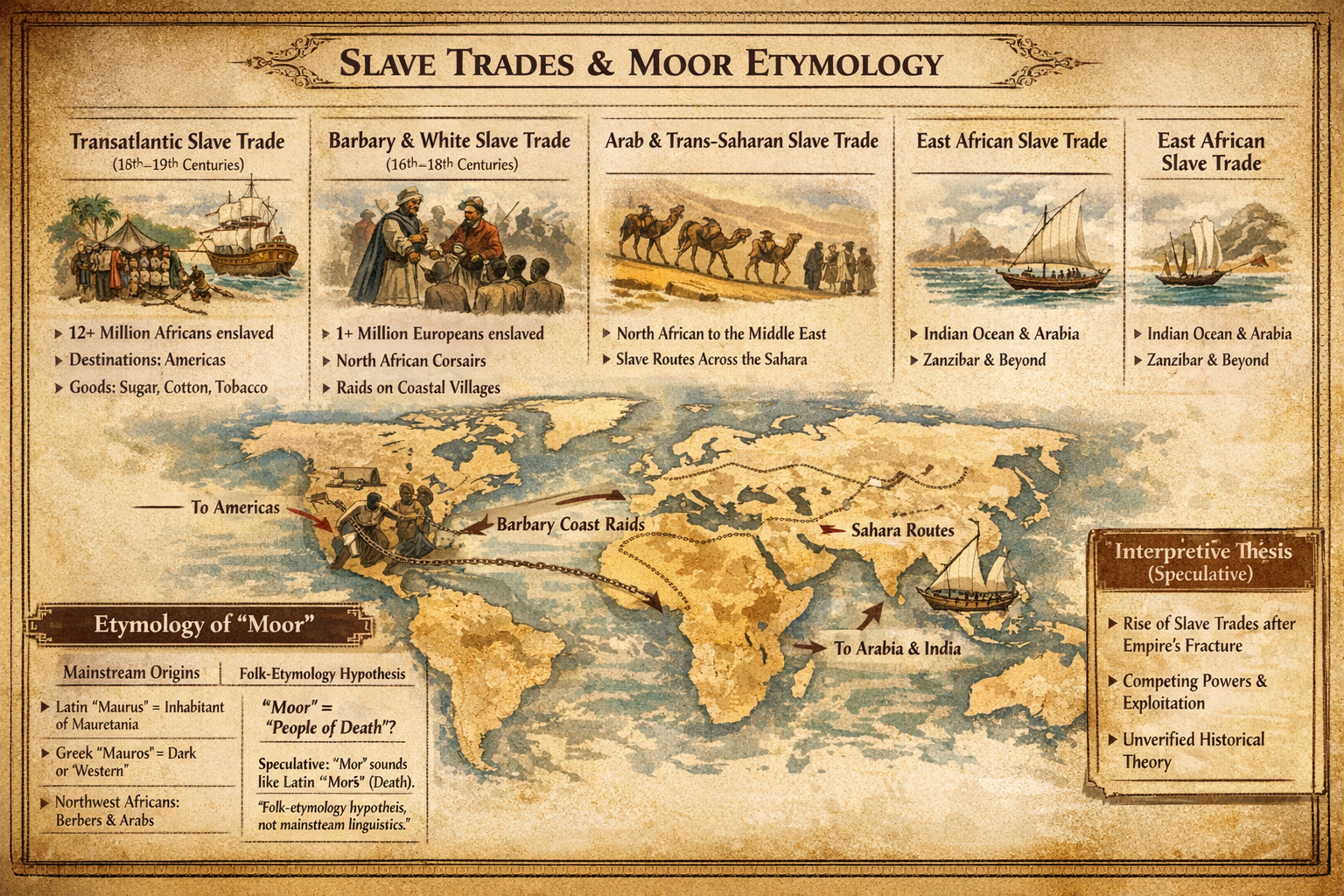
Scope: Major Slave Trades
1. Transatlantic (African) Slave Trade
- Period: 15th–19th centuries
- Actors: European powers (Portuguese, Spanish, British, French, Dutch); African coastal traders
- Scope: ~12.5 million enslaved Africans transported to the Americas; millions more died in transit or in Africa
- Destinations: Brazil, Caribbean, North America, Spanish Americas
- Commodities: Sugar, cotton, tobacco, coffee, cocoa
- Notes: Best-documented; dominant in Western historiography. African rulers and merchants participated in capture and sale.
2. Barbary / White Slavery (Mediterranean & Atlantic)
- Period: ~16th–early 19th century (peak); earlier roots in medieval raids
- Actors: Barbary corsairs operating from Morocco, Algiers, Tunis, Tripoli—regions historically called “Moorish”
- Victims: Europeans—Italians, Spanish, Portuguese, French, British, Irish; raids as far as Iceland
- Scope: Robert Davis (OSU) estimates 1–1.25 million European Christians enslaved between early 16th and mid-18th century; ~35,000 held on Barbary Coast at any time in the 17th century
- Methods: Raids on merchant ships, coastal towns, fishermen
- Justification: Often framed as jihad against Christian states
- End: Barbary Wars (US, Europe), French conquest of Algeria (~1830s)
- Sources: Davis, Christian Slaves, Muslim Masters; Wikipedia Barbary slave trade, Barbary corsairs
Validation: Moor/Berber/Arab North Africans were central to the Barbary slave trade. The Moors were heavily involved in slavery—this claim is well-supported.
3. Arab / Trans-Saharan Slave Trade
- Period: Mid-7th century (Islamic expansion) to early 20th century
- Routes: Sahara; Arab, Berber, and African merchant networks
- Scope: Millions; less precisely enumerated than transatlantic
- Notes: Overlaps with “Moorish” (Berber/Arab) populations of North Africa and Sahel.
4. Indian Ocean / East African Slave Trade
- Period: Ancient origins (4,000+ years); significant Muslim involvement from 7th century CE
- Destinations: Arabia, India, Madagascar, Southeast Asia
- Notes: Swahili coast, Zanzibar as major hubs. Muslim slavers; again overlapping with “Arab” and sometimes “Moor” in European usage.
Moor Involvement in Slavery: Validation
Claim: The Moors were heavily involved in slavery.
Status: Validated. The Barbary states (Morocco, Algeria, Tunisia, Libya)—the core “Moorish” sphere—operated the Barbary corsair slave trade. Moors/Berbers were raiders, slaveholders, and traders. Europeans captured by Barbary corsairs were sold in North African markets. The trans-Saharan trade also involved Berber and Arab (Moor-adjacent) networks. The historical record clearly supports heavy Moor involvement in slavery.
Etymology of “Moor”: Mainstream vs. Hypothesis
Mainstream Etymology
- Latin: Maurus — inhabitant of Mauretania (Roman NW Africa: Morocco, N Algeria)
- Greek: Mauros — from Maurus or possibly Greek mauros “black” (though mauros may derive from the people’s name)
- Phoenician: Mahurin — “Westerners” (reportedly)
- Related: Mauretania, Maghreb (“the West”), Morocco
- Exonym: A label applied by outsiders, not a strict ethnonym. Europeans used it loosely for Berbers, Arabs, Muslims, and black Africans.
Source: Etymonline, Wiktionary, Britannica, 1911 Encyclopædia Britannica, Wikipedia.
User Hypothesis: “People of Death” (Latin mor)
Claim: The name “Moor” may have been perceived—or even derived—from Latin mor (death). To “everyone’s ears,” the Moorish were the “People of Death” because of their engagement in slavery.
Linguistic assessment:
- Latin mors (death): From PIE mer- “to die.” Root mor- appears in mori (to die), mors (death), mortalis, mortuus, etc. The root was familiar in Latin and in medieval/early modern Europe.
- Formal etymology: Maurus and mors are treated as separate. Maurus is traced to Greek Mauros and Mauretania, not to mors.
- Folk etymology / paronomasia: Even if the official origin is Mauretania, speakers could have associated Moor with mor/mors because of sound similarity. Folk etymologies often arise from perceived meaning, especially when a group is associated with violence or death.
- Cognate: The landscape term moor (heath, “dead land”) in Old English is sometimes linked to PIE mer- “to die” via “dead land” — etymonline notes this possibility. So a mor = death/infertility connection was present in Germanic contexts.
- Conclusion: The formal etymology does not support “Moor” = “People of Death” as a linguistic derivation. The hypothesis is better understood as folk etymology or popular perception: that the name could have been heard and interpreted as “death-related” by Latin- and Romance-speaking populations who knew mors/mor and who associated the Moors with slave-raiding and violence.
Author’s sentiment: Whether or not “Moor” derives from mor, the idea that contemporaries heard “People of Death” in the name—because of slavery, raids, and conquest—is plausible as a layer of meaning. The Moors were heavily involved in slavery; Europeans captured by them would have had strong reason to associate the name with death and bondage. Folk etymology often encodes how a group is perceived, not how a word was first formed.
Summary of Validations
| Claim | Status |
| Moors heavily involved in slavery | Validated — Barbary corsairs, trans-Saharan trade |
| Origin of “Moor” unknown / disputed | Partially validated — Phoenician “Westerners” and Mauretania are standard; ultimate origin still debated |
| “Westerners” as meaning | Validated — Mahurin (Phoenician), Maghreb, etc. |
| Moor = “People of Death” (Latin mor) | Speculative / folk etymology — Not supported by formal etymology; plausible as perception/folk etymology |
| White/European slavery under Barbary/Moors | Validated — 1–1.25M Europeans enslaved, 16th–18th c. |
| Colonization/slave trade = direct result of Rus-Horde fracture | Investigative — Timing aligns; splinter states more extractive than unified empire (speculative) |
Horde-Fracture Thesis: Colonization and Slave Trade as Direct Result
Claim: Colonization and the great slave trades were a direct result of the breaking up of the Rus-Horde (Russia-Horde / Hordian Empire). The old Serbian/Slavic empire was far more humanitarian than the splinter empires and detached aristocracies that arose from its fracture — who went on to commit the worst crimes in human history for centuries.
Timeline Correlation
The paradigm-threat timeline treats the fracture of the Hordian Empire as the pivotal event of the early 17th century (Romanov Seizure, Deep State breaks up the Hordian Empire). The Romanov seizure (1613), coordinated with the King James Bible (1611) and Petavius’s chronology (1627), destroyed the world’s only superpower and replaced it with vassal states — Russia, Ottoman, Austria, Germany, Italy, Poland, France, Spain, Egypt, England, Persia, China, Japan, India, America. Each region had aristocratic families that had once owed fealty to a single Imperial throne; as ties were cut, they became Kings and Queens of their own states.
The transatlantic slave trade peaked in the 17th–18th centuries — immediately after the fracture. The Barbary slave trade (16th–19th c.) and European colonial expansion (Portuguese, Spanish, British, French, Dutch) coincide with the same period. The timeline’s British Empire as Deep State thesis — that Britain did not want to retain colonies but to divide, arm, and leave — describes a detached aristocracy operating as an instrument of a non-state entity, not as a traditional empire.
The Humanitarian Contrast
Under the Horde-Fracture thesis, the unified empire had:
- A single center of authority and fealty
- Shared legal and religious frameworks
- No incentive for rival states to extract maximum wealth from subject populations before a competitor could
After the fracture:
- Detached aristocracies — former vassals with no loyalty to the old center — competed for territory, labour, and resources
- Slavery and colonization became tools of extraction for rival states, each maximizing short-term gain
- The transatlantic trade, Barbary raids, colonial plunder, and later “divide and conquer” decolonization follow from this structural shift
Author’s sentiment: The irony is that the old Serbian/Slavic empire — often portrayed in mainstream historiography as “Mongol hordes” or “oriental despotism” — may have been more humane than what followed. The splinter states, freed from Imperial constraint and driven by competition, engaged in mass enslavement, genocide, and resource extraction on a scale the unified order had no structural motive to pursue. The worst crimes of the modern era were committed not by the empire but by the splinter empires and detached aristocracies that replaced it. Once again this world-wide networked behavior is evidence of a Deep State influence, even if it only traces back to protestant literature.
Validation Status
| Claim | Status |
| Colonization/slave trade coincided with Horde fracture | Validated — timing aligns (17th c. fracture, 16th–19th c. slave trades) |
| Fracture produced competing vassal states | Validated — timeline 11.01.00 |
| Splinter states more extractive than unified empire | Speculative — requires comparative analysis of Hordian vs. colonial governance |
| Old empire more humanitarian | Investigative — contradicts mainstream “Mongol barbarism” narrative; Fomenko/NC sources may support |
Open Questions
- Primary sources on Hordian/Slavic governance vs. colonial governance (legal codes, treatment of subject populations)
- Serfdom under Horde vs. chattel slavery under colonial powers — structural comparison
- Fomenko/chronologia.org on the humanitarian character of the pre-fracture empire
Related investigations
- Franklin “Palatine Moors” screenshot — Circulated book page vs authentic Observations (1751); Boors/Moors forensics; Palatine settlers inside British colonial slavery; Anna’s Archive book hunt.
- Europe: white bloodline, complexion, whitewash — Status vs pigment; Moor/swarthy taxonomy; Fomenko map erasure parallel.
- Cherokee Moors meme — Delaware Lenape “Moor” label — Validated: 29 Del. C. § 106, 1921 Moor schools, Smithsonian 1948; unverified: Oklahoma “Cherokee Moors” photo; three Moor lanes.
Open Questions
- Primary sources: contemporary Latin/Romance texts linking Maurus/Moor to mors or “death”
- Medieval/early modern folk etymologies for “Moor” in European vernaculars
- Barbary slave trade scope and chronology vs. Fomenko/phantom-time frameworks
- Relationship between Barbary corsairs and earlier Moorish/Al-Andalus slave systems
- Cross-reference with timeline events (e.g., Ottoman conquests, Barbary Wars)
References
- Etymonline: moor
- Wikipedia: Moors, Barbary slave trade, Barbary corsairs, Transatlantic slave trade, Arab slave trade, Indian Ocean slave trade
- Robert Davis, Christian Slaves, Muslim Masters: White Slavery in the Mediterranean, the Barbary Coast, and Italy, 1500–1800
- Britannica: Moor (people)
- 1911 Encyclopædia Britannica: Moors
- Wiktionary / Perseus: mors, Maurus, PIE mer-
Prisca sapientia (epistemic foundation): This investigation assumes prisca sapientia—the historical and philosophical belief that the ancients possessed a vast, profound understanding of the universe, nature, and theology that was subsequently lost or degraded. Modern consensus science and institutions are not treated as default truth; evidence tiers below adjudicate specific claims.
Keywords: #Slave #Trades #Moor #Etymology
Share